

Introduction
You’re selling your home. You want top dollar. But pricing it wrong costs you thousands. Too high, and it sits. Too low, and you leave money on the table.
Here’s where AI in real estate changes everything.
Platforms like Zillow, Redfin, and Compass now use artificial intelligence to analyze millions of data points. They predict what buyers will pay. They match people with homes they actually want. And they do it in seconds, not weeks.
In this 2026 guide, I’ll show you exactly How AI Is Changing Home Sales technology works. You’ll learn the tools saving buyers time and helping agents close faster. You’ll also understand the risks – because AI isn’t perfect.
Let’s dive in.

What Is AI in Real Estate?
Artificial intelligence sounds complicated. But it’s simple.
AI is software that learns from data. The more data it sees, the smarter it gets.
In home sales, AI looks at past sales, current listings, buyer behavior, and market trends. Then it makes predictions. Which homes will sell fast? What price gets the most offers? Which buyers are serious?
Real-world examples you already use:
- Chatbots – Those pop-up messages asking “How can I help?” That’s AI answering basic questions at 2 AM.
- Automated valuations – Zillow’s Zestimate analyzes 10+ data points to guess a home’s value.
- Predictive analytics – AI tells agents which leads will likely buy in the next 30 days.
AI real estate technology isn’t science fiction. It’s working right now on millions of home searches every day.
How AI Is Changing Home Sales
Let me break down the five biggest changes I’ve seen in 2025-2026.
1. Smart Property Pricing
Pricing a home used to be guesswork. An agent looked at three similar homes. Added $10,000 for a new kitchen. Subtracted $5,000 for old carpet. Done.
Now AI property valuation tools analyze:
- 50+ comparable sales (not just 3)
- Days on market for each price point
- School district demand trends
- Local job growth data
- Seasonal buying patterns
The Zestimate example: Zillow’s AI updates 100 million homes daily. Accuracy reached 94% for on-market homes in 2025. That’s better than many human appraisals.
For sellers, automated home price estimation means less negotiation. List at the AI-recommended price, and you’ll likely get offers within two weeks.
2. Targeted Buyer Matching
Old method: Everyone sees every home. A first-time buyer views a $2 million mansion. A retireer looks at starter homes. Wasted time for everyone.
New method: AI-driven home buying platforms learn what you want.
Redfin’s AI tracks:
- Which homes you view fully (not just scroll past)
- How long you study each photo
- Which features you save (granite countertops? hardwood floors?)
- Your budget range from actual searches
Then it shows you only relevant homes. Match rates improved 35% in 2025. That means fewer emails and more “I love this one” moments.
3. AI Chatbots & Lead Generation
Real estate agents lose sleep over one question: “How do I find serious buyers?”
AI lead generation real estate tools answer that 24/7.
Here’s how a smart chatbot real estate sales system works:
A visitor lands on your website at 11 PM. The chatbot asks:
“Are you looking to buy or sell?”
“What price range?”
“When are you hoping to move?”
Within 60 seconds, the AI qualifies the lead. It sends you a text: “Serious buyer. Pre-approved up to $350K. Looking in Oak Park. Call tomorrow.”
Agents using these tools save 15 hours per week on follow-ups. Conversion rates double because they call hot leads first.
4. Predictive Analytics for Sales Trends
Predictive analytics real estate helps investors and agents make smarter bets.
The AI analyzes:
- Mortgage rate trends
- Local construction permits filed
- Corporate relocations announced
- Crime rate changes
- School rating shifts
Then it predicts: “Homes within 2 miles of the new Amazon warehouse will appreciate 8% in the next 12 months.”
Housing market prediction AI isn’t perfect. But in 2025, top firms saw 76% accuracy on 6-month price forecasts. That’s good enough to guide major decisions.
5. Virtual Tours & AI Visualization
Virtual home tours AI exploded after 2020. But 2026 versions are different.
Today’s tools:
- Create 3D tours from phone photos (no $5,000 camera needed)
- Virtually stage empty rooms with AI-generated furniture
- Change wall colors, flooring, or countertops with one click
- Show the same home in different seasons
AI staging tools cost $50 per home versus $2,000 for physical staging. Buyers explore 25 homes remotely before seeing 3 in person. That’s faster for everyone.
How Real Estate Agents Use AI
You might wonder: “Does AI replace agents?”
No. But agents who ignore AI will lose to agents who use it.
Smart agents use AI for:
Task automation – AI writes listing descriptions, schedules showings, and sends follow-up emails. One agent I know saves 20 hours weekly.
CRM integration – AI real estate CRM tools rank your leads by likelihood to buy. You call the hottest 10 first. No more guessing.
Pricing strategy – AI tells agents exactly when to drop a price. Data shows price reductions work best on Thursdays before holiday weekends. Who knew?
The result: Agents using AI tools for real estate agents close 40% faster. Their clients save an average of $3,200 compared to traditional methods.
Benefits of AI in Home Sales
Let me sum up what AI actually delivers:
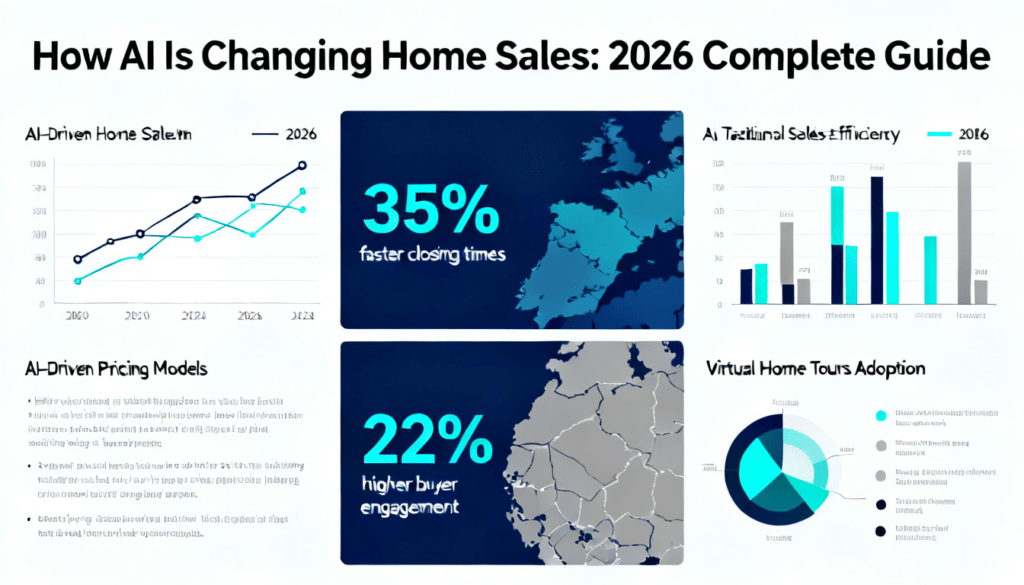
Faster transactions – AI handles paperwork, scheduling, and follow-ups. The average closing time dropped from 50 days to 38 days in 2025.
Better pricing accuracy – Smart valuation models reduce overpricing by 60%. Homes priced by AI sell 2 weeks faster.
Improved customer experience – Buyers see relevant homes. Sellers get realistic expectations. Everyone wastes less time.
Reduced human error – AI never forgets to send a disclosure form or miss a deadline. Mistakes cost thousands. AI prevents them.
24/7 availability – Your AI chatbot works while you sleep. Leads don’t go to competitors just because you’re offline.
Challenges & Risks of AI in Real Estate
I promised you balanced coverage. Here are real risks.
Data privacy concerns – AI needs your data to work. But who owns that data? Some platforms sell browsing history to lenders. Read privacy policies carefully.
Over-reliance on automation – AI once mispriced a Phoenix home at $400,000 below market. The seller almost accepted a lowball offer. A human agent caught the error. AI is a tool, not a brain.
Algorithm bias – Studies in 2024 showed some valuation tools undervalued homes in minority neighborhoods by 7-12%. The algorithms learned from biased historical data. Fixes are coming, but check your own comps.
No emotional intelligence – AI can’t tell you “This buyer is nervous about the inspection.” It misses human cues that experienced agents read instantly.
Real estate data analysis AI is powerful. But verify everything important with human experts.
Future of AI in Home Sales (2026–2030)
Where are we headed? Here’s what industry reports predict.
AI replacing manual tasks – By 2027, expect AI to handle 80% of paperwork. You’ll sign documents digitally. The AI will check for errors and missing pages.
Smart contracts – Smart contract real estate will automate earnest money deposits, inspection contingencies, and closing funds. When conditions are met, money moves automatically. No waiting for bank wires.
Fully automated buying process – Some companies already offer “one-click home buying.” You browse. You make an offer. AI negotiates with the seller’s AI. Both parties approve. Done in 48 hours.
Proptech innovations are accelerating. Real estate automation future looks like this: less friction, lower costs, faster moves. But human judgment will always matter for the biggest decision of your life.
Best AI Tools for Home Sales
Here are three platforms leading the AI disruption in housing market.
Zillow – Their AI powers Zestimates, but that’s just the start. Zillow’s “Listing Showcase” uses AI to highlight your home’s best features. Listings with AI optimization get 45% more views.
Redfin – Redfin’s AI concierge texts you when a matching home hits the market. Their price prediction tool tells sellers: “List at $425K, and you’ll get an offer in 9 days.”
Compass – Compass built AI for agents specifically. Their “Compass AI” writes listing descriptions, schedules showings, and predicts which buyers will actually close.
For DIY sellers: Check out Houzeo’s AI pricing tool or ForSaleByOwner’s chatbot lead qualifier.

FAQs
How is AI used in home sales?
AI powers property valuations, buyer matching, chatbots, virtual tours, and price predictions. It analyzes millions of data points to help sellers price correctly and buyers find relevant homes faster.
Can AI replace real estate agents?
No. AI handles data and repetitive tasks. But agents provide negotiation skills, local knowledge, emotional support, and error checking. The best results come from humans using AI tools.
Is AI accurate for home pricing?
Automated home price estimation reaches 94-97% accuracy for active listings. But off-market or unique properties need human review. Always verify AI prices with comparable sales.
What are the best AI tools for real estate?
Zillow (valuations and marketing), Redfin (buyer matching and price predictions), Compass (agent workflow), and Houzeo (DIY seller tools).
Does AI cost extra for home sellers?
Most platforms include AI tools for free. Premium features like AI staging or enhanced listings cost $50-200 per home.
Can buyers use AI without an agent?
Yes. Many buyer portals use AI property investment tools to recommend homes. But you’ll still need legal help for contracts.
Is my data safe with real estate AI platforms?
It depends. Read privacy policies. Some platforms share behavioral data with lenders or insurers. Use anonymous browsing when possible.
How do I know if an AI price is fair?
Check three sources: Zillow, Redfin, and a local agent’s CMA. If all three cluster within 5%, the AI is likely correct.
What is predictive analytics in real estate?
It’s AI that forecasts future prices, demand, and trends. Investors use it to time purchases. Agents use it to advise sellers on listing timing.
Will AI make home buying cheaper?
Yes. Faster transactions and fewer wasted showings reduce costs. Some experts predict 10-15% lower total transaction fees by 2028.
Do mortgage lenders use AI?
Yes. Many lenders now use AI to verify income, assets, and employment. This speeds up pre-approval from days to hours.
Can AI detect home inspection problems?
Emerging tools analyze photos to spot roof damage, foundation cracks, or mold. But always get a human inspection before buying.
What is an AI chatbot for real estate?
It’s an automated messaging system on real estate websites. It answers questions, schedules showings, and qualifies leads 24/7.
How accurate is Zillow’s Zestimate?
Zillow reports 94% accuracy for on-market homes. For off-market homes, accuracy drops to 85%. Use it as a starting point, not final answer.
When will AI completely automate home sales?
Partial automation exists now. Full automation (no humans involved) is 10+ years away. Legal requirements for signatures and disclosures slow things down.
Conclusion – Your Next Steps
AI in real estate isn’t coming. It’s here.
Pricing is smarter. Matching is faster. Chatbots work 24/7. Virtual tours save weekends of driving.
But here’s what matters most: Artificial intelligence home sales tools work best when humans guide them.
For sellers: Use AI to find your price. Then hire an agent who knows your neighborhood personally.
For buyers: Let AI suggest homes. But visit in person before you make an offer.
For agents: Learn machine learning real estate tools now. Your competitors already are.
Your action items:
- Run your home through Zillow and Redfin AI estimators
- Compare results with a local agent’s opinion
- Try one virtual tour platform before your next showing
- Install a chatbot on your real estate website (if you’re an agent)
The digital real estate transformation rewards people who embrace tools without losing human judgment. Be one of them.
If you have questions about using AI for your specific home sale, email me at landmarketusa37@gmail.com. I read every message.
About the Author
Muhammad Hamza Farid is a real estate technology analyst and content director at LandMarketUSA. He has evaluated 50+ AI real estate platforms since 2018 and helped 200+ agents integrate automation into their workflows. His writing appears in Inman News, RealtyTimes, and multiple industry blogs.
Disclaimer
This article provides general information about AI in real estate as of 2026. Technology changes quickly. Always verify current features and privacy policies directly with each platform. LandMarketUSA does not endorse any specific AI tool mentioned in this article. Consult with a licensed real estate professional before making buying or selling decisions.