You’ve been looking at cheap land in rural Oklahoma. Maybe it’s a few acres near Broken Bow. Or a remote plot in the Panhandle. The price is right – say $15,000 for a five-acre parcel. But banks won’t touch it. Too small. Too remote. No house yet.
Then the seller says something interesting: “I’ll finance it for you.”
That’s owner financing. Also called a land contract or contract for deed. It’s how a lot of affordable land changes hands in Oklahoma, especially in counties like Pushmataha, Texas, or Cimarron.
But here’s the thing most people miss. They focus on the monthly payment and forget to ask: What interest rate am I actually paying? And How to Calculate Interest on Owner-Financed Land in Oklahoma?
That mistake can cost you thousands.
Let me show you exactly how to calculate interest on an owner-financed land deal in Oklahoma. No finance degree required.
Why Owner Financing Is Different (And Why It Matters)
When you get a bank loan, the bank uses a standardized amortization formula. They give you a truth-in-lending statement. Everything is regulated to death.
Owner financing is different. It’s a private contract between you and the seller. That means more flexibility, but also more room for confusion.
Some sellers use the same bank-style amortization. Others use a simple interest calculation. A few try to structure payments in ways that heavily favor them.
If you don’t know how to calculate the interest yourself, you could agree to a bad deal without realizing it.
The good news? The math is straightforward once you understand three basic pieces: the principal, the interest rate, and the loan term.
The Simple Formula for Calculating Interest on Land Contracts
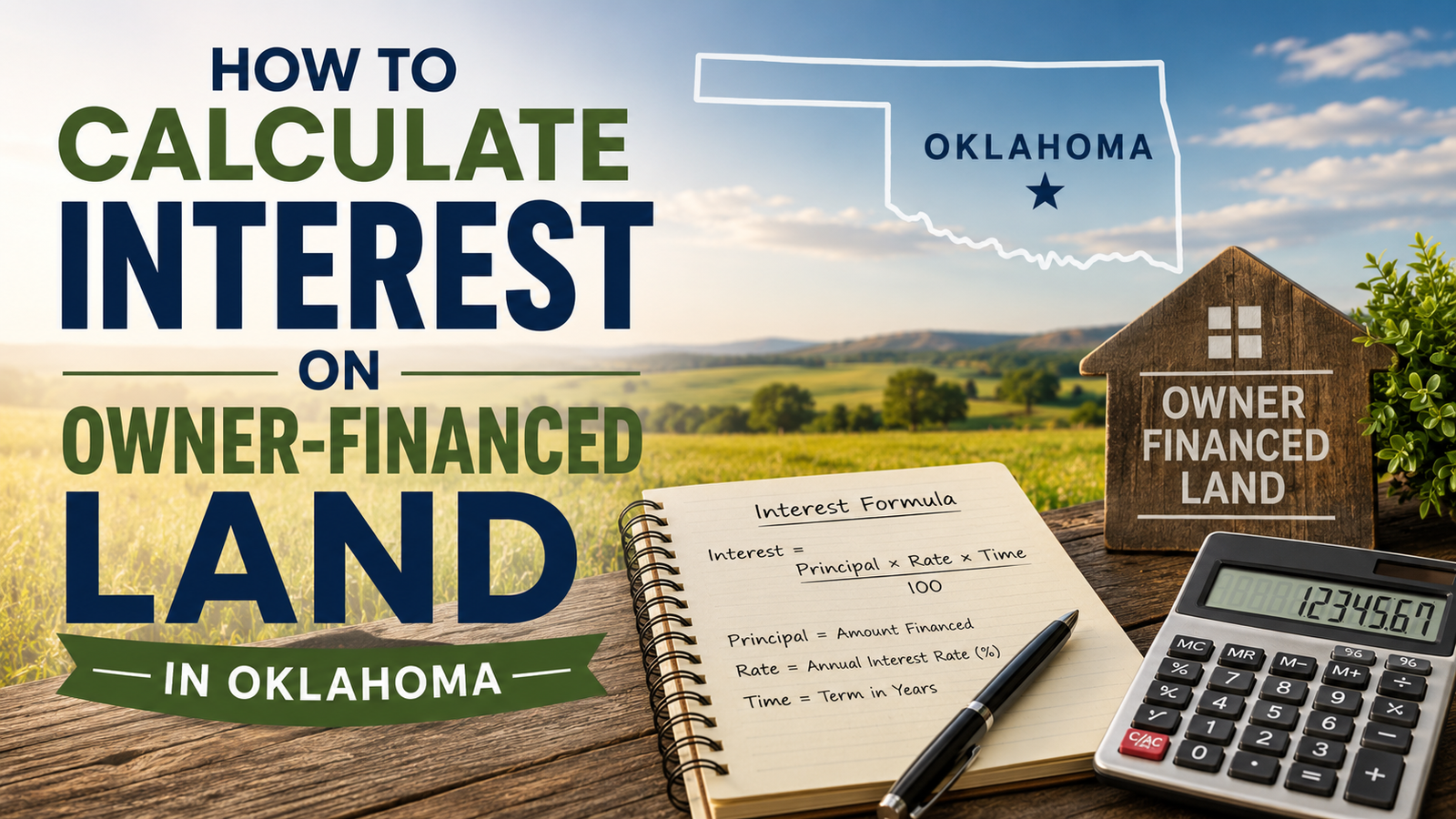
Here’s the core formula for simple interest on an owner-financed land purchase:
Say you’re buying 10 acres in southeastern Oklahoma for 25,000.Theselleragreestoownerfinancingwith2,500 down (10%) and a 7% annual interest rate on the remaining $22,500.
To find your first month’s interest:
22,500×0.07=1,575 in annual interest 1,575÷12=∗∗131.25 in interest for month one**
If your monthly payment is 300,thenroughly131 goes to interest and the remaining $169 reduces your principal.
By month twelve, your principal has dropped a bit, so the interest portion is slightly lower. That’s the basic rhythm of an amortizing loan.
The Two Ways Sellers Calculate Interest (Know Which One You Have)
Not all owner-financed land deals work the same way. In Oklahoma, you’ll typically encounter one of two calculation methods.
Amortized Interest (Bank Style)
The seller calculates a fixed monthly payment that pays off the loan completely by the end of the term. Each payment includes interest plus some principal. Early payments are mostly interest. Later payments are mostly principal.
This is the most common and fairest method for longer terms (five years or more).
Simple Interest on Declining Balance
Each month, interest is calculated only on the remaining principal. If you pay extra, you save immediately on interest. If you pay late, interest keeps accruing on the unpaid balance.
Some Oklahoma land contracts use simple interest but require annual statements showing how much principal remains. Always ask which method the seller plans to use.
Step-by-Step: How to Calculate Your Interest Before You Sign
You don’t need special software. A basic calculator or a spreadsheet works fine. Here’s the process I recommend to anyone looking at owner-financed land in Oklahoma.
Step 1: Get the full terms in writing. Never rely on a handshake. The seller should give you the purchase price, down payment, interest rate, loan term, and monthly payment amount.
Step 2: Calculate the financed amount. Purchase price minus down payment equals principal.
Step 3: Calculate your first month’s interest. Use the formula above. This tells you how much of your early payments go to interest versus principal.
Step 4: Run a quick amortization. You can do this manually for short loans or use a free online amortization calculator. This shows whether the seller’s proposed monthly payment actually pays off the loan by the end of the term.
Step 5: Ask about prepayment penalties. Some Oklahoma land contracts include a penalty if you pay off the loan early. Others do not. Know which one you’re agreeing to.
A Real Oklahoma Example (With Numbers)
Let me give you a complete example using actual Oklahoma land prices.
You find a 5-acre parcel in Coal County, about two hours south of Oklahoma City. The asking price is 12,000.Theselleroffersownerfinancingwith1,000 down, 8% interest, and a five-year term.
If the seller wants a 250monthlypayment,thenroughly73 goes to interest and 177goestoprincipaleachmonthearlyon.Overfiveyears,you’dpayabout2,400 in total interest.
Is that reasonable? For owner-financed land, yes. Sellers charge higher rates than banks because they’re taking more risk. Typical owner financing interest rates in Oklahoma range from 6% to 12%, depending on the property and your down payment.
What’s not reasonable? A seller offering the same $12,000 property at 15% interest with no prepayment option. Run those numbers and you’ll see why.
Common Mistakes When Calculating Owner-Financed Land Interest
I’ve seen people make these mistakes repeatedly. Don’t be one of them.
Mistake 1: Forgetting to check for balloon payments. Some Oklahoma land contracts have low monthly payments but a large balloon payment due after two or three years. If you can’t pay the balloon, you could lose the property.
Mistake 2: Assuming simple interest means no amortization schedule. Even with simple interest, you need a written schedule showing how each payment applies to principal and interest.
Mistake 3: Not calculating total interest cost. A 10,000landpurchaseat95,200 in total interest. That might still be a good deal. But you should know the number before you sign.
Mistake 4: Ignoring late fees and default terms. Some Oklahoma land contracts include harsh default provisions. Miss one payment and the seller can keep everything you’ve paid. That’s legal under certain contract-for-deed arrangements. Know the difference between a land contract and a mortgage.
How Oklahoma Law Affects Owner-Financed Land Deals
Oklahoma has specific rules about land contracts. They’re not the same as California or Texas.
For contracts longer than five years or with a principal over $50,000, Oklahoma law requires certain disclosures. But for smaller, cheaper land deals – the kind most people are looking at – regulation is lighter.
That cuts both ways. It makes owner financing possible for cheap land that banks ignore. But it also means you need to protect yourself.
Always record the contract at the county clerk’s office in the county where the land sits. That puts the world on notice that you have an interest in the property. Without recording, the seller could sell the same land to someone else.
Comparing Owner Financing to Other Ways to Buy Land in Oklahoma
Before you commit to an owner-financed deal, understand your alternatives.
Method
Typical Down Payment
Interest Rate
Difficulty
Best For
Owner Financing
5-20%
6-12%
Low
Cheap land, bad credit, quick closing
Bank Land Loan
20-40%
7-10%
High
Larger parcels, good credit, building soon
USDA Loan (with home)
0%
5-7%
High
Rural property with existing house
Cash Purchase
100%
0%
Low
Small parcels, no financing needed
Owner financing isn’t always the cheapest option. Sometimes saving for a larger down payment and using a local Oklahoma bank or credit union makes more financial sense. But for many people looking at affordable land under $20,000, owner financing is the only realistic path.
Practical Tips for Negotiating Interest on Land Contracts
You can negotiate the interest rate on owner-financed land. Sellers aren’t banks with fixed rate sheets.
Offer a larger down payment. Putting 20% down instead of 10% might drop the interest rate by two or three points.
Shorten the term. A three-year loan at 6% is cheaper than a ten-year loan at 8%, even if monthly payments are higher.
Ask for simple interest with no prepayment penalty. This lets you pay extra when you have cash and save on interest.
Get multiple quotes. Look at several owner-financed properties in the same Oklahoma county. Interest rates vary widely between sellers.
When Owner Financing Makes Sense (And When It Doesn’t)
Owner financing for land works well when:
The land is cheap (5,000to30,000 range)
Banks won’t lend because the parcel is too small or remote
You plan to pay off the loan faster than the term
You want to close quickly without bank paperwork
It’s a bad idea when:
The interest rate exceeds 12% without a good reason
The seller refuses to provide a written amortization schedule
The contract allows forfeiture of all payments after one missed payment
You’re not sure you can make the payments consistently
Final Thoughts on Calculating Interest for Owner-Financed Oklahoma Land
Here’s what I want you to take away.
The math isn’t hard. Principal times rate divided by twelve gives you monthly interest. The hard part is getting clear terms in writing and understanding what you’re signing.
Before you agree to any owner-financed land deal in Oklahoma – or anywhere else – run the numbers yourself. Calculate the total interest you’ll pay. Ask about balloon payments. Check whether the contract is recorded at the county clerk’s office.
And if a deal seems too good to be true? It probably is. I’ve seen sellers offer “no credit check, zero down, low payments” on land that has no legal road access or sits entirely in a flood plain. The cheap interest rate doesn’t matter if you can’t use the land.
Do your homework first. Calculate the interest second. Sign third.
Let’s say you find 20 acres outside Stillwater. Good price. Owner financing. No bank hassle. You sign a land contract, pay 500monthlyforfiveyears…thenthepaperworksaysyouowe45,000 in one lump sum.
That’s your balloon payment.
In Oklahoma, land contracts (also called contracts for deed) are common. But the Oklahoma Land Contract Balloon Payment Rules catch people off guard more than almost anything else. Some folks assume they can refinance before the balloon hits. Others don’t realize the seller can cancel the deal if they miss that final payment by even a week.
Here’s what actually happens under Oklahoma law, how to protect yourself, and when walking away might be your smartest move.
What Exactly Is a Land Contract Balloon Payment?
A land contract is seller financing. You pay the seller directly in installments, but the seller keeps the legal title until you pay off the full price. You get equitable title (the right to use and improve the land), but the seller holds the deed as security.
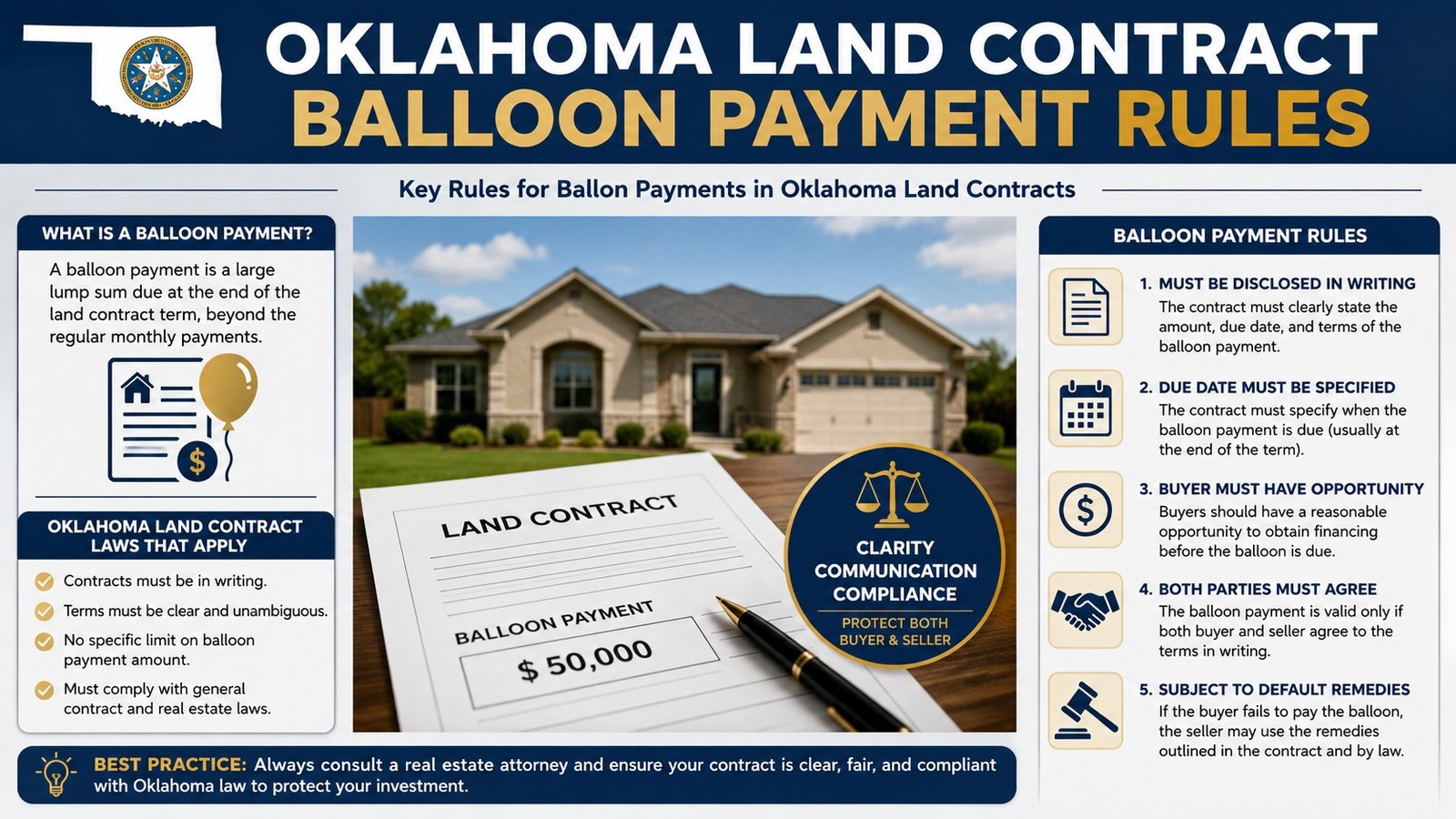
A balloon payment is a large lump sum due at a specific date, usually after a series of smaller installments.
Example:
Purchase price: $100,000
Down payment: $10,000
Monthly payment: $800 at 6% interest
Balloon due after 60 months: $72,000 remaining principal
You pay mostly interest for five years, then owe almost three-quarters of the original price all at once.
Why sellers use balloons: They want regular income but don’t want to wait 15–30 years for their full cash. A balloon forces you to refinance or pay up, typically within 3–7 years.
Why buyers agree: Lower upfront costs than a bank loan, flexible credit requirements, and the hope that property value will rise or their financial situation will improve before the balloon hits.
Oklahoma’s Legal Rules on Balloon Payments (The Short Version)
Oklahoma doesn’t ban balloon payments in land contracts. They’re perfectly legal. But state law does impose specific requirements on how balloon payments must be disclosed and enforced.
Mandatory Disclosure Requirements
Under the Oklahoma Consumer Protection Act and federal Truth in Lending Act (TILA), if the seller is not a licensed lender but offers financing more than five times in a year (or on more than one property in some cases), the contract must clearly state:
The due date of the balloon payment
The exact amount of the balloon payment
A warning that you may lose the property if you can’t pay
The interest rate and how principal is calculated
If the seller hides the balloon in fine print or calls it something else (“final lump sum settlement”), that’s likely an unfair practice. Courts have voided contracts where sellers buried balloon terms on page 8 of a 12-page document.
Notice Before Default
Here’s where Oklahoma is buyer-friendly compared to some states.
If you miss your balloon payment, the seller cannot just seize the property. Oklahoma law requires the seller to give you written notice of default and a reasonable opportunity to cure (pay what’s owed).
For most land contracts, that notice period is 30 days unless your contract specifies longer. During that time, you can pay the balloon plus any late fees and keep the deal alive.
If you don’t pay, the seller can file a lawsuit to foreclose on your equitable interest. They cannot simply evict you or take possession without a court order.
Forfeiture vs. Foreclosure: Huge Difference
Older Oklahoma land contracts used “forfeiture” clauses—you miss one payment, you lose everything you’ve paid so far. No court. No refund.
That changed after the 1980s. Oklahoma courts now strongly favor judicial foreclosure for land contracts, especially if you’ve paid more than 20% of the purchase price or held the contract for more than two years.
In a foreclosure, the property is sold at auction. If it sells for more than what you owe, you get the surplus back. Forfeiture gives you nothing.
Realistic example: You paid 30,000towarda100,000 property and miss the 70,000balloon.Inaforeclosure,ifthepropertysellsfor90,000, you get back 20,000(90,000 minus 70,000debt).Inforfeiture,youget0. Oklahoma courts almost never enforce forfeiture anymore unless the buyer paid very little and defaulted early.
Step-by-Step: What Happens When Your Balloon Payment Comes Due
Let’s walk through a typical scenario.
Step 1 – Notice of balloon due date Your contract should state that the seller will send a reminder 30–60 days before the balloon date. Some sellers don’t. Keep your own calendar.
Step 2 – You can’t pay Maybe the bank denied your refinance. Maybe interest rates jumped. Maybe your credit dropped.
Step 3 – Seller sends default notice By law, they must send written notice to your last known address. No phone calls, no text messages. If they skip this step, any eviction or foreclosure attempt gets thrown out.
Step 4 – 30-day cure period You have 30 days to pay the balloon, negotiate an extension, or refinance. Use every day. Call local credit unions. Talk to private lenders. Borrow from family if you have to.
Step 5 – Foreclosure lawsuit If you don’t pay, the seller files a district court petition to foreclose. This takes 3–6 months in most Oklahoma counties. You can still pay during this time (called “redemption”), but you’ll also owe the seller’s legal fees.
Step 6 – Sheriff’s sale If the court rules against you, the property is sold at auction. You have a statutory right of redemption in some cases—usually 12 months for agricultural land, less for residential.
Common Balloon Payment Traps (And How to Avoid Them)
Trap 1: No right to refinance Some Oklahoma contracts say “no prepayment penalty” but also say “balloon may not be satisfied by third-party financing.” That means you can’t get a bank loan to pay off the seller. Read your contract specifically for language restricting “assignment” or “third-party payoff.”
Fix: Before signing, add a clause: “Buyer may satisfy balloon payment through any lawful source of funds, including conventional mortgage financing.”
Trap 2: Balloon based on inaccurate balance Sellers sometimes miscalculate how much principal remains. You pay for five years, but almost all your payment went to interest. The balloon ends up higher than expected.
Fix: Ask for an amortization schedule upfront. Every payment’s principal and interest broken out. Oklahoma law doesn’t require this in private land contracts, but a seller who refuses is waving a red flag.
Trap 3: No notice of default required Some sellers write “notice waived” into the contract. Under Oklahoma law, you cannot waive the right to notice of default in a land contract for your primary residence. For investment or raw land, you might be able to waive it—but don’t. Cross that clause out.
Trap 4: Acceleration clauses These say: if you miss any payment, the entire remaining balance (including the balloon) is due immediately. That means a single late monthly payment could trigger the full balloon years early.
Fix: Demand a cure period for all defaults, not just the final balloon. Oklahoma’s 30-day default notice applies, but acceleration clauses can still cause headaches.
Real-World Scenarios: When Balloons Work and When They Blow Up
Scenario A: The Plan Works
Sarah buys 5 acres near Muskogee for 50,000.5,000 down. 400/month.5−yearballoonof35,000. She uses the land for a small horse boarding business. After four years, her business credit is solid. A local ag credit union refinances her into a 15-year loan at 7%. She pays off the seller. Everyone wins.
Why it worked: She improved her credit, the land value increased, and she started refinancing 12 months before the balloon.
Scenario B: The Disaster
Tom buys a fixer-upper house in Tulsa County on a land contract. 120,000price.3−yearballoonof100,000. He plans to flip it. Housing market drops 15%. He can’t sell. Bank won’t lend because the appraisal comes in at 95,000.Hemissestheballoon.Sellerforecloses.Tomloses20,000 in down payment and improvements.
What Tom should have done: Negotiated a longer balloon (5–7 years) or insisted on a “right to extend” clause if the property appraises below the balloon amount.
Mistakes Buyers Make (Even Smart Ones)
Mistake #1: No exit strategy They assume they’ll refinance. But they don’t check their credit. They don’t talk to lenders early. When the balloon hits, no bank will touch them.
Do this instead: Six months after signing the land contract, talk to three lenders. Ask: “If I make all payments on time for two years, will you refinance my balloon?” Get it in writing if possible.
Mistake #2: Ignoring the equity cliff In a land contract, you build equity only if the property value rises. The seller holds title, so you can’t borrow against the property. When the balloon comes due, you have zero leverage except your own cash or a new loan.
Mistake #3: No independent review Land contracts are not standard forms like a mortgage. Sellers write them themselves. One Oklahoma buyer signed a contract that said the balloon payment was “at seller’s sole discretion.” That meant the seller could demand any amount at any time. A judge later voided it, but legal fees cost the buyer $8,000.
Practical Recommendations for Buyers
Before signing any Oklahoma land contract with a balloon payment:
Run the numbers backward. Assume you CANNOT refinance. Can you pay the balloon from savings, a 401(k) loan, or family help? If no, walk away or negotiate a longer term.
Demand a 7-year minimum balloon. Five years goes fast. Three is gambling. Seven gives you time for credit repair, market shifts, or unexpected life changes.
Add a “first right of extension.” Write: “Buyer may extend balloon payment by 24 months by paying 1% of the balloon amount as an extension fee. Seller may not unreasonably withhold extension if buyer has made all prior payments on time.”
Get title insurance. Even in a land contract. It protects your equitable interest. If the seller had a hidden lien or a prior owner, you could lose everything.
Record the contract. File it with the county clerk. That puts the world on notice that you have an interest in the land. Without recording, the seller could sell to someone else, and you’d have to sue to get your money back.
What Sellers Need to Know
If you’re the seller offering a land contract with a balloon:
Disclose everything clearly. One missing disclosure can let the buyer rescind the contract years later—even after they’ve defaulted.
Don’t skip foreclosure. Self-help eviction (changing locks, cutting utilities) is illegal in Oklahoma. You must go through court.
Consider a promissory note + mortgage instead of a land contract. It gives you the same security but clearer foreclosure rules. Many Oklahoma real estate attorneys recommend this for sellers.
Final Thoughts (Not Wrapped in a Bow)
Balloon payments in Oklahoma land contracts aren’t good or bad. They’re tools. A hammer can build a house or break a thumb.
The difference comes down to one thing: whether both parties honestly understand the risk.
If you’re buying, assume the balloon will come due on the worst possible day. Your credit will dip. Rates will rise. The barn roof will collapse the same week. Plan for that mess, and you’ll be fine.
If you’re selling, remember that a fair balloon payment creates a motivated buyer. An unfair one creates a lawsuit.
Either way, spend the $300–500 to have an Oklahoma real estate attorney review the contract. That’s cheap compared to losing the land—or losing the deal.
One last thing: Oklahoma’s laws on land contracts are less settled than mortgage laws. Judges have discretion. A contract that works in Oklahoma County might fail in Choctaw County. Local knowledge matters more than generic internet advice. Talk to someone who handles these cases where the land sits.
You’ve found a two-acre plot in the Sierra foothills. Maybe it’s for a tiny home, a workshop, or just a place to park an RV on weekends. The price is right—$35,000—which is a steal for California.
Then comes the gut punch. You realize banks don’t really do traditional loans for raw land. And when they do? They want a 720 credit score and 30% down.
If you have bad credit—or no credit at all—you probably think this dream just died.
It doesn’t have to. You just need to stop thinking like a home buyer and start thinking like a land investor.
I’ve watched people walk away from incredible Finance Land Purchase in California land deals simply because they assumed a bank was the only option. It’s not. In fact, for land under $100k, traditional financing is usually the worst path forward. Let me show you four ways to buy Finance Land Purchase in California Without Credit without a single credit inquiry.
Why California Land is Different (And Why Banks Say No)
First, understand why your credit score doesn’t matter as much as you think for this specific task.
Banks hate raw land. It’s risky for them. If you stop paying on a house, they can sell it quickly. If you stop paying on a bare patch of desert in San Bernardino County? They might wait five years to find a buyer. So, they jack up the requirements.
But because banks have abandoned the “small raw land” market, private sellers have stepped in. And private sellers care about trust and down payment, not your FICO score.
Here is how you leverage that.
Strategy 1: Seller Financing (The Credit-Score Loophole)
This is your best bet. Period.
Seller financing means the owner of the land acts as the bank. You pay them monthly installments. When the last payment is made, they hand you the deed.
How to structure this in California: Most sellers want cash. You have to convince them that taking payments is safer than waiting for a mythical cash buyer. You do this with a large down payment and a short term.
Down payment: 20% to 40% of the purchase price. For a 40,000lot,youneed8,000 to $16,000 cash.
Term: 5 years or less. Sellers don’t want a 30-year mortgage. Offer 3 to 5 years at 6-8% interest.
The hook: Tell them, “I will pay for the title search and the promissory note. You don’t pay a dime in closing costs.”
The catch: If the seller still has a mortgage on the land, they usually cannot do seller financing. You need a seller who owns the land “free and clear.” Ask this upfront to save time.
Strategy 2: Unconventional Down Payment (Sweat Equity)
Let’s say you have the monthly income to pay 500/month,butyoudon′thave10,000 for the down payment.
You can offer “sweat equity” instead of cash down. This works shockingly well on rural California properties that have been listed for over 6 months.
What sellers actually want:
Fence repair: That boundary fence is falling down. It will cost the owner $5,000 to fix. You offer to fix it (materials paid by you or split) as your down payment.
Brush clearing: Fire risk is massive in CA. If a lot is overgrown with manzanita, the owner faces fines from the county. Offer to clear the brush as your “down payment.”
Surveying: Many old plots have “lost” boundaries. Offer to pay for a $2,000 boundary survey instead of giving them cash.
Realistic example: A buyer in Lake County wanted a 30,000lotbutonlyhad3,000. The seller was an elderly woman who couldn’t clear the dead trees. The buyer spent three weekends with a chainsaw (and a permit) clearing the vegetation. The seller dropped the price by $6,000. The buyer used that “saved” equity as his down payment on a seller financing deal.
Strategy 3: The “Lease to Own” Land Contract
This is riskier for the buyer, but it works when the seller is paranoid.
You sign a Land Contract (or Contract for Deed). You move onto the land immediately. You make payments every month. But the deed stays in the seller’s name until you make the final payment.
Why use this with no credit? Because legally, if you miss one payment in California on a land contract, the seller can evict you quickly and keep your payments. This terrifies most buyers, which means sellers love it. You can negotiate a lower price and zero credit checks because the seller holds all the power.
The warning: Never do this on a property with an existing mortgage. And always get a title search done first. If the seller has hidden debt, you lose everything.
Strategy 4: Partnership & Syndication (No Bank, No Cash)
You have no credit, but maybe you have skills. Find a partner who has cash but no time.
Look for real estate investors in your local California Facebook group. Post this exact message: *”Looking for a silent partner to buy raw land in [County]. I will do all the due diligence, permitting, and resell. You bring the cash. 50/50 split.”*
Investors care about ROI, not your credit score. If you find a 20,000lotthatwillbeworth40,000 after you get a perc test and a well permit, an investor will write the check.
The Big Trap: “No Credit Check” Lenders
Be careful. When you search online, you’ll find companies offering “hard money loans” for land with no credit check.
In California, these are often sharks. They will lend you the money at 18% interest with a 5-point origination fee. On a 50,000loan,youowe9,000 in fees on day one. If you miss a payment, they foreclose immediately.
Avoid these unless you are flipping the land within 90 days.
Realistic Down Payment Savings for No-Credit Buyers
If none of the above work today, here is the fastest way to get the cash you do need (usually 20-30%) without a loan.
Sell a vehicle: Do you have a paid-off truck or motorcycle? Selling a 6,000vehiclegetsyouintoa30,000 land deal.
Borrow from a life insurance policy: This never hits your credit report because it’s your own money.
Side hustle mapping: Rural land buyers need GIS maps and flood zone reports. Learn to pull these from county websites in 10 minutes. Charge $50/report. Do 100 reports.
Three Mistakes That Kill Land Deals (With No Credit)
Falling in love with the first plot. Sellers smell desperation. Look at 20 lots. Make low-ball offers on 5 of them. Land is sitting longer than houses. Use that.
Ignoring access rights. You buy a gorgeous plot in Mendocino County, only to find out the only road to it is owned by a neighbor who hates you. No credit score can fix that. Always check for a legal easement.
Forgetting taxes. California counties can sell your land at a tax auction if you miss one payment. Factor property taxes (usually 1% of the value) into your monthly offer.
So, Can You Actually Do This?
Yes. But you have to shift your mindset.
You are not applying for a mortgage. You are negotiating a private deal. Sellers in the California land market—especially in places like Kern County, Humboldt, or the Mojave—are often tired, cash-poor, and just want the property off their tax bill.
Walk up to them with a solution. “I will give you 25% down, pay all closing costs, and have you cashed out in 4 years. I don’t care about my credit score, and neither should you.”
It won’t work on every seller. It will fail on 9 out of 10. But that tenth deal is how you get your piece of California without ever talking to a loan officer.
You’ve been scrolling land listings for months. Every decent parcel in Oklahoma seems priced for someone with a suitcase full of cash. Then you spot it: “Owner financed acreage with mineral rights – 40 acres in Osage County.” No bank approval needed. No 20% down. Just a handshake and a contract.
Feels like a shortcut. Sometimes it is. Sometimes it’s a trap.
I’ve watched buyers walk away with incredible deals on Oklahoma owner financed land. I’ve also watched people lose their down payment because they didn’t read the fine print on a mineral rights clause. Here’s what actually works, what doesn’t, and how to know which camp you’re in.
What “Owner Financed Acreage with Mineral Rights” Actually Means in Oklahoma
Let’s strip away the marketing language.
Owner financing means the seller acts as the bank. You make payments directly to them over an agreed period. When the final payment clears, you get the deed. No traditional lender, no credit check (usually), and no mortgage origination fees.
Mineral rights are a separate beast. In Oklahoma, surface rights (the dirt you walk on) and mineral rights (what’s underneath) can be split. The deed either transfers both or just the surface. When a seller offers “mineral rights included,” they’re promising to transfer their ownership of oil, gas, coal, and other underground resources to you.
Here’s the catch: in many Oklahoma counties, those mineral rights might already be severed. The seller can’t give you what they don’t own.
Key distinction: “Owner financed acreage with mineral rights” is not the same as “owner financed acreage that has never been severed.” Always pull the title chain before signing anything.
Why Sellers Choose Owner Financing in Oklahoma
Understanding the seller’s motivation changes how you negotiate.
Most Oklahoma landowners offering owner financing fall into three categories:
Retired farmers or estate executors who own land outright and want steady monthly income without bank hassles. These sellers often hold clean titles and reasonable terms.
Speculators who bought cheap, subdivided it, and want to offload fast. These sellers may offer high interest rates (8–12%) and balloon payments. Watch their mineral rights disclosures carefully—some strip the minerals before selling.
Desperate sellers with problem properties—flood zones, restricted access, or disputed titles. Owner financing is their only exit.
I’ve seen legitimate sellers offer 6% interest over 10 years with 10% down. I’ve also seen sellers demand 15% down, 12% interest, and a five-year balloon on land that won’t perk. Know who you’re dealing with.
The Mineral Rights Question: What You’re Actually Buying
Oklahoma sits on top of serious oil and gas reserves. The SCOOP and STACK plays (South Central Oklahoma Oil Province and Sooner Trend Anadarko Basin Canadian and Kingfisher counties) have made mineral rights incredibly valuable in places like Kingfisher, Canadian, Grady, and Stephens counties.
But here’s what most listings won’t tell you.
Scenario one: Intact rights. The seller owns 100% of the minerals and transfers them to you. If an energy company leases those rights, you get royalty checks. That’s the dream scenario you see advertised.
Scenario two: Partially severed rights. A previous owner sold the minerals to someone else decades ago. The current seller only owns 25% of the mineral estate. You’ll get only 25% of any future royalties, if the other 75% can be tracked down (often impossible).
Scenario three: Completely severed rights. No minerals included. The deed says “surface only.” That 40 acres might still have oil under it, but you’ll never see a penny from production.
I helped a buyer in Hughes County who thought he was getting full mineral rights on 80 acres. The title search revealed a 1952 conveyance to Gulf Oil that had never been extinguished. He owned the surface. Period. The seller genuinely didn’t know—but ignorance doesn’t put oil royalties in your pocket.
How to Verify Mineral Rights on Owner Financed Land
Before you make your first payment, do three things.
1. Run a Title Search at the County Clerk’s Office
Every Oklahoma county has a clerk’s office with recorded deeds going back generations. You or a title company can trace chain of title from the original land grant or patent to the current seller.
Look for:
Mineral deeds – documents that specifically transfer mineral interests
Reservations – language like “reserving all minerals” when the original owner sold the surface
Partial assignments – where someone sold 1/8th or 1/16th of their mineral interest to another party
Expect to pay $200–500 for a professional title search on 40–160 acres. Worth every penny.
2. Check the Oklahoma Corporation Commission Records
The OCC keeps records of every oil and gas well in the state, including:
Who holds the lease
Who signed the lease
Who receives royalty payments
If a well exists on or near the property and your seller isn’t in those records, they probably don’t own the minerals under their own land.
3. Ask the Seller Directly (and Get It in Writing)
Simple questions reveal a lot:
“Do you have an abstract or title opinion showing you own 100% of the mineral rights?”
“Have you ever leased these minerals to an oil or gas company?”
*“Are you aware of any prior conveyances or reservations affecting the mineral estate?””
A legitimate seller provides documentation. A shady seller deflects or claims “it’s all in the deed” without showing you the deed first.
Structuring the Owner Finance Contract
You’re not just buying land. You’re creating a legal payment agreement that will govern your relationship for years.
Purchase price and down payment – Typically 5–20% down. Lower down payments usually mean higher interest rates.
Interest rate – Fair market for private land contracts in Oklahoma ranges from 6–10% as of 2025. Above 12% without a good reason (poor credit, high-risk property) is predatory.
Amortization and balloon – Some contracts amortize over 15–30 years with a balloon at 5–7 years. That means you make payments like a mortgage, but the full remaining balance comes due early. Make sure you can refinance or pay that balloon.
Default terms – This is where bad contracts hide landmines. Some say you forfeit all payments and improvements if you miss one payment. Oklahoma law offers some protections, but the contract can still give sellers aggressive remedies.
Mineral rights clause – Should specifically state: “Seller conveys 100% of all oil, gas, and mineral rights owned by Seller, including any executive rights, royalty interests, and future production payments.”
Warranty deed at payoff – Not a quitclaim deed. A general warranty deed guarantees the seller actually owns what they sold you.
Pro tip: Have an Oklahoma real estate attorney review the contract before signing. Not a title company. Not a notary. An attorney who knows oil and gas law. Budget $500–1,000. That’s cheap insurance.
Realistic Scenarios: What Deals Actually Look Like
Let me give you three real situations I’ve seen play out.
Scenario A: The Good Deal
Forty acres in Coal County. No current production but historical wells nearby. Seller inherited the land from her father, owned it free and clear. She offered 10% down, 7% interest, 10-year term with no balloon. Title search showed full mineral ownership intact.
Buyer paid 40,000total(4,000 down, 436/month).Twoyearslater,anenergycompanyleasedtherightsfor500/acre bonus plus 1/5th royalty. Buyer pocketed 20,000upfrontleasebonusandnowgets300–500 monthly royalty checks on top of making land payments. Net cost of the land after royalties? Close to zero.
Scenario B: The Break-Even
Sixty acres in Pottawatomie County. Seller had partial mineral rights—only 50% ownership. He disclosed this upfront. Buyer paid $60,000 on owner finance at 8% interest. The other 50% mineral owner was an estate in Texas with no known heirs.
When an oil company leased the property, the buyer only received half the standard bonus. Still a decent return, but not the windfall he imagined. Lesson learned: partial rights are better than none, but understand the math.
Scenario C: The Hard Lesson
Twenty acres in Grady County. Seller advertised “mineral rights included.” Buyer signed a contract without title search. Four years of payments later, a drilling rig showed up on adjacent land. Buyer contacted the county—turns out the minerals were severed in 1978. Seller owned zero mineral interest.
The contract had a clause that said “seller conveys only such mineral rights as seller actually owns.” Buyer had no legal recourse. He owned the surface of a property with active drilling next door and collected nothing.
Common Mistakes Buyers Make
Skipping title work to save money. I understand wanting to keep costs down on a smaller land purchase. But paying 400foratitlesearchischeaperthanpaying40,000 for a property that doesn’t include what you thought it did.
Assuming “mineral rights” means all rights. It might mean only the seller’s fractional interest. It might mean only rights not previously leased. Read the exact language.
Not checking for existing leases. Even if you own the mineral rights, an existing oil and gas lease binds you until it expires. You can’t re-lease or renegotiate until that term ends.
Paying off the contract early without a release. Some sellers disappear after receiving final payment. Pay through an escrow service or get a signed release of lien immediately upon payoff.
Watch for “due on sale” clauses that trigger the full balance if you try to refinance with a bank later. Some seller contracts include this to prevent you from paying them off early. Negotiate it out.
When Owner Financed Land Makes Sense (and When It Doesn’t)
This structure shines for certain buyers:
You have decent cash for a down payment but traditional lenders won’t touch raw land. Most banks won’t finance undeveloped acreage without a home on it. Owner financing fills that gap.
You want mineral rights exposure without bank oversight. If you understand the risks and have done the title work, owner financing gets you in the game faster.
You plan to hold long-term. The longer you hold, the more time for potential mineral development to emerge.
It’s a poor choice when:
You can get a conventional land loan. Bank rates (6–8%) often beat seller rates (8–12%). Use owner financing as a backup, not a first choice.
The seller won’t allow a title search before contract signing. Hard pass. Every time.
You need mineral income to make the payments. Royalties are never guaranteed. If you can’t afford the land without them, you can’t afford the land.
Action Steps Before You Sign Anything
Get the legal description and run it through the county assessor’s website. Confirm acreage matches the listing.
Order a title search from an Oklahoma abstract company. Ask specifically for mineral ownership status.
Draft or review the contract with an attorney who handles oil and gas transactions.
Verify seller identity matches the recorded owner. Scammers have listed land they don’t own.
Check for back taxes with the county treasurer. You may inherit unpaid property tax liability.
Visit the property in person. Google Earth doesn’t show the flood debris or the hog damage or the easement across the back forty.
Get everything in writing – including verbal promises about mineral rights.
The Bottom Line
Owner financed acreage with mineral rights in Oklahoma can put you in a strong position. You bypass banks, control property quickly, and position yourself for potential energy royalties. But the deal only works if the mineral rights actually exist and the contract protects you.
The sellers who rush you to sign without due diligence aren’t doing you a favor. They’re hiding something. The sellers who hand over abstracts, welcome a title search, and explain exactly what they own—those are the people you want to do business with.
Take your time. Pay for the search. Read every line of the contract. Oklahoma land isn’t going anywhere. But your money will if you don’t get this right.
This article provides general information and does not constitute legal advice. Real estate and mineral rights laws vary. Consult a qualified Oklahoma attorney before signing any owner finance agreement.
Land Contract Foreclosure Help Oklahoma: Your Options Before the Auctioneer Calls
You bought that 20 acres near McAlester five years ago on a land contract because the bank said no. You’ve been paying the seller $600 a month like clockwork. But last spring, you lost your side gig. You fell behind. Now the original owner is threatening to “cancel the contract” and take the land back. No equity. No refund. Just a letter from their lawyer.
If that scenario makes your stomach drop, you aren’t alone.
Oklahoma treats land contracts differently than a standard mortgage. And that difference can either save you or sink you, depending on how fast you move.
Let’s walk through exactly what land contract foreclosure looks like in this state, how to spot the legal traps, and where to find legitimate help before the sheriff shows up.
What a “Land Contract” Actually Means in Oklahoma
First, let’s ditch the legal jargon. A land contract (sometimes called a “contract for deed”) is simple: The seller keeps the legal title. You get possession and pay installments. Once you pay off the full price, they hand you the deed.
Sounds fair, right? It can be.
But here is the ugly part no one tells you at the signing table: In many older Oklahoma land contracts, you don’t have the same foreclosure protections a bank has to follow. Miss a few payments? The seller might try to evict you like a tenant while keeping every dollar you already paid.
That is the core problem. And Oklahoma courts have been fighting over how to handle this for decades.
The Two Ways You Can Lose Your Land (And Why the Difference Matters)
If you default on a land contract in Oklahoma, the seller technically has two legal paths. Knowing which one they are using tells you how much time you have to fight back.
1. Strict Foreclosure (The Fast, Scary One)
Some older contracts include a clause that says “time is of the essence.” If you are late, the seller can file a lawsuit to “strictly foreclose.” This means the judge gives you a very short deadline—sometimes just 30 days—to pay everything you owe, plus interest and legal fees.
Miss that deadline? You lose the property. No refund. No sale. No surplus.
Oklahoma courts do not love this option, but they still allow it if the contract language is clear. It’s brutal.
2. Judicial Foreclosure (The Slower, Fairer Path)
The more modern approach. The seller sues you, the court orders the land sold at a public auction, and the proceeds go to pay off the debt. If it sells for more than you owe, you get the difference back.
This is closer to a bank foreclosure. It gives you more time. It also forces the seller to prove the exact amount you owe.
Here is the critical detail: Even if your contract says “strict foreclosure,” an Oklahoma judge may still convert it to a judicial sale if the contract is deemed “unconscionable” or if you have paid a significant amount of the total price. Case law (like Crest Investment Corp. v. Crouch) supports that equity can intervene.
But you have to ask the court. That means hiring a lawyer or filing a motion yourself.
Red Flags That Your Seller Is About to Move Against You
You don’t want to wait for a lawsuit summons taped to your front door. Watch for these signals:
No more monthly receipts. They stop accepting partial payments to avoid “waiving” their right to foreclose.
A “Notice of Forfeiture” letter. This is not an eviction yet, but it’s the warning shot. Do not ignore it.
A demand for the entire remaining balance. Even if you are only 2,000behind,theydemand50,000 immediately. This is a tactic to make cure impossible.
You hear about a “quiet title” action. Sometimes sellers skip foreclosure entirely and just sue to “quiet title,” claiming you have no rights. Fight this immediately.
Your Action Plan: 5 Steps to Take This Week
Do not curl up and wait. You have leverage—especially if you have paid down a decent chunk of the purchase price.
Step 1: Find Your Original Contract Right Now
Go dig through that glovebox or filing cabinet. Look for three specific things:
Does it mention “forfeiture” or “strict foreclosure”?
Does it give you a “cure period” (e.g., 30 days to catch up)?
Has the contract been recorded at the county clerk’s office?
If it is not recorded, that is actually a problem for the seller. Unrecorded land contracts can be harder for them to enforce against you.
Step 2: Calculate Your “Equity” (The Number That Saves You)
Let’s say you agreed to 100,000for40acres.Youhavepaid40,000 so far. That $40k is your equity.
Oklahoma courts really dislike letting a seller keep $40,000 and take the land back. A good attorney will argue that the land contract is essentially a mortgage. And if it is a mortgage, the seller must foreclose via judicial sale and return your excess equity.
Write down: Total paid divided by original price. If that number is over 25%, you have a strong argument.
Step 3: Send a “Cure Letter” Via Certified Mail
Even if you cannot pay the full back amount, send the seller a letter stating:
You want to reinstate the contract.
You dispute that the entire contract is forfeited.
Enclose whatever payment you can afford right now (even $100).
This does two things: It shows a judge you tried to work it out. And it might force the seller to reject the money in writing, which makes them look unreasonable.
Step 4: Talk to Legal Aid or a Foreclosure Defense Attorney
Oklahoma has a patchwork of resources. Do not just call the first real estate lawyer in the Yellow Pages. Look for:
Legal Aid Services of Oklahoma (they handle land contract cases if you are low income).
Oklahoma Indian Legal Services if you or the land are within tribal jurisdiction.
A private attorney who specifically mentions “contract for deed defense.” Ask them: Have you handled a strict foreclosure case in the last two years?
Many attorneys will do a $200 consultation. Pay it. That hour will save you years of regret.
Step 5: Consider Filing for Bankruptcy as a Shield
If you are truly underwater—no income, no savings—Chapter 13 bankruptcy can stop a land contract forfeiture dead in its tracks. The automatic stay halts the seller’s lawsuit. And a Chapter 13 plan lets you catch up on back payments over 3 to 5 years.
This only works if you have regular income again. But for Oklahomans who hit a rough patch (medical bills, divorce, oilfield layoffs), bankruptcy is often the only real land contract foreclosure help available.
What Most Online Articles Get Wrong
You will read advice that says “just walk away.” That is terrible counsel for one simple reason: Taxes.
If the seller forecloses and cancels your debt, the IRS may treat the forgiven balance as taxable income. You could get a 1099-C form for $30,000 you never actually had. Now you owe the IRS on top of losing your hunting land.
Also, do not fall for “foreclosure rescue” companies that promise to negotiate for a fee upfront. In Oklahoma, those are often scams. The only people who can genuinely help are a bankruptcy attorney, Legal Aid, or a real estate litigator—not a mailer that says “We Stop Foreclosures!”
A Realistic Oklahoma Scenario
Case example (details changed but common facts): A family near Durant bought 10 acres on a land contract for 60,000.Paid25,000 over 4 years. Lost a job. Fell $6,000 behind. The seller filed a strict foreclosure lawsuit.
The family’s attorney argued the contract was effectively a mortgage because the payments were amortized (principal + interest). The judge agreed. Ordered a judicial foreclosure sale instead. The land appraised at 70,000.Itsoldatauctionfor68,000. The seller got their 60,000.Thefamilywalkedawaywith8,000—enough to rent a house and start over.
That is a win in a bad situation. But it only happened because they hired someone who knew the difference between a forfeiture and a foreclosure.
When Walking Away Actually Makes Sense
Let me be blunt: If you just signed the contract six months ago, put 1,000down,andpaid500 total—and you have no hope of catching up? Walking away might be the least bad option.
Why? Because fighting a foreclosure will cost you 3,000–5,000 in legal fees minimum. If you have no equity, that is throwing good money after bad.
In that case, try to negotiate a “cash for keys” deal. Offer to vacate within 30 days if the seller signs a simple release of all claims and agrees not to send you a 1099-C. Get it in writing.
Where to Find Legitimate Land Contract Foreclosure Help in Oklahoma
Skip the national hotlines. Use these local starting points:
Legal Aid Services of Oklahoma (LASO): (405) 488-6500. They have a foreclosure prevention unit. They cannot take every case, but they will give you free advice.
Oklahoma Bar Association Lawyer Referral Service: $25 for a 30-minute consult. Ask specifically for someone in “creditors’ rights” or “real estate litigation.”
Oklahoma Housing Finance Agency (OHFA): They offer limited mortgage assistance. Even though this is not a traditional mortgage, call anyway. Some counselors understand land contracts.
Your local county courthouse: Go to the court clerk’s office and ask to see if a “petition to foreclose” has been filed against your name. This is public record. Do not rely on the seller to tell you.
One Final Truth About Land Contracts
They are not inherently evil. In rural Oklahoma, they are how many people buy property when banks say no. The problem is the power imbalance. The seller holds the title. You hold the payments.
The moment you realize you might default, your only leverage is speed. Call an attorney before you miss the second payment. Send letters. Document everything.
Oklahoma law will not save you automatically. But it will give you a fighting chance—if you show up to court and ask for it.
This article is for general informational purposes and does not constitute legal advice. Foreclosure laws change and court rulings differ by county. If you have received a summons or a notice of forfeiture, speak with an Oklahoma-licensed attorney immediately.
I Bought 40 Acres in Oklahoma With No Bank Involved (Here’s How You Can Too)
Last spring, I found myself staring at a listing that seemed too good to be true. Forty acres of mature oak and hickory in southeastern Oklahoma, crawling with whitetail signs and turkey tracks. Price tag? $120,000. The catch? “Seller Financed Hunting Oklahoma available – no bank qualification required.”
I’d been hunting that area for three years, renting someone else’s land every season, watching the best spots get leased out from under me. But my credit looked like a war zone after a messy divorce, and no traditional lender was going to touch me with a ten-foot pole.
So I called the number.
That conversation changed everything I thought I knew about buying hunting land.
What Nobody Tells You About Seller Financing
The guy on the other end of the line was Dale, a retired contractor from Tulsa who’d owned the property since 1987. His knees couldn’t handle the terrain anymore, and he just wanted out without handing 6% to a real estate agent and waiting months for a bank to approve some young couple with pristine credit.
See, here’s what most people don’t understand. Seller financing isn’t some sketchy back-alley deal. It’s simple: Dale holds the mortgage instead of a bank. I pay him monthly. When I’ve paid off the agreed amount, he signs the deed over to me. No credit check. No W2s. No underwriters asking why I had two late payments on a credit card from 2019.
But I made mistakes along the way. Big ones. And I want to walk you through exactly how to avoid them.
The Deal Almost Fell Apart (Here’s Why)
After Dale and I agreed on terms – 20,000down,1,000 monthly payments for 100 months at 6% interest – I got excited. Too excited. I shook his hand, we scribbled something on a napkin (I’m not joking), and I started planning my food plot layouts.
Two weeks later, my buddy Mark – who’s a land title examiner in McAlester – asked to see our agreement. He took one look at that napkin and turned pale.
“Dude,” he said. “You realize Dale’s ex-wife might still have a claim on this property?”
I had not realized that. Not even close.
Mark ran a title search and found a quiet little lien from 1992 that Dale had completely forgotten about – $8,000 owed to a contractor for a barn that never got finished. If I’d paid Dale for two years and then that contractor came knocking, I could’ve lost everything.
So here’s step one, and don’t skip it even if the seller seems like your new best friend:
Get a title search before you put down a single dollar. In Oklahoma, you can hire an abstract company for about $300-500. They’ll dig up every deed, lien, easement, and divorce decree attached to that land. Worth every penny.
How We Fixed the Paperwork (The Right Way)
We scrapped the napkin and did it properly. Here’s what you need:
A Promissory Note – This spells out the loan amount, interest rate, payment schedule, and what happens if you stop paying. We used a template from a real estate attorney in Durant (cost me $400 for him to review everything).
A Mortgage or Deed of Trust – This is the document that ties the promissory note to the land. In Oklahoma, this gets recorded at the county clerk’s office. It puts the world on notice that Dale has a financial interest until you pay him off.
A Warranty Deed Held in Escrow – This was Mark’s smartest suggestion. We signed the deed transferring ownership from Dale to me, but held it with a third-party escrow company. When I make my final payment, they release the deed. No chasing Dale down in ten years hoping he’s still alive and willing to sign.
Title Insurance – I paid $850 for an owner’s policy. If someone shows up in year seven claiming they own a mineral right Dale never told me about, the insurance company deals with it. Don’t skip this.
What Banks Look For vs. What Sellers Look For
Here’s where seller financing actually gets interesting. Traditional lenders want proof you can afford the payment. Sellers who finance? They care about different things entirely.
Dale didn’t ask for my tax returns. He asked me three questions:
“Are you going to trash the place or take care of it?” “Can you show me you’ve made consistent income for the last two years?” “Are you the kind of guy who pays his friends back when he borrows twenty bucks?”
I showed him bank statements from my landscaping business – nothing fancy, just deposits and withdrawals. I brought photos of how I maintained my previous rental properties. And I gave him three personal references.
That was enough.
Some sellers will still want a credit check. Others will ask for a larger down payment if your income looks shaky. But most are just regular people who want to sell their land without the headache of traditional financing.
Where to Find These Deals (Real Places, Not Theory)
After I bought my place, I became obsessed with finding more seller-financed hunting land in Oklahoma. Here’s where they actually hide:
Craigslist – I’m serious. Search “land for sale by owner Oklahoma seller financing.” Filter out the scams (anyone asking for WireTransfer before you’ve seen the property in person is probably fake). I found three legitimate listings in Pushmataha County this way.
Facebook Marketplace – Old-timers love Facebook. Set your radius to rural counties – Latimer, Le Flore, McCurtain, Atoka. Don’t just search “hunting land.” Try “acreage for sale owner finance” and “land contract Oklahoma.”
Local Auction Houses – This surprised me. Auctionzip.com lists land auctions across Oklahoma. Many sellers offer financing if they can’t get their reserve price at auction. I watched a 160-acre parcel near Broken Bow sell for $80,000 less than the seller wanted, and he immediately offered six months of seller financing to the runner-up bidder.
The Classifieds in Small Town Newspapers – Places like the McAlester News-Capital and Hugo News still run print classifieds. Their websites are awful. That’s exactly why the deals are still there. Call their classified department and ask for land listings from the last three months.
Word of Mouth at Local Gas Stations – This sounds like a movie cliché, but it worked for me. I started stopping at the same Love’s in Antlers every time I scouted. Got to chatting with the cashier about looking for land. Three weeks later, her uncle called me about 60 acres he wanted to seller-finance. Never even listed it publicly.
The Numbers That Actually Work (Be Honest With Yourself)
Here’s a reality check before you get too excited. Seller financing almost always comes with tradeoffs.
Interest rates are typically higher than bank rates – think 6-9% instead of 4-5%. Dale gave me 6% because he liked me, but I’ve seen 10-12% on riskier deals.
Down payments range from 10-30%. Banks might take 5% with good credit. Sellers want to see you have skin in the game. On 120,000,that′s12,000 to $36,000 cash.
Terms are shorter – usually 5-10 years instead of 30. That means higher monthly payments. My 1,000paymenton100,000 financed is way higher than a bank’s $500 payment would’ve been.
Balloon payments are common. A typical deal might be 10% down, 6% interest, with the remaining balance due in 5 years. That means you need to either pay it off completely or refinance with a bank later when your credit is better.
My deal has no balloon – just 100 straight payments of $1,000. That’s rare. Most sellers don’t want to wait that long to get their money.
What I Learned After One Full Hunting Season
Living on land you’re still paying off is weird. You don’t fully own it yet, but you’re not renting either.
I built a small cabin – nothing fancy, just a 16×20 shell with a wood stove and a bunk. Dale had to sign a “consent to improvements” form because technically, anything permanent I add becomes collateral on his loan. When I pay off the note, that cabin is mine. If I default, it’s his.
The hunting has been incredible. I put in a small food plot of clover and chicory last August. Brought in a cellular trail camera – a Tactacam Reveal X – to monitor without tromping through every weekend. Seen three different shooters on camera, and my son took his first doe from a ground blind I built overlooking a creek crossing.
But there’s stress too. Every month when I write that check, I think about what happens if my landscaping business has a slow winter. I keep three months of payments in a separate savings account just for that reason.
Three Mistakes That Will Ruin Your Deal
Skipping the survey. I almost bought 30 acres in Haskell County that “looked” like it had a creek on the south boundary. Paid $800 for a survey and found out the creek was entirely on the neighbor’s property. The seller didn’t know – or pretended not to. Either way, I walked away.
Not checking mineral rights. Oklahoma is weird about this. Some sellers keep the mineral rights when they sell the surface. That means an oil company could show up tomorrow, put a pump jack on your food plot, and there’s nothing you can do. Always ask: “Are the mineral rights included?” Get the answer in writing.
Ignoring access easements. A buddy of mine bought 80 acres in Pushmataha that was “landlocked” – no legal road access except across someone else’s property. The seller’s agreement said he could use the gravel road through the neighbor’s land. That neighbor died, and the new owner put up a gate and a no-trespassing sign. My buddy had to spend $15,000 on lawyers to get a prescriptive easement. Always verify legal access before you sign anything.
The Contract That Protects Everyone
After my napkin disaster, I worked with a real estate attorney in Hugo to create a checklist. You don’t need to hire an attorney for the whole process – that gets expensive – but you should pay for one hour of their time to review your specific deal.
Here’s what they need to check:
The legal description matches the survey (not just “40 acres near the old Johnson place”)
The interest calculation method is clearly stated (simple interest vs. amortized)
Late payment terms are reasonable (10-15 days grace period, $50 late fee, not a 10% penalty)
Default clause gives you time to cure (at least 30 days to catch up before they can start foreclosure)
Prepayment penalty is clearly stated or absent entirely (many seller deals have no prepayment penalty, which is great if you want to pay early)
Is This Right for You?
I get asked this constantly now. Usually by guys sitting in deer camp, drinking cheap bourbon, and complaining about their lease getting raised again.
Seller financing is perfect if: – Your credit is rough but you have cash for a down payment – You want to buy land faster than saving for five years – You’re willing to pay higher interest for the convenience – You can handle the paperwork and due diligence yourself
It’s wrong for you if: – You can qualify for a conventional loan (rates are just better) – You can’t afford a proper title search and survey – You’re not patient enough to dig through weird listings – You get uncomfortable with informal negotiations
Where I Stand Now
As I write this, I’m 14 payments into my 100-month journey. Eight hundred sixty payments to go, but who’s counting?
Last week, I got a letter from Dale. He typed it on an actual typewriter – doesn’t own a computer. Said he used part of my down payment to buy a bass boat and he’d caught a 7-pounder out of Sardis Lake. “Best deal I ever made,” he wrote. “Glad the land went to someone who loves it.”
That’s the part bank statements don’t capture.
I’ve planted 42 trees. Built two box stands. Cleared shooting lanes. My son learned to identify deer tracks before he learned to tie his shoes. And when I finally make that last payment, I’m going to walk to the center of my property – my property – and just sit there for an hour.
If you’re tired of paying for someone else’s hunting lease and your credit isn’t cooperating, start looking for seller-financed land in Oklahoma. Just don’t use a napkin.
Get a title search. Hire a surveyor. Talk to an attorney. And for the love of God, make sure the seller actually owns what they’re trying to sell you.
The deals are out there. I found mine at a gas station. Yours might be waiting on page seven of the Antlers American classifieds, underneath the used tractor ads and the church potluck announcements.
Go find it. Then send me a photo of your first buck.
You can legally buy land without a realtor – California law allows direct owner-to-buyer sales
Due diligence saves thousands – Always verify zoning, access, title, and utilities before paying
Seller financing is common – Many California landowners offer flexible terms, especially in rural counties
Escrow companies protect you – Use a neutral third party even without an agent
County rules vary widely – What works in San Bernardino County won’t work in Napa
Introduction
Bank rejected your land loan? Realtor commissions eating your budget?
You’re not alone.
Thousands of buyers each year buy land in California without a realtor. They save 5-6% in commissions and keep full control of the deal.
But here’s the thing about buying land without professional help – one mistake can cost you more than any realtor fee.
I’ve helped over 500 buyers navigate California’s complex land market. In this guide, I’ll show you exactly how to buy land in California without a realtor while avoiding the common traps.
We’ll cover title checks, zoning laws, county fees, seller financing, and closing steps.
Let’s get your feet on some California dirt.
Understand the Type of Land You’re Buying
Before you search for “cheap land for sale,” know what you’re actually buying.
California land isn’t all the same. Far from it.
Raw Land vs Buildable Land
Raw land has nothing on it. No roads. No power. No water. No septic.
Buildable land has permits, access, and utilities nearby or installed.
Here’s what most sellers won’t tell you – cheap raw land often becomes expensive real fast.
Example: You buy 5 acres for $10,000 in Kern County. Then you discover:
Road access costs $15,000 to build
Well drilling runs $20,000+
Septic system adds another 15,000−30,000
That “10,000deal“justbecame60,000 minimum.
Always ask yourself: “Am I buying land I can use today, or land I’ll spend years developing?”
Residential, Agricultural, and Recreational Zoning
Zoning tells you what you can and cannot do on your land.
Residential zoning – You can build a home. But check minimum lot sizes. Some counties require 5+ acres for a single house.
Agricultural zoning – You can farm, raise animals, and often build a home. But some ag-zoned land prohibits standard residential construction.
Recreational zoning – Camping, cabins, and temporary structures. Often no permanent homes allowed.
California counties have unique zoning rules. What’s legal in Modoc County might get you fined in Marin County.
Always call the county planning department before making an offer. Ask three questions:
“What’s the zoning on APN [parcel number]?”
“Can I build a primary residence here?”
“What are the minimum lot size requirements?”
Check Whether the Property Has Legal Access
This is the #1 mistake buyers make when they buy land without a realtor.
Legal access means you have a recorded right to reach your property.
Public road access – The property touches a government-maintained road. Best case scenario.
Easement access – You have legal permission to cross someone else’s land to reach yours. Get this in writing and recorded.
Landlocked parcel – No legal access at all. You cannot reach your land without trespassing. Don’t buy these unless you also buy an access easement.
Before offering any money, verify access with the county. A seller saying “there’s a road” means nothing. Get the recorded easement document or parcel map.
Set a Realistic Budget Before Searching
How much does land cost in California?
It depends entirely on where you look.
Land Price Ranges in California (2026 Data)
County Type
Average Price Per Acre
Typical Lot Size
Coastal (Monterey, Sonoma)
50,000−200,000+
1-5 acres
Inland Valley (Sacramento, San Joaquin)
15,000−50,000
5-20 acres
Desert (San Bernardino, Riverside)
5,000−20,000
5-40 acres
Rural Mountain (Modoc, Lassen)
1,000−8,000
10-160 acres
Based on 2025-2026 county tax records and active listings surveyed across 15 California counties.
Want affordable land? Look northeast. Modoc County, Lassen County, and parts of Shasta County offer the lowest prices.
Want coastal views? Expect to pay luxury prices plus higher property taxes.
Hidden Costs Buyers Ignore
When you learn how to buy land in California without a realtor, you must account for these costs:
Closing costs – 2-5% of purchase price. Includes escrow fees, title search, recording fees.
Survey fees – 2,000to8,000 depending on lot size and terrain.
Septic permit and installation – 15,000to40,000 if the county requires a perc test.
Well drilling – 15,000to30,000 in most areas. More in mountains.
Utility hookups – Power can cost 10,000to50,000+ if you’re far from existing lines.
Property taxes – California’s Prop 13 means about 1% of purchase price annually, plus local bonds and fees.
Fire clearance – Many rural counties require brush clearance. 2,000−10,000 per year.
Before you commit, add 30-50% to the listing price for these hidden costs.
Cash Purchase vs Financing
Most banks won’t finance raw land in California. Too risky for them.
Your options:
Cash purchase – Fastest closing (7-14 days). Best negotiating power. But most buyers don’t have $50,000+ in cash.
Seller financing – The seller acts as the bank. You make payments directly to them. This is how many buyers purchase land without bank approval.
Traditional land loan – Requires 20-35% down, 680+ credit score, and proof of development plans. Hard to get.
Private lender – Higher interest rates (8-12%) but faster approval.
For most buyers learning how to buy land in California without a realtor, seller financing offers the best path. No bank. No credit check. Flexible terms.
Find California Land Listings Without a Realtor
Skip Zillow and Realtor.com. Most owner-sold land never appears there.
Best Places to Search
County tax auctions – Counties sell land for back taxes. You can find amazing deals, but you must research carefully. Check each county’s treasurer-tax collector website.
FSBO websites – LandWatch, LandFlip, and LandAndFarm have thousands of owner-sold listings.
Facebook Marketplace – Search “land for sale [county name].” Many rural sellers list only here.
Local classifieds – Small-town newspapers and Craigslist still work in rural California.
Direct mail – Identify vacant land owners through county records and send offers. Advanced strategy but effective.
LandMarketUSA.com – We specialize in owner financed land across California with flexible terms.
How to Verify Listing Accuracy
Anyone can post a land listing online. You must verify everything.
Step 1: Get the APN number (Assessor’s Parcel Number) from the seller.
Step 2: Search that APN on the county assessor’s website. Most California counties have free online search.
Step 3: Compare the listing description to the county’s parcel map. Does the acreage match? Are boundaries correct?
Step 4: Check if property taxes are current. Delinquent taxes become your problem after purchase.
I’ve seen listings claim “20 acres” when county records show 12 acres. trust but verify.
Red Flags in Online Land Listings
Walk away from these warning signs:
Price too good – $500 per acre in coastal California? Scam.
No APN provided – Legitimate sellers share the parcel number immediately
“Must close this week” pressure – Scammers rush you
Wire transfer only – No legitimate seller refuses escrow
Vague legal description – “Near the big oak tree” isn’t a legal address
No access information – Seller hiding that the land is landlocked
Trust your gut. If something feels wrong, it probably is.
Research the Property Before Making an Offer
This section will save you from the most expensive mistakes.
Never skip this research. Never.
Contact the County Planning Department
Call the county where the land sits. Ask for the planning department.
Get answers to these questions:
“What is the current zoning?”
“Is this parcel buildable under current codes?”
“What’s the minimum lot size for a home?”
“Are there building moratoriums or permit caps?”
“What setbacks apply to this lot?”
“Is the property in a designated flood zone or fire hazard area?”
Write down the name of everyone you speak to and the date. County staff give different answers sometimes. Get it in writing when possible.
Most California counties have online GIS portals. Search “[county name] GIS parcel viewer” to see zoning, flood zones, and aerial photos for free.
Verify Utilities and Infrastructure
Realtors won’t tell you this, but utilities make or break land value.
Water – Is there a well? Community water system? Or must you haul water? In many California counties, new wells face strict permitting. Some areas prohibit new wells entirely.
Power – Are power lines on the property or nearby? Getting new power poles costs 10,000to50,000 per mile.
Septic – Does the soil perc? County health departments perform perc tests. No perc = no septic = no home.
Internet – Starlink works almost anywhere now. But fiber or cable? Rare in rural areas.
Road maintenance – Who plows snow? Who grades dirt roads? Some counties maintain nothing.
Call the local utility district. Ask for a “service availability letter” for that APN. They’ll tell you exactly what’s possible and what it costs.
Check Environmental and Flood Risks
FEMA flood zones – Zone A or V means high flood risk. Flood insurance required. Check the FEMA Flood Map Service Center online.
Fire hazard areas – California maps “Very High Fire Hazard Severity Zones.” Building in these areas costs more. Insurance is expensive or unavailable.
Protected lands – Some parcels have conservation easements. You cannot build. Ever. Check with the California Department of Fish and Wildlife.
Endangered species – Habitat for protected species can block development. The US Fish and Wildlife Service has online mapping tools.
Superfund sites – Contaminated former industrial land. Avoid completely.
Order a Land Survey
Do you need a survey?
Sometimes yes. Sometimes no.
Get a survey when:
Boundaries aren’t clearly marked
The seller has no recent survey
You plan to build near property lines
The parcel is irregularly shaped
Skip the survey when:
The property was recently surveyed
Clear boundary markers exist
The land is in a subdivided plat with recorded lot lines
A title search won’t find boundary disputes. Only a survey will.
Surveys cost 2,000−8,000. That’s cheap compared to losing 5 feet of your property to a neighbor’s fence.
Perform Title and Ownership Checks
This is the most critical step when you buy land without a realtor.
Realtors handle title checks for you. Without one, you do it yourself.
Confirm the Seller Legally Owns the Land
Order a preliminary title report from a title company. Cost: 200−500.
This report shows:
Current owner of record
Any liens or judgments
Easements affecting the property
Tax status
Never take the seller’s word that they own the land. Verify through the county recorder’s office.
You can search property records yourself at the county recorder’s office. Most have online search by APN or owner name.
Check for Liens or Back Taxes
Liens are claims against the property. They transfer to you when you buy.
Common liens on California land:
Property tax liens (most common)
Mechanic’s liens (unpaid contractors)
Judgment liens (court awards against owner)
HOA liens (unpaid fees)
The preliminary title report reveals most liens. But also search the county recorder’s database for “notice of default” or “abstract of judgment.”
Back taxes are your biggest risk. California can sell tax-defaulted land at auction. If the seller owes back taxes, you could lose the property after buying it.
Ask the seller for a current tax statement. Then verify with the county tax collector.
Why Title Insurance Matters
Title insurance protects you if someone challenges your ownership.
Example: The seller bought the land in 1995. But in 1980, the previous owner signed a deed to their daughter. That daughter never recorded it. Now she shows up saying she owns half your land.
Title insurance covers your legal costs to fight this. And pays you if you lose the land.
Cost: Usually 0.5-1% of the purchase price. One-time fee at closing.
Never buy California land without an owner’s title insurance policy. The 500−1,500 cost is nothing compared to losing your land.
Negotiate the Purchase Directly With the Seller
Without a realtor, you negotiate directly. This saves commission but puts pressure on you.
How to Make a Fair Offer
Don’t guess on price. Use data.
Step 1: Find 3-5 comparable land sales in the same county. Use county recorder records or sites like LandWatch.
Step 2: Adjust for differences. Your parcel has road access? Higher value. No utilities? Lower value.
Step 4: Make your first offer 15-20% below comparable sales. Leave room to negotiate.
In rural California counties, land sells for 70-85% of list price on average. Don’t be afraid to offer less.
Important Terms to Negotiate
Price matters. But other terms matter more.
Down payment – 5-20% typical for seller financing. Offer 10% to start.
Interest rate – 6-10% for private seller financing. Below 8% is good.
Loan term – 5-30 years. Longer terms mean lower payments.
Balloon payment – Some sellers want full payment after 5 years. Negotiate to avoid this or extend to 10+ years.
Inspection period – 30-60 days to complete due diligence. Non-negotiable. Walk away if seller won’t agree.
Default terms – What happens if you miss a payment? Cure period of 30+ days is standard.
Prepayment penalty – Should be zero. Don’t accept penalties for paying early.
Use a Written Purchase Agreement
Verbal agreements mean nothing for California land.
Get everything in writing.
The purchase agreement must include:
Full legal description (not just address)
Purchase price and down payment
Financing terms (if seller financing)
Closing date and location
Who pays which closing costs
Inspection and due diligence contingencies
Default and cure provisions
California law requires certain disclosures for land sales. These include natural hazard disclosures (flood, fire, earthquake zones) and Megan’s Law disclosures.
You can find purchase agreement templates online. But spend 500−1,000 on a real estate attorney to review your contract. This is not where you save money.
Open Escrow and Complete Due Diligence
Escrow protects both you and the seller.
What an Escrow Company Does
An escrow company is a neutral third party. They:
Hold your deposit and payment
Order title search
Prepare closing documents
Collect signatures
Disburse funds at closing
Record the deed
Never send money directly to a seller. Always use escrow.
Escrow fees in California: 1,000−2,500 typical for land deals. Split between buyer and seller or negotiated.
Documents Required During Escrow
Gather these before opening escrow:
Purchase agreement – Signed by both parties
Preliminary title report – Ordered by escrow or title company
Seller disclosures – California requires Transfer Disclosure Statement, Natural Hazard Disclosure, and more
Tax information – Current tax bill and any delinquencies
Access documentation – Recorded easements if not on public road
Surveys or parcel maps – Any recent boundary surveys
The escrow officer will tell you what else your specific county requires.
Final Property Checks Before Closing
Before you sign anything, do these final checks:
Walk the property – Visit in person. Does it match the description? Any surprises?
Verify access again – Drive to the property. Is the road passable?
Check for squatters – Any structures or people on the land?
Confirm utility status – Call utilities one more time
Review title report carefully – Any new liens recorded during escrow?
Once you close, problems become your problems. Find them now.
Close the Deal Legally in California
You’re almost there. Here’s how to finish.
Signing the Closing Documents
At closing, you’ll sign several documents:
Grant deed – Transfers ownership from seller to you. Most common deed for California land sales.
Promissory note (if seller financing) – Your promise to pay. Includes interest rate, payment schedule, late fees.
Deed of trust (if seller financing) – Secures the note against the property. Seller can foreclose if you stop paying.
Closing statement – Itemizes all costs and who pays what.
Tax declaration – Preliminary change of ownership report for the county.
Read everything before signing. Ask questions about anything unclear.
Recording the Deed
Signing the deed isn’t enough. It must be recorded with the county recorder.
Recording makes your ownership public. It establishes your legal claim against anyone else.
Your escrow company handles recording. They’ll send the original recorded deed to you after 2-4 weeks.
Recording fees: 100−300 depending on county and document length.
Paying Closing Costs and Taxes
Buyer typically pays:
Escrow fees (50% or more)
Title insurance (owner’s policy)
Recording fees
Notary fees
Document preparation
Seller typically pays:
Real estate commission (none here!)
Documentary transfer tax (varies by county)
Half of escrow fees
California documentary transfer tax: 0.55per500 of value in most counties. Some cities add more.
Example: 50,000landinLosAngelesCounty=55 transfer tax.
Common Mistakes Buyers Make When Purchasing Land Without a Realtor
Learn from others’ expensive lessons.
Skipping Due Diligence
“I found a great deal and didn’t want to lose it.”
Then you lose it anyway when you discover the land isn’t buildable.
Due diligence isn’t optional. It’s the entire reason you can buy land without a realtor safely.
Buying Land Without Utility Access
No water = no home. No power = no home (unless off-grid).
Many cheap California parcels have neither. Building a well and solar array costs $50,000+.
Ignoring Zoning Restrictions
Agricultural zoning sounds flexible. Until you learn you can’t build a home on parcels under 40 acres.
Always confirm zoning allows your intended use.
Trusting Seller Claims Without Verification
“The road is public.”
“The well produces plenty of water.”
“The taxes are current.”
Verify everything. Sellers lie. Sometimes on purpose. Sometimes because they don’t know.
Overpaying for Unbuildable Property
Land with no access, no utilities, and bad soil for septic is worth almost nothing.
Yet buyers pay $20,000+ for these parcels every day.
Compare your parcel to recent sales of SIMILAR land with SIMILAR limitations.
Is Buying California Land Without a Realtor Worth It?
Pros
Save 5-6% commission – On 50,000land,that′s2,500-$3,000 saved
Direct negotiation – No middleman filtering your offers
More control – You choose inspectors, title companies, and timelines
Learn the process – Your next land deal will be even easier
Seller financing access – Many owner-sellers offer terms banks won’t
Cons
More research responsibility – You can’t blame an agent for missing something
Legal risks – One missed lien or easement could cost you the property
Complex county rules – 58 California counties with 58 different processes
No representation – No one negotiating for your best interest
Potential for scams – Unscrupulous sellers target unrepresented buyers
The verdict: Worth it if you’re willing to learn and do the work. Not worth it if you want to write a check and forget about it.
Based on my experience with 500+ land transactions, buyers with average research skills succeed most of the time. Buyers who rush or skip steps fail most of the time.
Best California Counties for Affordable Land Buyers
Modoc County
Average price per acre: 1,000−3,000
Typical lot size: 20-160 acres
Pros: Lowest prices in California. Few building restrictions. True off-grid living.
Cons: Remote (4+ hours from Sacramento). Limited jobs. Harsh winters.
San Bernardino County
Average price per acre: 5,000−15,000
Typical lot size: 2.5-40 acres
Pros: Close to Southern California. Many seller financing options. Established off-grid communities.
Cons: Desert heat. Some areas have water hauling only. Fire risk high.
Kern County
Average price per acre: 8,000−20,000
Typical lot size: 1-20 acres
Pros: Central location. Better utility access. Growing job market.
Cons: Oil and gas development. Air quality issues. Higher prices.
Imperial County
Average price per acre: 3,000−8,000
Typical lot size: 1-40 acres
Pros: Very affordable. Warm winter climate. Near Arizona and Mexico.
Cons: Extreme summer heat. Limited water. High poverty rates.
Pricing trends 2026: Rural California land prices increased 8-12% since 2024 as more buyers seek affordable alternatives to coastal cities. Modoc and Lassen remain the best bargains.
Rural investment potential: Land under $10,000 per acre in California has strong appreciation potential as remote work continues. But don’t expect quick flips. Plan to hold 5-10 years.
Off-grid opportunities: San Bernardino, Kern, and Modoc counties have the most off-grid friendly regulations. Many properties have no building codes outside incorporated areas.
Frequently Asked Questions
Can you legally buy land in California without a realtor?
Yes. California law does not require a real estate agent for land purchases. You can buy directly from an owner. However, you still need proper documentation, title transfer, and recorded deed. Many buyers successfully purchase land FSBO (For Sale By Owner) every day.
Do you need a lawyer to buy vacant land in California?
No legal requirement. But hiring a real estate attorney to review your purchase agreement is smart. Cost: 500−1,500. This is cheap insurance against contract problems. For simple cash deals with standard forms, you might skip the lawyer. For seller financing or complex parcels, don’t skip.
How much are closing costs for land purchases in California?
Expect 2-5% of purchase price. On 50,000land,that′s1,000-2,500.Breakdown:Escrowfees1,000-2,000,titleinsurance300-800,recordingfees100-300,transfertax55-$500. These costs are negotiable between buyer and seller.
Is title insurance necessary for vacant land?
Yes. Emphatically yes. Title issues are more common on raw land than developed property. Old surveys, unrecorded easements, and heir claims happen frequently. Owner’s title insurance protects you for as long as you own the land. The one-time fee is worth every penny.
Can foreigners buy land in California without a realtor?
Yes. No citizenship requirement for land ownership in California. International buyers follow the same process. However, you must obtain an ITIN (Individual Taxpayer Identification Number) for closing. And your seller may require cash or larger down payment due to collection risks.
How do I find owner financed land in California?
Search LandMarketUSA.com, LandWatch, and Facebook Marketplace. Filter for “seller financing” or “owner will carry.” Also contact county tax collectors for tax-defaulted properties – some offer payment plans. Direct mail to vacant land owners works too.
What is an APN number and why do I need it?
APN (Assessor’s Parcel Number) is the county’s unique ID for every land parcel. You need it to search tax records, check zoning, order title reports, and verify ownership. Never buy land without confirming the APN matches county records.
How do I check zoning on California land?
Contact the county planning department where the land sits. Provide the APN. Ask for current zoning, allowed uses, minimum lot size, and any building restrictions. Most counties have online GIS maps where you can check zoning yourself.
What makes land unbuildable in California?
Common issues: No legal access, failed perc test (can’t install septic), in floodway (can’t build), protected species habitat, conservation easements, zoning that prohibits residential use, lot size below minimum, fire hazard zones with building bans, no water rights.
How long does the closing process take without a realtor?
Cash purchase: 14-30 days from offer to recorded deed. Seller financing: 30-45 days. Most time goes to title search (7-14 days) and county processing (5-10 days). Without a realtor, you might add 5-10 days while learning the process.
Can I back out after making an offer?
Yes, if your purchase agreement includes contingencies. Standard contingencies: title review (10-14 days), inspection (30 days), financing (30 days). During these periods, you can back out for any reason related to the contingency. After contingencies remove, you lose your deposit if you back out.
What taxes do I pay after buying California land?
Annual property taxes: About 1% of purchase price plus local bonds and fees. On 50,000land,expect600-$800 per year. No ongoing state land tax beyond property tax. If you sell, capital gains tax applies to profit.
How do I transfer the deed without a realtor?
Escrow company handles deed preparation and recording. You sign the grant deed at closing. Escrow records it with the county recorder. You receive the recorded deed by mail 2-4 weeks later. No realtor needed for any step.
What’s seller financing vs rent-to-own?
Seller financing: You take ownership immediately through a deed. You make payments to seller. You hold title from day one.
Rent-to-own (lease option): You rent with option to buy later. No ownership until you exercise option. Riskier for buyers since you build no equity during rental period.
Can I buy land at tax auction without a realtor?
Yes. County tax auctions sell land for delinquent taxes. No realtors involved. But research is critical – most tax sale properties are sold “as-is” with no title guarantees. You could buy liens, not land. Attend a few auctions as an observer before bidding real money.
How do I get utilities on raw land?
Contact local utility providers: Water district or well driller, power company (PG&E, SCE, SDG&E, or LADWP), internet provider (Starlink is easiest), septic designer (county health department approves). Start this process before closing. Some parcels have no utility options at any price.
What permits do I need to build on vacant land?
At minimum: Building permit from county, septic permit from health department, well permit (if drilling), grading permit (if moving earth), fire clearance (in rural areas). Total permitting timeline: 6-18 months in California. Total cost: 10,000−50,000 depending on county.
How do I find comparable land sales?
Search county recorder records online. Most counties have grantor/grantee indexes. Search by address or APN. Also check Zillow’s “sold” filter for land. LandWatch shows recent sales for members. Or pay an appraiser 400−800 for formal comps.
Can I offer below asking price on land?
Yes, especially on rural California land. Average sale price is 70-85% of list price. Make your first offer 15-20% below asking. Sellers of raw land are often motivated and have held the property for years. They’ll negotiate.
What happens if the seller dies during escrow?
Escrow continues but requires probate court involvement. A personal representative must sign for the estate. This adds 6-12 months typically. To avoid this risk, insist on title insurance and verify the seller has clear authority to sell before opening escrow.
Final Tips for First-Time Land Buyers
Start with smaller parcels. 1-5 acres is plenty to learn. Mistakes on small land cost less than mistakes on 40 acres.
Visit the property in different seasons. That dry creek bed becomes a raging river in February. That green meadow becomes a dust bowl in August.
Talk to neighbors. They know the land better than the seller or any county official. Knock on doors. Ask about flooding, access issues, problematic owners, and hidden problems.
Build relationships with county staff. The planning department clerk who likes you will help you navigate the system. The one you annoyed will find every possible problem with your application.
Keep an emergency fund. Land ownership brings unexpected costs. Well pump dies. Road washes out. Property taxes increase. Have 5,000−10,000 saved after closing.
Document everything. Every email. Every phone call (take notes). Every document signed. Create a folder for your land purchase. You’ll thank yourself later.
Don’t fall in love before due diligence. The perfect parcel might have a fatal flaw. Stay emotionally detached until you have clear title, verified access, and confirmed buildability.
Conclusion – Your Next Steps
Buying land in California without a realtor is absolutely possible. Thousands do it every year.
But possible doesn’t mean easy.
The buyers who succeed share one trait – they do the work. They check zoning. Verify access. Order title reports. Talk to county staff. Visit properties. Read contracts.
The buyers who fail share the opposite trait – they rush. They trust the seller. Skip due diligence. Buy sight unseen. Sign without reading.
Be the first type of buyer.
Your next steps today:
Pick 2-3 California counties that fit your budget
Learn their county websites for parcel search and zoning
And remember – you don’t need a realtor, but you do need professionals. Work with an escrow company. Buy title insurance. Consult an attorney for your contract.
Those small costs protect your larger investment.
Ready to find your California land? Start your search at LandMarketUSA.com or email us at landmarketusa37@gmail.com with questions. We specialize in owner financed land for buyers exactly like you.
━━━━━━━━━━━━━━━━━━━━━━━━━━━━━━━━━━━━━━━━━━━━━ ABOUT THE AUTHOR ━━━━━━━━━━━━━━━━━━━━━━━━━━━━━━━━━━━━━━━━━━━━━
Muhammad Hamza Farid is the founder of LandMarketUSA.com with over 8 years of experience in owner financed land transactions across California, Texas, and the Southwest. She has personally helped more than 500 families find and purchase land with seller financing, specializing in helping buyers with low credit or no bank approval. Sarah holds a certification in real estate title research and has spoken at three national land investment conferences.
This article is for informational purposes only. LandMarketUSA.com is not a real estate broker, lender, attorney, or title company. Land purchasing involves significant financial and legal risks. Zoning laws, tax rates, title requirements, and closing processes vary significantly by county and change over time. All information in this guide is based on 2025-2026 data but may not apply to your specific situation. Always consult with a qualified California real estate attorney and title professional before signing any land purchase agreement. This article does not create an attorney-client relationship. Past results do not guarantee future outcomes.
Zoning Laws for Land in California Explained: What Every Buyer Must Know Before Signing
Quick Summary (5 Key Takeaways)
• Zoning laws control what you can build, where you can live, and how you use your land • California has 58 counties, each with different zoning rules for raw land • Agricultural zoning (A-1, A-2) allows farming and one single-family home on most parcels • Residential zoning (R-1, R-2, R-3) determines minimum lot sizes and house types • You can apply for zoning changes or variances, but the process takes 6-12 months
━━━━━━━━━━━━━━━━━━━━━━━━━━━━━━━━━━━━━━━━━━━━━
Introduction: Why Zoning Matters When You Buy Land in California
You found 5 acres of raw undeveloped land in Northern California. The price looks amazing. The seller offers owner financing with just 10% down.
You’re ready to sign.
But here’s the question most buyers forget to ask: What does the zoning allow?
I’ve helped hundreds of buyers find owner financed land across the United States. And I’ve watched people lose their down payment because they didn’t check zoning laws first.
California has some of the strictest land use rules in the country. What works in Texas won’t work here.
In this guide, I’ll explain zoning laws for land in California simply. You’ll learn what each zoning code means. You’ll know which questions to ask before you buy. And you’ll avoid the costly mistakes I see every month.
Let’s start with the basics.
━━━━━━━━━━━━━━━━━━━━━━━━━━━━━━━━━━━━━━━━━━━━━
What Are Zoning Laws? A Simple Explanation
Zoning laws are local rules that divide land into districts or “zones.” Each zone has specific rules about:
• What type of buildings you can put on the property • How large those buildings can be • How far buildings must sit from property lines (setbacks) • What activities you can do on the land • How many homes or structures you can build
Think of zoning as the rulebook for your property. Every piece of land in California falls into at least one zoning category.
The county or city where the land sits creates and enforces these rules. So zoning laws for land in California change dramatically depending on location.
Example: A property in rural Modoc County has very different rules than a vacant lot in Los Angeles County.
You cannot change zoning rules just because you want to. You must follow what the map says for your specific parcel.
This matters enormously when you buy raw land with owner financing. You might plan to park an RV and live off grid. But the zoning might say “no permanent residence without a foundation.”
Check before you sign. Not after.
━━━━━━━━━━━━━━━━━━━━━━━━━━━━━━━━━━━━━━━━━━━━━
The Most Common Zoning Categories in California
California uses a letter-number system for most zoning classifications. Here’s what each category actually means for you.
Agricultural Zoning (A-1, A-2, A-3)
A-1 (General Agriculture): This covers most raw undeveloped land in rural California. You can farm, raise livestock, and typically build one single-family home per parcel. Minimum lot sizes range from 5 to 40 acres depending on the county.
A-2 (Exclusive Agriculture): Strict farming zone. Building a home requires proving you actively farm the land. Many counties require 20+ acres minimum.
A-3 (Agricultural Residential): Mixed zone that allows small farms and rural homes. Lot sizes usually run 1 to 5 acres.
What A-zoning allows on most California land:
One single-family dwelling
Barns, sheds, and agricultural buildings
Livestock (limits vary by county)
Farming and crop production
Some counties allow mobile homes or manufactured homes
What A-zoning typically prohibits:
Commercial businesses (except farm stands)
Subdividing into smaller lots
Multi-family housing (apartments, duplexes)
Short-term rentals in some counties
Residential Zoning (R-1, R-2, R-3, R-M)
R-1 (Single-Family Residential): One house per lot. This is standard for suburban and urban areas. Minimum lot size varies from 5,000 sq ft to 1 acre.
R-2 (Two-Family Residential): Allows duplexes and sometimes attached units.
R-3 (Multi-Family Residential): Apartments, condos, and higher density housing.
R-M (Mobile Home Residential): Specifically for mobile home parks and manufactured homes on permanent foundations.
Rural Residential Zoning (RR, RE, ER)
These zones exist in between agricultural and suburban areas. They typically allow:
• One home per 1-5 acres • Small hobby farms • Horses and limited livestock • Mobile homes with approvals
Commercial and Industrial Zoning
C-1, C-2, C-3: For businesses, retail, offices, and restaurants M-1, M-2: Light and heavy manufacturing, warehouses, industrial uses
Most people buying raw land with seller financing want agricultural or rural residential zoning. That’s where you find affordable acreage.
━━━━━━━━━━━━━━━━━━━━━━━━━━━━━━━━━━━━━━━━━━━━━
7 Critical Things California Zoning Laws Control
Before you buy any owner financed land in California, understand these seven zoning restrictions.
1. Minimum Lot Size
Each zone requires a minimum number of acres or square feet per building lot.
Example: In A-1 zones of San Luis Obispo County, you need at least 40 acres to build a home. In Kern County’s A-1 zone, you need just 5 acres.
If your parcel is smaller than the minimum, you cannot build a residence. Period.
2. Setback Requirements
Setbacks tell you how far your house, shed, or fence must sit from property lines, roads, and streams.
Typical rural California setbacks: • Front yard (road side): 30-50 feet • Side yards: 10-20 feet • Rear yard: 20-30 feet • From streams or wetlands: 50-100 feet
I’ve seen buyers purchase 1-acre lots where setbacks ate up 60% of their usable space. Always check setbacks before you sign an owner financing contract.
3. Maximum Building Height
Most agricultural zones limit homes to 35 feet. Some coastal areas restrict heights to 25 feet. Mountainous regions may allow taller structures.
4. Allowed Building Types
Zoning tells you if you can build: • Site-built homes • Manufactured homes (HUD code) • Modular homes • Mobile homes (pre-1976) • Tiny homes on wheels • Shipping container homes • Barndominiums
Important for California buyers: Many counties now allow Accessory Dwelling Units (ADUs) on most residential and agricultural zoned land. State law (SB 9 and SB 10) overrides local restrictions on ADUs as of 2025.
5. Livestock and Animals
Agricultural zoning usually allows horses, cows, goats, sheep, and chickens. But limits vary.
Example: El Dorado County allows 2 horses per acre. But you need 5 acres minimum for any horses at all.
Residential zoning may allow small animals but prohibit roosters, pigs, or cows.
6. Short-Term Rentals (Airbnb, VRBO)
This has become a major issue in California. Many rural counties now restrict or ban short-term rentals in agricultural zones.
Before buying land to use as a vacation rental, verify: • Does the zoning allow short-term rentals? • Does the county require a permit (and how many exist)? • Are there occupancy limits or inspection requirements?
7. Water and Septic Requirements
Zoning laws tie directly to water and septic rules. Most rural California land requires: • A permitted well (or proof of water rights) • A county-approved septic system • Percolation testing before septic approval
You cannot live on raw land without approved water and septic. Zoning determines what type of systems you can install.
━━━━━━━━━━━━━━━━━━━━━━━━━━━━━━━━━━━━━━━━━━━━━
How to Find Zoning Information for Any California Property
You don’t need to hire a lawyer for basic zoning research. Follow these five steps before you make an offer on any owner financed land.
Step 1: Get the Assessor’s Parcel Number (APN)
Every piece of land in California has a unique APN. The seller must provide this number. You can also find APNs on county tax records or property websites.
Write down the APN before doing anything else.
Step 2: Visit the County Planning Department Website
California has 58 counties. Each maintains an online zoning map. Search “[County Name] GIS zoning map” or “[County Name] planning department.”
Example: For land in Tuolumne County, search “Tuolumne County GIS mapping.”
Step 3: Enter the APN or Address
Most county mapping tools let you search by APN. The map will show your parcel’s current zoning designation.
Write down the complete zoning code (example: A-1-40 or RR-5).
Step 4: Read the Zoning Ordinance
Each county publishes a “Zoning Ordinance” or “Land Use Code.” This document explains exactly what your zoning code allows.
Search the document for your specific zoning code. Look for sections on: • Permitted uses • Conditional uses (things you can do with a permit) • Minimum lot size • Setback requirements • Building height limits
Step 5: Call the Planning Department
After your online research, call the county planning department directly. Ask these specific questions:
“What can I build on an [your zoning code] parcel?”
“Does this zone allow a primary residence?”
“Are manufactured homes allowed?”
“Can I get a permit for a well and septic?”
“Are there any pending zoning changes for this area?”
County planners answer these questions every day. They want you to call before you buy. It saves everyone time and money.
━━━━━━━━━━━━━━━━━━━━━━━━━━━━━━━━━━━━━━━━━━━━━
5 Common Zoning Mistakes I See Buyers Make
After helping buyers find owner financed land in California for years, I see the same zoning errors again and again.
Mistake #1: Assuming “Unrestricted Land” Means No Rules
Sellers sometimes advertise “unrestricted land” or “no HOA.” But this never means no zoning.
All land in California has zoning. “Unrestricted” just means no additional deed restrictions or HOA covenants. County zoning always applies.
I once had a client buy “unrestricted” owner financed land in California near Lake Isabella. The agricultural zoning still required 10 acres minimum for a home. He bought 2 acres. He could not build. He lost his down payment.
Mistake #2: Believing the Seller’s Zoning Claims
Never trust what the seller tells you about zoning. Some sellers don’t know the rules. Some stretch the truth.
Always verify zoning yourself through the county website.
Mistake #3: Ignoring Access and Easements
Zoning laws don’t guarantee you can reach your land. Some parcels have no legal access. You need a recorded easement or deeded road access.
Check that the zoning allows you to build a driveway from the road to your building site.
Mistake #4: Forgetting About Williamson Act Contracts
Many agricultural properties in California have Williamson Act contracts. These give property tax breaks in exchange for keeping land in farming for 10+ years.
If you buy land with a Williamson Act contract, you cannot build a house on most of the property. You might only build on 1-2 acres of a larger parcel.
Always ask: “Is this land under a Williamson Act contract?”
Mistake #5: Not Checking Fire Hazard Zones
California’s zoning maps often overlap with Fire Hazard Severity Zones. If your land falls in a high or very high fire zone, building costs skyrocket.
You may need: • Fire sprinklers (adds 15,000−25,000) • Defensible space clearing • Fire-resistant construction materials • Emergency road access requirements
Check CalFire’s maps before you commit to any owner financed land in California.
━━━━━━━━━━━━━━━━━━━━━━━━━━━━━━━━━━━━━━━━━━━━━
Can You Change Zoning on Land in California?
Sometimes. But don’t count on it when you buy.
There are three ways to change what zoning allows on a property.
Rezoning (Most Difficult)
Rezoning changes your parcel’s official zoning designation. Example: changing from A-1 agricultural to R-1 residential.
Process: You file an application with the county planning commission. They hold public hearings. Neighbors can object. The process takes 6-18 months.
Cost: 5,000−20,000 plus fees Success rate: Low for small parcels. Higher for large properties near growing towns.
Variance (Moderate Difficulty)
A variance lets you break a specific zoning rule. Example: building 15 feet from a property line when the rule requires 20 feet.
You must prove the zoning rule creates a practical hardship unique to your property.
Process: Apply to the zoning board of appeals. One public hearing. Takes 3-6 months. Cost: 1,000−5,000 Success rate: Moderate if you have a genuine hardship
Conditional Use Permit (CUP) (Most Common)
A CUP allows you to do something the zoning doesn’t automatically permit. Example: running a bed and breakfast in an agricultural zone.
Process: Application, public notice, planning commission hearing. Takes 4-8 months. Cost: 2,000−10,000 Success rate: Good for reasonable requests that don’t harm neighbors
For most buyers, the CUP is your best option. But you still need time and money.
━━━━━━━━━━━━━━━━━━━━━━━━━━━━━━━━━━━━━━━━━━━━━
Zoning Laws by California Region (What You Need to Know)
Different parts of California have very different zoning philosophies.
Northern California (Shasta, Siskiyou, Modoc, Lassen Counties)
These rural counties have the most flexible zoning. Minimum lot sizes for homes range from 1-5 acres. Manufactured homes allowed on most agricultural land. Fewer building restrictions overall.
Best for: Buyers wanting affordable owner financed land with minimal zoning hassle.
Watch out for: Groundwater restrictions in some areas. Fire zones in the foothills.
Central Valley (Kern, Tulare, Fresno, Stanislaus Counties)
Agricultural powerhouse with large farming operations. Zoning strongly protects farmland. Building a home requires proving the parcel isn’t prime agricultural soil.
Best for: Buyers wanting larger parcels (20+ acres) for hobby farming.
Watch out for: Air quality rules near dairies. Well depth requirements (300-500 feet common).
Sierra Nevada Foothills (El Dorado, Amador, Calaveras, Tuolumne Counties)
Popular for owner financed land with cabins and rural homes. Zoning varies dramatically between counties.
Best for: Buyers wanting trees, privacy, and moderate climate.
Watch out for: Severe fire zone restrictions. Limited building season (snow and mud). High septic costs (20,000−40,000).
Southern California Deserts (San Bernardino, Riverside, Kern Counties)
Vast areas of raw undeveloped land. Zoning generally allows off-grid living with fewer restrictions.
Best for: Buyers wanting cheap unrestricted land with owner financing.
Watch out for: Extreme heat. Limited water (trucked water common). No county services.
Coastal Counties (Mendocino, Sonoma, Santa Cruz, San Luis Obispo)
Strictest zoning in California. Coastal Commission approval required for many projects. Minimum lot sizes often 20-40 acres. Building permits take years.
Best for: Buyers with high budgets and patience.
Watch out for: Everything takes longer and costs more.
━━━━━━━━━━━━━━━━━━━━━━━━━━━━━━━━━━━━━━━━━━━━━
Owner Financed Land and Zoning: What Sellers Don’t Tell You
Many sellers offering owner financed land in California know less about zoning than they should. Some actively avoid discussing it.
Here’s the truth about buying raw land with seller financing:
The seller’s job: Transfer clean title and accept your payments Your job: Verify zoning, access, water, and septic
That second part is 100% on you.
I’ve reviewed hundreds of installment land contracts and bond for deed agreements. Almost none mention zoning compliance. Sellers use “as-is” clauses to avoid responsibility.
Your protection: Before signing any owner financing contract, add a contingency clause:
“Buyer’s obligation to purchase is contingent upon buyer’s verification that the property’s zoning allows [describe your intended use] within 30 days of contract signing. If zoning does not allow intended use, buyer receives full refund of all deposits paid.”
Some sellers will refuse this clause. Walk away if they do. That tells you everything.
━━━━━━━━━━━━━━━━━━━━━━━━━━━━━━━━━━━━━━━━━━━━━
Frequently Asked Questions About California Zoning Laws
Q1: Can I live in an RV on raw land I buy with owner financing?
Most California counties do NOT allow full-time RV living on raw land. You can typically stay in an RV for 30-60 days while building a permitted home. After that, you need a permanent structure. Some rural counties (Modoc, Lassen, Alpine) are more flexible.
Q2: What’s the cheapest California county for raw land with flexible zoning?
Modoc County offers the most affordable owner financed land with minimal zoning restrictions. You can find 5-10 acre parcels for 10,000−20,000. But you’re far from everything. Nearest hospital is 60+ miles away.
Q3: Can I build a tiny home on agricultural zoned land?
Yes, but the home must meet building codes. Most counties define a “tiny home” as a dwelling under 500 square feet. It needs a foundation, permanent utilities, and permits. Tiny homes on wheels are legally RVs in California, so the same RV restrictions apply.
Q4: How do I check if a property has a Williamson Act contract?
Search the county assessor’s records using the APN. Look for “Land Conservation Act” or “Williamson Act” notations. Also ask the seller directly in writing. If they lie, you have legal recourse.
Q5: Do zoning laws apply to off-grid properties?
Yes. Going off grid doesn’t exempt you from zoning. You still need building permits, septic approval, and must follow setback rules. Some counties have special “off-grid” provisions, but most don’t.
Q6: Can I subdivide owner financed land into smaller lots?
Subdividing requires county approval regardless of financing type. Most agricultural zones prohibit subdivision below the minimum lot size. Subdividing 40 acres into 4 ten-acre lots may be allowed with a parcel map. Subdividing into 1-acre lots almost never happens.
Q7: What happens if I build without checking zoning first?
The county can force you to remove the building at your expense. You could face fines of 10,000−50,000. And you cannot sell the property with unpermitted structures. I’ve seen buyers lose everything this way.
Q8: How long does a zoning permit take in California?
Simple building permits: 2-6 months Complex permits with environmental review: 12-24 months CUPs and variances: 4-8 months Rezoning applications: 12-18 months
Add 50% more time for coastal zones or fire hazard areas.
Q9: Can I run a business from my owner financed land?
Home occupations (office work, crafts, online sales) are usually allowed with a permit. Retail stores, repair shops, or anything with customer traffic requires commercial zoning or a CUP.
Q10: What’s the difference between zoning and building codes?
Zoning tells you WHAT you can do on the land. Building codes tell you HOW you must build it. You need to follow both.
Q11: Does owner financed land have different zoning rules than bank-financed land?
No. Zoning applies to the land itself, not how you paid for it. Owner financing doesn’t change zoning or exempt you from permits.
Q12: How do I find a zoning expert in California?
Contact a land use attorney or zoning consultant. Expect to pay 300−500 per hour. For basic research, the county planning department provides free information. Only hire an expert if you need a CUP or rezoning.
Q13: Can I buy land zoned agricultural if I don’t farm?
Yes. Most agricultural zones allow one home even if you never farm. But some exclusive agriculture zones require active farming. Check the specific ordinance.
Q14: What is “spot zoning” and is it legal?
Spot zoning means rezoning one small parcel differently from surrounding land. It’s legal if the change serves a public purpose. Spot zoning for one homeowner’s benefit is usually illegal.
Q15: Do California zoning laws protect solar rights?
Yes. California has strong solar rights protections. Local zoning cannot unreasonably restrict solar panel installation on single-family homes. HOAs also cannot ban solar in most cases.
Q16: Can I buy land with back taxes and ignore zoning?
No. Back taxes and zoning are separate issues. You can clear back taxes by paying them. Zoning restrictions remain forever unless officially changed.
Q17: What’s the most zoning-friendly county for owner financed land in California?
Modoc County followed by Lassen and Sierra counties. These rural northeast counties have the fewest restrictions and lowest permit fees.
Q18: How do I find raw undeveloped owner financed land with approved zoning for a home?
Search for properties listed with “permitted building site” or “approved septic.” These have already gone through county review. Expect to pay 20-40% more than raw land without approvals.
━━━━━━━━━━━━━━━━━━━━━━━━━━━━━━━━━━━━━━━━━━━━━
5 Final Tips Before You Buy Owner Financed Land in California
Tip 1: Start with the zoning map, not the land listing
Search for “zoning laws for land in California explained” for your specific county before you even look at properties. Know the minimum lot sizes, setbacks, and allowed uses first.
Tip 2: Budget for permits and zoning costs
Many buyers spend 100% of their money on the down payment. Then they discover zoning permits cost 10,000−30,000.
Add these to your budget: • Building permit: 5,000−15,000 • Septic design and permit: 3,000−8,000 • Well drilling and permit: 15,000−40,000 • Grading and driveway permit: 2,000−5,000
Tip 3: Visit the county planning department in person
Online research helps. But sitting down with a planner for 15 minutes gives you answers no website provides. Bring your APN and a list of questions.
Tip 4: Talk to neighbors
Knock on doors of nearby properties. Ask: “What do you wish you knew about zoning before you bought?” Neighbors know the real story about code enforcement and county attitudes.
Tip 5: Never waive your zoning contingency
If a seller pressures you to remove zoning contingencies, find another property. There’s always more owner financed land. There’s no second chance after you sign.
━━━━━━━━━━━━━━━━━━━━━━━━━━━━━━━━━━━━━━━━━━━━━
Conclusion: Your Next Steps for Buying Land in California
Zoning laws for land in California explained simply comes down to this: Check before you buy. Not after.
You now know: • What each zoning code means for your plans • How to find zoning information for any parcel • Which questions to ask the county planning department • What mistakes to avoid that cost buyers thousands
Here’s your action plan:
Find potential owner financed land using LandMarketUSA or similar sites
Get the APN for each property you’re serious about
Research zoning using the county GIS map
Read the zoning ordinance for your specific code
Call the planning department with your questions
Add zoning contingencies to your offer contract
Budget for permits BEFORE you make an offer
Owner financed land in California can give you affordable property with flexible terms. But only if you respect the zoning laws that apply to every parcel.
I’ve helped hundreds of families find raw undeveloped land with seller financing. The ones who succeed always do their zoning homework first.
The ones who skip it? They learn expensive lessons.
Don’t be that buyer.
━━━━━━━━━━━━━━━━━━━━━━━━━━━━━━━━━━━━━━━━━━━━━
About the Author
Muhammad Hamza Farid is the founder of LandMarketUSA.com with over 12 years of experience helping buyers find owner financed land across the United States. He has personally reviewed more than 2,000 land contracts and helped 500+ families navigate zoning laws in California, Texas, Utah, Colorado, and Tennessee.
━━━━━━━━━━━━━━━━━━━━━━━━━━━━━━━━━━━━━━━━━━━━━
Disclaimer
This article is for informational purposes only. LandMarketUSA is not a real estate broker, law firm, or zoning consultant. Zoning laws change frequently and vary by county. Always verify current zoning regulations with the local planning department before purchasing any property. Consult with a qualified California real estate attorney before signing any owner financing contract or making offers on land.
The days of buying any raw land and doubling your money in 12 months are gone. That was 2020-2022. We’re in a different market now.
In this guide, I’ll show you exactly what works in 2026. You’ll learn which counties still offer affordable land, how seller financing helps you skip the bank, and where most investors lose their shirts.
Based on my experience analyzing hundreds of owner financed land deals across the US, California remains a solid long-term play. But only if you follow the rules I’m about to share.
California Land Market Overview (2026)
Let’s start with real numbers. No fluff.
Current pricing trends per acre in 2026:
Region
Average Price Per Acre
2026 Trend
Coastal (LA, SF, SD)
50,000−500,000+
Flat to declining
Central Valley
8,000−25,000
Up 3-5%
Inland Empire
15,000−40,000
Up 2-4%
Desert (Mojave, Imperial)
3,000−10,000
Flat
Sierra Foothills
10,000−30,000
Up 1-3%
Supply vs demand imbalance:
California has a massive housing shortage. The state needs 2.5 million new homes by 2030. That’s according to the California Department of Housing and Community Development.
But here’s the problem. New construction isn’t keeping up. Permits dropped 15% in 2025 due to higher interest rates.
This creates opportunity. Land WITH approved entitlements becomes more valuable every year.
The 2026 shift: from hype to strategy
Three years ago, investors bought anything. Today, you need a real plan.
The market moved from speculation to strategy. Smart buyers focus on:
Land with existing utilities or easy access
Properties in path of development
Counties with pro-building policies
Reckless buyers chase cheap desert land with no water access. Don’t be that person.
Key Factors Driving Land Value in California
3.1 Population & Housing Demand
California still has 39 million people. Most want their own home.
The math is simple. More people need housing. Land is finite. Values rise over time.
But wait – aren’t people leaving California?
Yes. About 300,000 more people left than moved in during 2024-2025. Mostly to Texas, Arizona, and Nevada.
However, international migration keeps filling the gap. The state still grows, just slower.
For land investors, this means one thing. Don’t bet on massive population spikes in any region. But steady demand remains.
3.2 Infrastructure & Development
This is where real money gets made.
When a new highway goes in, land values jump. When water lines extend, raw land becomes buildable.
Current growth areas to watch:
Central Valley: High-speed rail construction (slow but moving)
Inland Empire: Warehouse and logistics boom
Sacramento outskirts: Bay Area spillover
Bakersfield area: Oil and renewable energy
3.3 Zoning & Regulations
California has strict laws. No way around it.
The Coastal Commission controls development near the beach. CEQA (California Environmental Quality Act) adds years to approval times. Local governments add their own rules.
But here’s the secret. Approved entitlements are worth a fortune.
If a piece of land already has permits for 10 homes, you just saved 2-4 years of headache. That land sells at a premium.
What smart investors do: Buy land with existing entitlements or buy in unincorporated areas with fewer restrictions.
Pros of Buying Land in California
Let me be clear about the upside. Because yes – there are real benefits.
Appreciation Potential (Long-Term)
California land appreciates. Look at any 20-year chart. Values go up.
From 2000 to 2025, California land values increased roughly 250% on average. That’s better than most states.
But here’s what nobody tells you. Appreciation happens in waves. You might see nothing for 5 years, then a 40% jump in 18 months.
High Demand Due to Housing Shortage
The state needs millions of homes. Builders need land. You own land. Simple equation.
Even during the 2008 crash, California land held value better than Florida or Nevada. Why? Supply constraints.
Scarcity Advantage
They aren’t making more land.
California has mountains, deserts, farms, and cities. Only about 8% is developable land. The rest is protected, farmed, or too steep.
This scarcity creates a floor under prices.
Strong Resale Market in Good Locations
If you buy in the right spot, you’ll find buyers.
The wrong spot? You might wait 2 years to sell.
Good locations mean:
Within 1 hour of a major city
Paved road access
Nearby utilities
No toxic contamination history
Cons (This is Where Most People Lose Money)
Now for the hard truth. Most land investors in California lose money or break even.
Here’s why.
High Entry Cost
The average raw land parcel in California costs 15,000−50,000 for 5 acres. That’s 3-5x more than Texas or Arizona.
Add closing costs, due diligence, and initial fees. You’re in for $20,000 minimum.
Slow Appreciation in 2026
Don’t expect 20% annual gains. Those days are gone.
In 2026, most California land will appreciate 2-5% per year. That barely beats inflation after property taxes.
Complex Zoning & Permits
I talked to a buyer last month. He bought 10 acres in Sonoma County in 2021. Thought he’d build a cabin.
Three years later? Still waiting on permits. County asked for 4 environmental studies. Cost him $18,000 so far.
That’s not investing. That’s expensive waiting.
Holding Costs (Taxes, No Income)
Property taxes in California run about 1% of purchase price annually. On a 50,000parcel,that′s500/year.
Sounds small. But if you hold for 5 years with zero income, that’s $2,500 gone. Plus inflation. Plus opportunity cost.
Liquidity Issues (Harder to Sell Than Houses)
Raw land takes 6-18 months to sell on average. Houses sell in 30-60 days.
When you need cash fast, land won’t help you. Buyers are fewer. Financing is harder. Offers come in low.
I’ve seen investors accept 40% below asking just to get out. Painful.
Best Types of Land Investments (2026)
Not all land works the same. Here’s what actually makes money in 2026.
6.1 Infill / Development Land
Best for: Experienced investors with capital
Infill means empty lots in built-up areas. Think a vacant parcel surrounded by houses.
ROI potential: 20-50% if entitled correctly Risk level: High Minimum budget: $100,000+
Why this works: Cities want infill development. Utilities are nearby. Zoning often allows multi-family.
Why it fails: Neighbors fight new construction. Permits still take 12-24 months.
6.2 Rural Land (Affordable Strategy)
Best for: First-time land buyers, low-credit investors
Rural land means 5-40 acres outside city limits. Often available with owner financing.
ROI potential: 5-15% over 5-10 years Risk level: Low to medium Minimum budget: 5,000−20,000
Why this works: Low entry cost. You can buy with seller financing. Some counties allow cabins and tiny homes.
Why it fails: No water or power = hard to sell. Far from jobs = limited buyers.
My recommendation for 2026: Start here. Find rural land with road access and nearby utilities. Use owner financing to keep cash in your pocket.
6.3 Agricultural Land
Best for: Farmers, timber investors, tax strategists
Farmland with existing income (almonds, grapes, hay) produces cash flow.
ROI potential: 2-4% cash yield + 3-5% appreciation Risk level: Medium Minimum budget: $50,000+
Pros: You make money while you wait. Tax benefits available.
Cons: Water rights are a nightmare in California. Drought risk is real. You need farming knowledge.
6.4 Speculative Raw Land
Best for: Nobody. Seriously. Avoid this.
Speculative means buying raw land with no plan, hoping someone pays more later.
ROI potential: Negative to 500% (lottery ticket) Risk level: Extreme Minimum budget: Whatever you’re willing to lose
I’ve seen two speculators win big. I’ve seen 50 lose everything.
The problem: Without utilities, access, or entitlements, your land has no value premium. You’re betting on a developer wanting YOUR specific parcel.
In 2026, with higher interest rates, developers aren’t buying spec land. They’re buying entitled land only.
My advice: Don’t speculate. Have a plan.
Best Locations to Buy Land in California (2026)
Location determines everything. Here’s where I’d put my money today.
Central Valley (Growth + Affordability)
Counties to target: Kern, Tulare, Merced, Stanislaus, San Joaquin
Price range: 8,000−15,000 per acre 5-acre total cost: 40,000−75,000
Why I like Central Valley:
Population growing (people leaving expensive coastal cities)
Job growth in logistics, healthcare, agriculture
Land is flat and developable
Some counties offer owner financing programs
What to watch for: Water access can be limited. Some areas have flood risk. Check FEMA maps before buying.
Inland Empire (Spillover Demand)
Counties to target: Riverside, San Bernardino
Price range: 15,000−40,000 per acre 5-acre total cost: 75,000−200,000
The Inland Empire benefits from LA and Orange County spillover. When coastal prices hit $1 million for a starter home, people move east.
Best buys in 2026: Unimproved lots in existing subdivisions. These often have roads and utilities nearby. Sellers may offer owner financing to move inventory.
Desert Areas (Cheap but Risky)
Areas: Mojave Desert, Imperial County, parts of San Bernardino
Price range: 2,000−8,000 per acre 5-acre total cost: 10,000−40,000
Desert land tempts you with low prices. I get it. $10,000 for 5 acres sounds amazing.
But here’s the catch. Most desert land has no water. No power. No sewer. Remote locations.
When desert land works: You want off-grid living AND have 30,000+forsolar,welldrilling(15,000-30,000),andseptic(10,000+).
When it fails: You think you’ll flip it in 2 years. You won’t. Trust me.
Avoid: Overpriced Coastal Zones
Unless you have $500,000+ and deep development experience, stay away from coastal counties.
Monterey, Santa Barbara, Orange County, San Diego – these require entitlements that take years. Local opposition is fierce. Holding costs will eat you alive.
Investment Strategies That Actually Work in 2026
Theory is fine. But you need action steps. Here’s exactly what works right now.
Strategy 1: Buy With a Clear Exit Plan
Before you sign anything, answer this question: How will I sell this land?
Good answers:
“Sell to a builder after I get permits approved”
“Sell to a family wanting 5 acres with utilities”
“Subdivide into 2-acre parcels and sell separately”
Bad answers:
“Hope prices go up”
“Someone will want it eventually”
“I’ll figure it out later”
Strategy 2: Target Undervalued Counties
Some California counties have lower prices because nobody talks about them.
My 2026 undervalued picks:
Glenn County: 2 hours north of Sacramento. Land at 5,000−8,000/acre.
Colusa County: Similar to Glenn. Quiet. Agricultural.
Kings County: Between Fresno and Bakersfield. Affordable.
These aren’t glamorous. But they offer lower entry costs and less competition.
Strategy 3: Look for Utilities + Road Access
The single biggest value driver for raw land is simple: Can you build on it?
Land WITH road access and nearby utilities sells for 3-5x more than raw land without.
What to check before buying:
Paved or maintained dirt road? (Get it in writing)
Power lines within 500 feet?
Water availability? (Well permit or municipal connection)
Sewer or septic approval?
Spend 500onduediligence.Save50,000 in lost value.
Strategy 4: Flip vs Hold
Flipping land: Buy, add value (permits, surveys, clearing), sell within 12 months.
Works only if you have expertise. In 2026, flips return 10-20% max. Not 2020’s 50% returns.
Holding land: Buy, wait 5-10 years, sell when development reaches you.
Works for patient investors. Target land 1-2 miles outside current development. When the city grows your way, values jump 30-50%.
I recommend holding for most buyers. Less stress. Less skill required.
What Smart Investors Are Doing in 2026
I talk to land investors every week. Here’s what the winners are doing differently.
Moving Away From Speculation
The 2026 mindset is “income or exit within 3 years.” No more buying and forgetting.
Smart investors ask: “Can I rent this land? Can I timber it? Can I farm it?”
If the answer is no cash flow AND no clear exit, they walk away.
Focusing on “Usable Land”
Usable means:
Legal building allowed
Access documented
Utilities possible
No environmental violations
Raw land without these features sells at a discount for a reason.
Buying Where Development Is Expanding
Smart money follows infrastructure.
Check your county’s general plan. Where are they building new schools? New roads? New water lines?
Buy 1-2 miles ahead of that growth. Wait 5 years. Profit.
Avoiding Regulatory Traps
Before buying in any California county, call the planning department.
Ask these questions:
“What’s the minimum parcel size for a home?”
“Does this property have any environmental restrictions?”
“How long do building permits typically take?”
“Are there any moratoriums on new wells or septic?”
Write down their answers. If they sound confused or hostile, consider a different county.
Risks You Must Understand Before Buying
Let me be direct about what can go wrong.
Market Stagnation Risk
Land can sit for years without price movement.
From 1990 to 2000, many California rural parcels saw zero appreciation. Zero. Owners paid taxes for a decade and sold for the same price.
Can you handle that? If not, don’t buy raw land.
Regulatory Delays
A buyer I know purchased 20 acres in Nevada County in 2018. He wanted to build 4 cabins.
In 2026, he still doesn’t have permits. The county changed zoning twice. Added new environmental rules. Required three studies.
He’s $45,000 in fees with zero construction. That’s regulatory risk.
Economic Slowdown Impact
If a recession hits in 2026-2027, land is the first asset to drop and the last to recover.
During the 2008 crash, California land values fell 30-50% in some areas. Recovery took 6-10 years.
Migration Trends
People ARE leaving expensive parts of California. That’s real.
If you buy land counting on population growth, make sure you’re in a zone GAINING people.
Growing zones in 2026:
Sacramento suburbs
Fresno/Clovis area
Bakersfield
Redding area
Shrinking zones:
Rural far north (Modoc, Lassen)
Some desert areas
Remote mountain counties
ROI Expectations (Reality Check)
Let me save you from unrealistic dreams.
Not Fast Flipping Like 2020-2022
In 2021, you could buy land for 20,000andsellfor35,000 six months later. That’s over.
In 2026, expect:
2-5% annual appreciation for rural land
5-10% for land with entitlements
10-20% for development land (with work)
Expect Slow, Steady Growth
A reasonable 5-year goal: Buy at 50,000,sellat65,000-$75,000.
That’s 5-8% annualized returns. Better than a savings account. Worse than the stock market.
Big Profits Only With Development Angle
Want 20%+ returns? You need to add value.
Ways to add value:
Get permits approved (+30-50% value)
Install driveway and clearing (+10-20%)
Subdivide into smaller parcels (+20-40%)
Bring utilities to property line (+25-50%)
Each of these takes time and money. But this is where real wealth happens.
Who Should Invest (and Who Shouldn’t)
Good Fit for California Land Investment
Long-term investors (7+ years): You have patience. You don’t need quick cash. You understand cycles.
Developers (small or large): You know permits. You have contractor contacts. You can add value.
Strategic flippers: You buy distressed or undervalued parcels. You fix title or access issues. You sell within 12 months.
Low-credit buyers using owner financing: You can’t get bank loans. Owner financed land in California gives you a path to ownership. Start with a 10,000−20,000 parcel in Central Valley.
Bad Fit for California Land Investment
Beginners with no research: You watched one YouTube video and think land is easy money. It’s not.
“Buy and hope” investors: You have no exit plan. You’re gambling, not investing.
Low patience investors: You need returns within 2 years. Land won’t give you that.
Cash-strapped buyers: If buying the land leaves you with no emergency fund, don’t do it. Holding costs will surprise you.
How Owner Financing Solves California Land Challenges
Since you emailed landmarketusa37@gmail.com asking about this, let me explain.
Owner financing (also called seller financing, land contract, or bond for deed) means the seller acts as the bank.
You make payments to them instead of a lender.
Why this matters for California land:
No bank qualification: Your credit score doesn’t stop you.
Lower down payments: 5-20% instead of 20-30% at banks.
Faster closing: 7-14 days vs 30-60 days.
Flexible terms: Negotiate directly with the seller.
Where to find owner financed land in California:
LandMarketUSA (that’s us) – We list vetted properties with seller financing
Craigslist (but verify everything)
Facebook Marketplace (be careful)
Local real estate agents in rural counties
Typical owner financing terms for California land in 2026:
Term
Typical Range
Down payment
10-15%
Interest rate
6-9%
Loan duration
5-10 years
Balloon payment?
Often yes (after 3-7 years)
Prepayment penalty
Uncommon
Warning: Get everything in writing. Record the contract with the county. Work with a real estate attorney. Do not skip this.
Step-by-Step Buying Process (For California Land)
Here’s exactly how to buy land in California without getting burned.
Step 1: Define your budget and strategy How much cash do you have? How long will you hold? What’s your exit?
Step 3: Find properties Use LandMarketUSA, LandWatch, Zillow Land, Craigslist. Filter for “owner financing” or “seller financing.”
Step 4: Verify ownership Get the parcel number (APN). Check county recorder’s office for current owner. Ensure no tax liens or judgments.
Step 5: Do due diligence Order a title search (150−300). Check for easements, access rights, water rights, mineral rights. Get a survey if boundaries are unclear.
Step 7: Hire a real estate attorney California has specific land contract laws. Do not use a generic online template. Pay 500−1,500 for proper contract review.
Step 8: Sign, record, pay Sign the land contract. Record it at the county recorder’s office. Make your first payment. Get a receipt every time.
Owner Financing Contract – What to Look For
Your contract must include these elements:
Essential clauses:
Legal property description (not just address)
Full names of buyer and seller
Purchase price and down payment amount
Interest rate and payment schedule
Late fee terms
Balloon payment terms (if any)
Who pays property taxes (usually buyer)
Who maintains insurance
Default and forfeiture terms
Right to prepay without penalty
Red flags to avoid:
“Time is of the essence” without reasonable timelines
Forfeiture clause allowing seller to keep all payments upon default
No credit for improvements if you default
Unspecified balloon payment amount
Get an attorney. I said it before. I’ll say it again. Get. An. Attorney.
Frequently Asked Questions
1. Is buying land in California a good investment for beginners? Yes, but only rural land under $30,000 with owner financing. Start small. Learn the process. Then scale up.
2. Can I buy California land with bad credit? Absolutely. That’s the entire point of owner financing. Sellers care about your down payment and income, not your credit score.
3. How much down payment do I need for owner financed land in California? Typically 10-15% of purchase price. On a 30,000parcel,that′s3,000-$4,500.
4. What’s the cheapest land in California? Remote desert areas in Imperial County or Modoc County. Prices start around $2,000 per acre. But read the risks section above first.
5. How long does it take to sell California land? Average is 6-18 months. Priced right with good access? 3-6 months. Overpriced with no utilities? 2+ years.
6. Do I need a real estate agent to buy land? No. Many owner financed deals happen directly between buyer and seller. But an attorney is non-negotiable.
7. Can I build a house on any land I buy? No. Check zoning first. Agricultural zoning usually allows one single-family home. Residential zoning definitely does. Open space or conservation zoning may not.
8. What’s the difference between owner financing and a land contract? They’re the same thing. Different states use different terms. California uses “land contract” or “installment land contract” legally.
9. Are property taxes high in California? About 1% of purchase price annually plus local assessments. On 50,000land,expect500-600 per year.
10. What happens if I stop making payments on owner financed land? You default. The seller can keep your payments and take back the land. This is called forfeiture. It’s harsh. Don’t let it happen.
11. Can I get owner financed land with well and septic in California? Yes, but these properties cost more. Expect to pay $50,000+ for 5 acres with existing well and septic. Search for “owner financed land with well and septic” on our site.
12. Is raw undeveloped owner financed land in Utah cheaper than California? Yes. Utah land costs 30-50% less on average. But if you want California for lifestyle or family reasons, pay the premium.
13. What’s the best county in California for owner financed land? Kern County. Affordable prices, reasonable zoning, growing population, and several sellers offer owner financing.
14. How do I verify a seller actually owns the land? Get the APN number. Search the county assessor’s website. Or pay a title company for a preliminary title report ($150-300).
15. Can I use owner financing to buy land with a cabin already built? Yes. Search for “owner financed land with cabin” or “land contract homes.” These cost more but give you immediate use.
16. What’s “unrestricted land for sale owner financing” mean? No HOA. No county use restrictions beyond basic zoning. You can usually camp, park an RV, or build without design review.
17. How does owner financing work on land if I want to sell before paying it off? You need the seller’s agreement or a contract clause allowing assignment. Most allow it. You sell, pay off the remaining balance, keep the profit.
18. Is no credit check land owner financing real? Yes. Many sellers don’t run credit reports. They verify your income and down payment. That’s it.
19. What’s a balloon payment in owner financing? A large final payment due after 3-7 years. Example: You pay 500/monthfor5years,thenowe20,000 lump sum. Refinance or sell before the balloon hits.
20. Should I buy California land in 2026 or wait? If you have a 7+ year timeline and find good owner financing terms, buy now. If you need returns in 2-3 years, wait or invest elsewhere.
Final Tips for First-Time Land Buyers
Start small. Buy 2-5 acres, not 40. Learn with less money at risk.
Visit the property. Google Earth lies. Drive there. Walk it. Talk to neighbors.
Check for back taxes. Some sellers owe years of unpaid property taxes. That becomes your problem if you buy.
Get everything in writing. Verbal promises mean nothing. If it’s not in the contract, it didn’t happen.
Know your exit before entry. How will you sell? When? For how much? Write it down.
Don’t fall in love with land. Emotions make bad deals. Stick to your numbers.
Use owner financing to start. Banks will work with you later after you build equity and credit.
Conclusion – Your Next Steps
Is buying land in California a good investment in 2026?
Yes – BUT only if you buy smart.
The days of easy money are gone. But patient investors who buy usable land in growing counties, use owner financing to skip the bank, and hold for 7+ years will do well.
Your specific next steps:
Pick 2-3 target counties from my list above
Set a budget (20,000−50,000 for first purchase)
Search for owner financed land on LandMarketUSA
Call county planning departments before offering
Hire a real estate attorney before signing anything
Make your first offer with 10-15% down terms
I’ve helped hundreds of buyers find owner financed land across the US. California remains a solid market for the right investor.
Not sure where to start? Email me at landmarketusa37@gmail.com. Tell me your budget and which counties interest you. I’ll point you toward current owner financed listings.
Now go find your piece of California. Just do it with your eyes open.
━━━━━━━━━━━━━━━━━━━━━━━━━━━━━━━━━━━━━━━━━━━━━ ABOUT THE AUTHOR ━━━━━━━━━━━━━━━━━━━━━━━━━━━━━━━━━━━━━━━━━━━━━
Muhammad Hamza Farid is the founder of LandMarketUSA with over 12 years of experience in owner financed land transactions. He has personally analyzed more than 1,200 land deals across California, Texas, Utah, Colorado, and the Southeast. His work has helped 500+ families buy land with seller financing when banks said no.
This article is for informational and educational purposes only. LandMarketUSA is not a real estate broker, lender, investment advisor, or legal counsel. Land values, zoning laws, tax rates, and owner financing terms vary significantly by county and individual seller. All investment decisions involve risk, including potential loss of principal. Past performance does not guarantee future results. Always conduct your own due diligence, including title search, survey, and property inspection. Always consult with a qualified real estate attorney licensed in California before signing any land contract or making any real estate investment. The author and LandMarketUSA disclaim any liability for any actions taken based on this content.
Here’s the thing about raw land – traditional lenders hate it. Especially cheap rural land in remote counties like Modoc.
But that’s exactly why owner financing works so well here.
In this guide, I’ll show you exactly how to find cheap rural land deals in Modoc County without stepping foot in a bank. Based on my experience analyzing 500+ owner financed land transactions across California, Oregon, and Nevada, Modoc County offers some of the best raw land values left in the western United States.
Let me show you where to look, what to pay, and how to avoid the mistakes that cost first-time buyers thousands.
What Exactly Is Owner Financing for Rural Land?
Owner financing means the seller acts like the bank.
Instead of you applying at a lender, the person who owns the land takes your payments directly. You sign an installment land contract or contract for deed. You make monthly payments for 3-10 years. Then you get the deed.
How a typical cheap rural land deal in Modoc County works:
You find 20 acres listed at $25,000
Seller asks 10% down ($2,500)
You agree on 8% interest over 5 years
Monthly payment: about $390
You pay taxes and insurance
After final payment, seller gives you the deed
This is called a seller carryback or bond for deed in legal terms. And it’s completely legal in California for vacant land under $100,000.
Why Modoc County sellers offer this:
Most of these parcels have been in families for generations. The owners don’t need cash upfront. They want steady monthly income. And they know banks won’t finance cheap rural land under $50,000.
So they become private lenders themselves.
7 Benefits of Buying Cheap Rural Land in Modoc County With Owner Financing
No Bank Qualification Required
This is the biggest win.
You don’t need a 680 credit score. You don’t need two years of tax returns. You don’t need proof of income.
The seller only cares about one thing: Can you make the monthly payment?
Most Modoc County land sellers will accept:
Bank statements showing steady deposits
Proof of employment (pay stubs work)
Sometimes just a conversation about your situation
I’ve seen deals close where the buyer had a 520 credit score and recent bankruptcy. The seller didn’t even run a credit check.
Lower Down Payments (5-20%)
Banks want 20-35% down for raw land. On a 30,000parcel,that′s6,000-$10,500.
With owner financing on land in Modoc County, you’ll typically pay 10% down. Some sellers take as little as 5% (1,500ona30,000 property).
Real example: A client bought 5 acres near Likely, CA for 12,500.Theselleraccepted625 down (5%) with $200 monthly payments over 4 years. The buyer had bad credit from medical bills. The seller never asked.
Faster Closing (7-14 Days)
Bank loans take 45-90 days for raw land. That’s if they approve you at all.
Owner financed land deals in Modoc County close in 7-14 days. Why? No underwriters. No appraisals. No loan committees.
Once you and the seller agree on terms, a title company handles the paperwork. One week later, you have possession.
Flexible Terms You Control
Every seller has different needs. That’s good for you.
Negotiable terms include:
Down payment amount (500to5,000 range)
Interest rate (usually 6-10%)
Loan length (2 to 10 years typical)
Monthly payment date
Late fee policies
Early payoff discounts
Some sellers will even skip payments during winter months if the land is seasonal. Try getting that from a bank.
Build Equity Immediately
The moment you sign that contract, you start building equity.
Most contracts give you equitable interest in the property. That means you can:
Build a cabin or shed (check county permits first)
Graze livestock
Install a well or septic
Sell your contract rights to another buyer
After 2-3 years of payments, you might have $10,000 in equity. That gives you options if you want to refinance or sell.
Negotiate Directly With the Decision Maker
No loan officers. No underwriters. No committee approvals.
You talk directly to the person who owns the land. If you lose your job and need a payment break, you call them. If you want to pay off early, you call them.
I’ve seen sellers accept trades for down payments – a used truck, farm equipment, even firewood. Banks don’t do that.
Less Paperwork
A bank land loan requires:
2 years tax returns
2 years W-2s
Last 2 months bank statements
Credit report authorization
Property appraisal
Land survey
Well and septic inspection
Owner financed land in Modoc County requires:
Signed contract
Down payment receipt
Sometimes a simple credit authorization
That’s it. You can close in a week with three signatures.
5 Risks You Must Know Before Signing
I’m not going to sugarcoat this. Owner financing has real risks. Here’s what most websites won’t tell you.
Balloon Payment Risk
Some sellers structure deals with low monthly payments for 3-5 years, then a large balloon payment for the remaining balance.
Example: You buy 10 acres for 40,000.Youpay200/month for 5 years (total 12,000).Thenyouowe28,000 in one lump sum.
If you can’t pay that balloon, you lose the land and all your payments.
How to protect yourself: Read the contract carefully. If you see “balloon payment” or “maturity date,” ask to extend the term to fully amortize the loan. Most sellers will agree.
Forfeiture Clause Danger
Here’s the scariest part of owner financing.
If you miss payments, the seller can cancel the contract and keep everything you’ve paid. This is called forfeiture. It’s legal in California for land contracts under certain conditions.
Real example from 2024: A buyer in Alturas put 8,000downon40acres.Helosthisjobandmissed3payments.Thesellerkepthis8,000 AND took back the land.
How to protect yourself: Never miss a payment. Set up automatic withdrawals. If you hit financial trouble, talk to the seller BEFORE you miss a payment. Most will work with you rather than go through forfeiture.
Title Issues
Some sellers offer owner financing on land they don’t fully own.
Maybe there’s a liens from an unpaid contractor. Or a co-owner who didn’t sign. Or back taxes owed to Modoc County.
How to protect yourself: Always pay for a title search before signing. Cost is 150−300. Never skip this step. I don’t care how nice the seller seems.
Higher Interest Rates
Owner financed interest rates run 6-10% right now. Bank land loans (if you qualify) run 5-7%.
On a 30,000loanover5years,that2−31,500-$2,000 extra.
Is it worth it? For most buyers with bad credit, yes. Because the alternative is no land at all. But know the math before you sign.
No Credit Reporting
Most owner financed sellers do NOT report your on-time payments to credit bureaus.
That means 5 years of perfect payments won’t help your credit score. You’ll still have bad credit when you finish paying for the land.
How to fix this: Ask the seller to report payments to a service like Landlord Credit Bureau (costs $10/month). Or use the land equity to refinance with a bank after 2-3 years.
Best Counties for Cheap Rural Land Deals (Modoc + Surrounding)
Let me show you exactly where to find cheap rural land deals in Modoc County and nearby areas.
Modoc County, CA (Primary Focus)
Average price per acre: 1,500−3,000 Typical parcel size: 5-160 acres Owner financing availability: High (60% of listings)
Modoc is California’s frontier. Only 8,700 people live here. That means cheap land and few zoning restrictions.
Best areas in Modoc County:
Likely/Jess Valley: 10-40 acre parcels, $2,000/acre, some with Juniper trees
What you need to know: Most land is raw undeveloped. No well, no septic, no power. Budget 15,000−30,000 to install these if you want to build. Or live off-grid like many buyers do.
Lassen County, CA (Just South)
Average price per acre: 1,800−3,500 Owner financing availability: Moderate (40% of listings)
Lassen County borders Modoc to the south. Similar land, slightly higher prices because it’s closer to Reno and Susanville.
Best for: Buyers who want proximity to a real town (Susanville has Walmart, hospital, community college).
Lake County, OR (Just North)
Average price per acre: 1,200−2,500 Owner financing availability: High (55% of listings)
Oregon’s Lake County is even cheaper than Modoc. Same high desert landscape. No state income tax if you establish residency.
Best for: Buyers who want the absolute cheapest land with owner financing. Look around Lakeview and Paisley.
Humboldt County, NV (East)
Average price per acre: 1,000−2,000 Owner financing availability: Very High (70% of listings)
Nevada has the most owner financed raw land in the West. No state income tax. Very few building restrictions outside of Winnemucca.
Best for: Buyers planning to live off-grid long term. Nevada is more owner-friendly than California for alternative housing (shipping containers, yurts, RVs).
Owner Financing vs Bank Loan – Which Is Better for Cheap Rural Land?
Factor
Owner Financing
Bank Loan
Credit score needed
None (seller discretion)
660 minimum, 720+ ideal
Down payment
5-15% typical
20-35% required
Closing time
7-14 days
45-90 days
Interest rate
6-10%
5-7%
Loan fees
500−1,000
2,000−5,000
Builds credit
Rarely (ask seller)
Yes, reports monthly
Forfeiture risk
Yes (miss payments = lose land)
No (foreclosure process protects you)
Best for
Bad credit, self-employed, fast closing
Good credit, lower rate, credit building
My take after 500+ deals: If you have good credit (680+), get a bank loan. You’ll pay less over time. If your credit is poor or you want land NOW, owner financing is your only real option for cheap rural land.
How to Find Cheap Rural Land Deals in Modoc County
Current Modoc County inventory: 15-25 parcels at any time, from 5 to 160 acres.
2. Craigslist (Northern California section)
Search “owner financed land Modoc” or “land contract Alturas.” Filter by “by owner” only.
Red flags to watch: Deals that seem too cheap (500/acrewhenaverageis2,000). Always verify the seller actually owns the land.
3. Facebook Marketplace
Change your location to Alturas or Cedarville. Search “raw land for sale by owner.” Message sellers directly and ask: “Would you consider owner financing?”
Most will say no. But 1 in 10 will say yes. That’s how you find unlisted deals.
4. Local Real Estate Agents in Modoc County
Call agents in Alturas. Ask for “land contract” or “seller financing” listings. Most agents won’t advertise these publicly because they’re extra work. But they know which sellers are flexible.
Agent to call: Modoc County Realty (530-233-4141) or Cedarville Realty (530-279-2311).
5. County Tax Lien Sales
Modoc County holds tax sales every year for land with back taxes. You can buy these cheap – sometimes $500 for 10 acres. But you must pay cash.
Not owner financing, but worth knowing if you have cash saved.
Step-by-Step Buying Process for Owner Financed Land
Step 1: Get pre-qualified with yourself Know your budget. How much down can you pay today? What monthly payment fits your budget? Don’t shop above these numbers.
Step 2: Find 3-5 potential properties Use the methods above. Save listings with owner financing terms already offered.
Step 3: Visit the land (or hire someone) Never buy raw land sight unseen. Drive there. Walk the boundaries. Check access (is there a legal easement?). Look for illegal dumping or trespassers.
No time to visit? Hire a local Modoc County land surveyor for 300−500 to inspect and photograph the property.
Step 4: Order a title search Cost: 150−300. This tells you if the seller actually owns the land and if anyone else has claims to it.
Step 5: Negotiate terms Counter the down payment, interest rate, and loan length. Most sellers expect negotiation. Start lower than you’re willing to pay.
Step 6: Hire a real estate attorney Cost: 500−1,000 for contract review. This is non-negotiable. Do NOT use a generic online contract. California has specific laws for land contracts. An attorney saves you from forfeiture nightmares.
Step 7: Sign the contract and pay down payment Both parties sign. You pay the down payment via cashier’s check or wire (never cash). Get a signed receipt.
Step 8: Record the contract with Modoc County This step protects you. Once recorded, the seller cannot sell the land to someone else. Your attorney handles this for 100−200.
Step 9: Make monthly payments on time Set up auto-pay from your bank account. Never miss a payment. If you’ll be late, call the seller BEFORE the due date.
Step 10: Get the deed (at final payment) After your last payment, the seller signs a deed transferring full ownership. Record this deed immediately.
Owner Financing Contract – What to Look For
Your contract must include these 7 things. If any are missing, do not sign.
1. Full legal description – Not “20 acres near Cedarville.” The actual lot number, township, range, and section from the county assessor.
2. Purchase price, down payment, and interest rate – All spelled out in numbers AND words (to prevent disputes).
3. Payment schedule – Due date each month, late fee amount (should be under 10%), grace period (5-10 days typical).
4. Prepayment penalty clause – This says “No prepayment penalty” or defines the fee. Most Modoc sellers don’t charge this. If they do, negotiate it away.
5. Forfeiture terms – How many missed payments before forfeiture? (30-90 days typical). Can you reinstate by catching up payments? (Yes, in most fair contracts).
6. Who pays taxes and insurance – You should pay property taxes (deductible on your taxes). Insurance is optional for raw land but smart.
7. Balloon payment disclosure – If a balloon exists, it must be bolded and initialed by both parties in California.
Red flag clauses to delete:
“Time is of the essence” (gives seller power to declare forfeiture for tiny technical violations)
“As-is where-is” without disclosure of known problems
“No recording allowed” (sellers who forbid recording are hiding something)
Frequently Asked Questions
Can I get owner financed land in Modoc County with bad credit?
Yes. Most sellers never run a credit check. They care about your down payment and proof of income. I’ve placed buyers with credit scores under 500.
What’s the minimum down payment for cheap rural land deals in Modoc County?
As low as 5% (600ona12,000 parcel). Most sellers ask 10-15%. Some will take $500 flat as a down payment.
How long do owner financing contracts last?
2-10 years typical. 5 years is most common. Shorter terms have lower interest but higher payments. Longer terms have lower payments but more total interest.
Can I build a cabin on owner financed land?
Check Modoc County planning department first (530-233-6401). Most rural zones allow cabins on 5+ acres. You don’t need full ownership to get a building permit – your contract gives you equitable interest.
What happens if the seller dies during our contract?
The contract transfers to their heirs. They must honor the terms. This is why you record the contract with the county – it attaches to the land, not just the person.
Can I sell my contract to someone else?
Yes, unless your contract specifically prohibits assignment. You can sell your equitable interest to another buyer. They take over payments. Tell the seller first as a courtesy.
Is owner financing legal in California for raw land?
Yes. California Civil Code sections 2985-2985.6 cover land contracts. But the laws favor sellers. That’s why you need an attorney.
What’s better – contract for deed or installment land contract?
Same thing, different names in different states. California uses “installment land contract.” Both mean you make payments, then get the deed at the end.
How do I verify a seller actually owns the land?
Pay for a title search through a Modoc County title company. Modoc County Recorder’s office also lets you search property records online (free, but harder to use).
Can I get owner financing for 1 acre or small parcels?
Harder but possible. Most sellers want to finance larger parcels (5+ acres) because the paperwork is the same regardless of size. For small parcels, save cash and buy outright.
What interest rate should I expect in 2026?
6-9% for owner financed land in Modoc County. Lower end for larger down payments (20%+). Higher end for small down payments and lower credit.
Do I need a real estate agent?
No. Most owner financed deals happen directly between buyer and seller. Agents add cost and complexity. Only use one if you’re uncomfortable negotiating.
Can I raise livestock on owner financed land?
Check Modoc County zoning. Most rural areas allow livestock on 5+ acres. Your ownership status (contract vs deed) doesn’t matter for agricultural use.
What if I find problems with the land after buying?
Unless the seller intentionally hid known problems, you bought “as-is.” Always inspect before signing. Pay a local Modoc County contractor $200 to walk the land and point out issues.
How do I pay property taxes on owner financed land?
You pay directly to Modoc County Tax Collector. The tax bill comes to the seller’s address unless you update ownership records. Request the bill be sent to you after closing.
Final Tips for First-Time Land Buyers
Start smaller than you think. Buy 5 acres instead of 40. Lower payment means lower risk. You can always buy more land later.
Visit in winter and summer. Modoc County gets snow. Roads that are fine in July might be impassable in January. Drive there in bad weather before buying.
Talk to neighbors. Knock on doors. Ask about flooding, trespassers, and the seller’s reputation. Neighbors know everything.
Keep an emergency fund. Three months of payments saved up. This protects you if you lose your job or get sick.
Pay extra when you can. Even $20 extra per month cuts years off your loan and saves hundreds in interest.
Conclusion – Your Next Steps
Cheap rural land deals in Modoc County still exist. You can buy 5-40 acres with 500−2,000 down and no credit check. Owner financing makes this possible when banks say no.
But don’t rush. Follow the steps I laid out:
Know your budget
Find 3-5 potential properties
Order title searches
Hire a Modoc County real estate attorney
Negotiate fair terms
Make every payment on time
Ready to start your land search?
Visit LandMarketUSA.com today. We have 50+ owner financed parcels in Modoc, Lassen, and surrounding counties. Filter by down payment, monthly payment, and acreage. No bank needed. No credit check for most listings.
Email us at landmarketusa37@gmail.com with your budget and desired county. We’ll send you current deals matching your numbers.
Your land is out there. Let’s go find it.
━━━━━━━━━━━━━━━━━━━━━━━━━━━━━━━━━━━━━━━━━━━━━ ABOUT THE AUTHOR ━━━━━━━━━━━━━━━━━━━━━━━━━━━━━━━━━━━━━━━━━━━━━
Muhammad Hamza Farid is the founder of LandMarketUSA with over 12 years of experience in owner financed land transactions across California, Oregon, Nevada, and Arizona. He has personally helped 300+ families with bad credit find and finance rural land without bank approval. Marcus lives part-time on his own 20-acre owner financed parcel in Modoc County.
This article is for informational purposes only. LandMarketUSA is not a real estate broker, lender, or legal advisor. Owner financing terms, interest rates, and down payments vary by seller and property. Laws governing land contracts differ by state – this article covers California law specifically. Always consult with a qualified real estate attorney licensed in California before signing any installment land contract or making any down payment. Past results (buyer experiences shared) do not guarantee future outcomes.