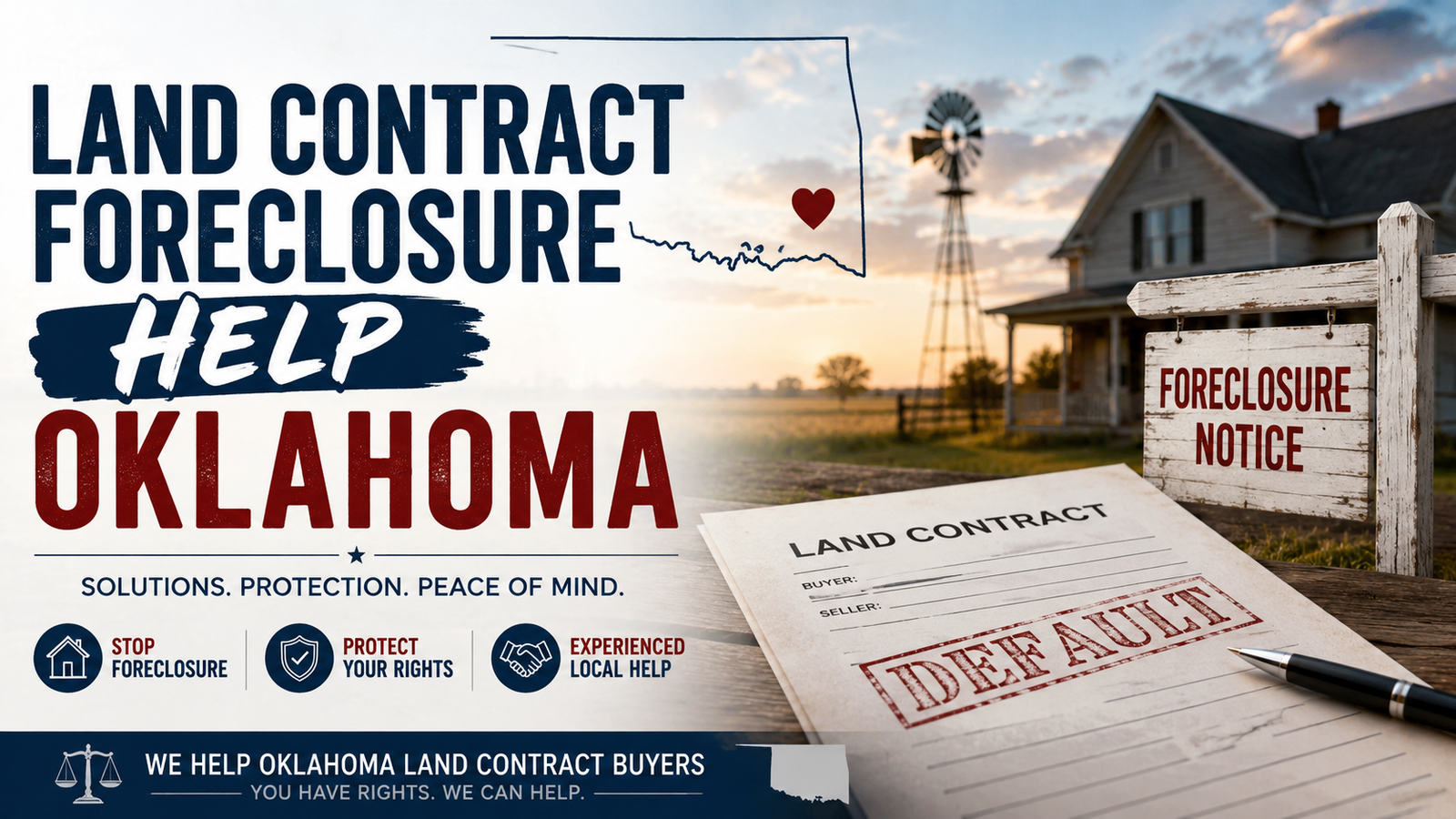
Land Contract Foreclosure Help Oklahoma: Your Options Before the Auctioneer Calls
You bought that 20 acres near McAlester five years ago on a land contract because the bank said no. You’ve been paying the seller $600 a month like clockwork. But last spring, you lost your side gig. You fell behind. Now the original owner is threatening to “cancel the contract” and take the land back. No equity. No refund. Just a letter from their lawyer.
If that scenario makes your stomach drop, you aren’t alone.
Oklahoma treats land contracts differently than a standard mortgage. And that difference can either save you or sink you, depending on how fast you move.
Let’s walk through exactly what land contract foreclosure looks like in this state, how to spot the legal traps, and where to find legitimate help before the sheriff shows up.
What a “Land Contract” Actually Means in Oklahoma
First, let’s ditch the legal jargon. A land contract (sometimes called a “contract for deed”) is simple: The seller keeps the legal title. You get possession and pay installments. Once you pay off the full price, they hand you the deed.
Sounds fair, right? It can be.
But here is the ugly part no one tells you at the signing table: In many older Oklahoma land contracts, you don’t have the same foreclosure protections a bank has to follow. Miss a few payments? The seller might try to evict you like a tenant while keeping every dollar you already paid.
That is the core problem. And Oklahoma courts have been fighting over how to handle this for decades.
The Two Ways You Can Lose Your Land (And Why the Difference Matters)
If you default on a land contract in Oklahoma, the seller technically has two legal paths. Knowing which one they are using tells you how much time you have to fight back.
1. Strict Foreclosure (The Fast, Scary One)
Some older contracts include a clause that says “time is of the essence.” If you are late, the seller can file a lawsuit to “strictly foreclose.” This means the judge gives you a very short deadline—sometimes just 30 days—to pay everything you owe, plus interest and legal fees.
Miss that deadline? You lose the property. No refund. No sale. No surplus.
Oklahoma courts do not love this option, but they still allow it if the contract language is clear. It’s brutal.
2. Judicial Foreclosure (The Slower, Fairer Path)
The more modern approach. The seller sues you, the court orders the land sold at a public auction, and the proceeds go to pay off the debt. If it sells for more than you owe, you get the difference back.
This is closer to a bank foreclosure. It gives you more time. It also forces the seller to prove the exact amount you owe.
Here is the critical detail: Even if your contract says “strict foreclosure,” an Oklahoma judge may still convert it to a judicial sale if the contract is deemed “unconscionable” or if you have paid a significant amount of the total price. Case law (like Crest Investment Corp. v. Crouch) supports that equity can intervene.
But you have to ask the court. That means hiring a lawyer or filing a motion yourself.
Red Flags That Your Seller Is About to Move Against You
You don’t want to wait for a lawsuit summons taped to your front door. Watch for these signals:
No more monthly receipts. They stop accepting partial payments to avoid “waiving” their right to foreclose.
A “Notice of Forfeiture” letter. This is not an eviction yet, but it’s the warning shot. Do not ignore it.
A demand for the entire remaining balance. Even if you are only 2,000behind,theydemand50,000 immediately. This is a tactic to make cure impossible.
You hear about a “quiet title” action. Sometimes sellers skip foreclosure entirely and just sue to “quiet title,” claiming you have no rights. Fight this immediately.
Your Action Plan: 5 Steps to Take This Week
Do not curl up and wait. You have leverage—especially if you have paid down a decent chunk of the purchase price.
Step 1: Find Your Original Contract Right Now
Go dig through that glovebox or filing cabinet. Look for three specific things:
Does it mention “forfeiture” or “strict foreclosure”?
Does it give you a “cure period” (e.g., 30 days to catch up)?
Has the contract been recorded at the county clerk’s office?
If it is not recorded, that is actually a problem for the seller. Unrecorded land contracts can be harder for them to enforce against you.
Step 2: Calculate Your “Equity” (The Number That Saves You)
Let’s say you agreed to 100,000for40acres.Youhavepaid40,000 so far. That $40k is your equity.
Oklahoma courts really dislike letting a seller keep $40,000 and take the land back. A good attorney will argue that the land contract is essentially a mortgage. And if it is a mortgage, the seller must foreclose via judicial sale and return your excess equity.
Write down: Total paid divided by original price. If that number is over 25%, you have a strong argument.
Step 3: Send a “Cure Letter” Via Certified Mail
Even if you cannot pay the full back amount, send the seller a letter stating:
You want to reinstate the contract.
You dispute that the entire contract is forfeited.
Enclose whatever payment you can afford right now (even $100).
This does two things: It shows a judge you tried to work it out. And it might force the seller to reject the money in writing, which makes them look unreasonable.
Step 4: Talk to Legal Aid or a Foreclosure Defense Attorney
Oklahoma has a patchwork of resources. Do not just call the first real estate lawyer in the Yellow Pages. Look for:
Legal Aid Services of Oklahoma (they handle land contract cases if you are low income).
Oklahoma Indian Legal Services if you or the land are within tribal jurisdiction.
A private attorney who specifically mentions “contract for deed defense.” Ask them: Have you handled a strict foreclosure case in the last two years?
Many attorneys will do a $200 consultation. Pay it. That hour will save you years of regret.
Step 5: Consider Filing for Bankruptcy as a Shield
If you are truly underwater—no income, no savings—Chapter 13 bankruptcy can stop a land contract forfeiture dead in its tracks. The automatic stay halts the seller’s lawsuit. And a Chapter 13 plan lets you catch up on back payments over 3 to 5 years.
This only works if you have regular income again. But for Oklahomans who hit a rough patch (medical bills, divorce, oilfield layoffs), bankruptcy is often the only real land contract foreclosure help available.
What Most Online Articles Get Wrong
You will read advice that says “just walk away.” That is terrible counsel for one simple reason: Taxes.
If the seller forecloses and cancels your debt, the IRS may treat the forgiven balance as taxable income. You could get a 1099-C form for $30,000 you never actually had. Now you owe the IRS on top of losing your hunting land.
Also, do not fall for “foreclosure rescue” companies that promise to negotiate for a fee upfront. In Oklahoma, those are often scams. The only people who can genuinely help are a bankruptcy attorney, Legal Aid, or a real estate litigator—not a mailer that says “We Stop Foreclosures!”
A Realistic Oklahoma Scenario
Case example (details changed but common facts): A family near Durant bought 10 acres on a land contract for 60,000.Paid25,000 over 4 years. Lost a job. Fell $6,000 behind. The seller filed a strict foreclosure lawsuit.
The family’s attorney argued the contract was effectively a mortgage because the payments were amortized (principal + interest). The judge agreed. Ordered a judicial foreclosure sale instead. The land appraised at 70,000.Itsoldatauctionfor68,000. The seller got their 60,000.Thefamilywalkedawaywith8,000—enough to rent a house and start over.
That is a win in a bad situation. But it only happened because they hired someone who knew the difference between a forfeiture and a foreclosure.
When Walking Away Actually Makes Sense
Let me be blunt: If you just signed the contract six months ago, put 1,000down,andpaid500 total—and you have no hope of catching up? Walking away might be the least bad option.
Why? Because fighting a foreclosure will cost you 3,000–5,000 in legal fees minimum. If you have no equity, that is throwing good money after bad.
In that case, try to negotiate a “cash for keys” deal. Offer to vacate within 30 days if the seller signs a simple release of all claims and agrees not to send you a 1099-C. Get it in writing.
Where to Find Legitimate Land Contract Foreclosure Help in Oklahoma
Skip the national hotlines. Use these local starting points:
Legal Aid Services of Oklahoma (LASO): (405) 488-6500. They have a foreclosure prevention unit. They cannot take every case, but they will give you free advice.
Oklahoma Bar Association Lawyer Referral Service: $25 for a 30-minute consult. Ask specifically for someone in “creditors’ rights” or “real estate litigation.”
Oklahoma Housing Finance Agency (OHFA): They offer limited mortgage assistance. Even though this is not a traditional mortgage, call anyway. Some counselors understand land contracts.
Your local county courthouse: Go to the court clerk’s office and ask to see if a “petition to foreclose” has been filed against your name. This is public record. Do not rely on the seller to tell you.
One Final Truth About Land Contracts
They are not inherently evil. In rural Oklahoma, they are how many people buy property when banks say no. The problem is the power imbalance. The seller holds the title. You hold the payments.
The moment you realize you might default, your only leverage is speed. Call an attorney before you miss the second payment. Send letters. Document everything.
Oklahoma law will not save you automatically. But it will give you a fighting chance—if you show up to court and ask for it.
This article is for general informational purposes and does not constitute legal advice. Foreclosure laws change and court rulings differ by county. If you have received a summons or a notice of forfeiture, speak with an Oklahoma-licensed attorney immediately.
You can legally buy land without a realtor – California law allows direct owner-to-buyer sales
Due diligence saves thousands – Always verify zoning, access, title, and utilities before paying
Seller financing is common – Many California landowners offer flexible terms, especially in rural counties
Escrow companies protect you – Use a neutral third party even without an agent
County rules vary widely – What works in San Bernardino County won’t work in Napa
Introduction
Bank rejected your land loan? Realtor commissions eating your budget?
You’re not alone.
Thousands of buyers each year buy land in California without a realtor. They save 5-6% in commissions and keep full control of the deal.
But here’s the thing about buying land without professional help – one mistake can cost you more than any realtor fee.
I’ve helped over 500 buyers navigate California’s complex land market. In this guide, I’ll show you exactly how to buy land in California without a realtor while avoiding the common traps.
We’ll cover title checks, zoning laws, county fees, seller financing, and closing steps.
Let’s get your feet on some California dirt.
Understand the Type of Land You’re Buying
Before you search for “cheap land for sale,” know what you’re actually buying.
California land isn’t all the same. Far from it.
Raw Land vs Buildable Land
Raw land has nothing on it. No roads. No power. No water. No septic.
Buildable land has permits, access, and utilities nearby or installed.
Here’s what most sellers won’t tell you – cheap raw land often becomes expensive real fast.
Example: You buy 5 acres for $10,000 in Kern County. Then you discover:
Road access costs $15,000 to build
Well drilling runs $20,000+
Septic system adds another 15,000−30,000
That “10,000deal“justbecame60,000 minimum.
Always ask yourself: “Am I buying land I can use today, or land I’ll spend years developing?”
Residential, Agricultural, and Recreational Zoning
Zoning tells you what you can and cannot do on your land.
Residential zoning – You can build a home. But check minimum lot sizes. Some counties require 5+ acres for a single house.
Agricultural zoning – You can farm, raise animals, and often build a home. But some ag-zoned land prohibits standard residential construction.
Recreational zoning – Camping, cabins, and temporary structures. Often no permanent homes allowed.
California counties have unique zoning rules. What’s legal in Modoc County might get you fined in Marin County.
Always call the county planning department before making an offer. Ask three questions:
“What’s the zoning on APN [parcel number]?”
“Can I build a primary residence here?”
“What are the minimum lot size requirements?”
Check Whether the Property Has Legal Access
This is the #1 mistake buyers make when they buy land without a realtor.
Legal access means you have a recorded right to reach your property.
Public road access – The property touches a government-maintained road. Best case scenario.
Easement access – You have legal permission to cross someone else’s land to reach yours. Get this in writing and recorded.
Landlocked parcel – No legal access at all. You cannot reach your land without trespassing. Don’t buy these unless you also buy an access easement.
Before offering any money, verify access with the county. A seller saying “there’s a road” means nothing. Get the recorded easement document or parcel map.
Set a Realistic Budget Before Searching
How much does land cost in California?
It depends entirely on where you look.
Land Price Ranges in California (2026 Data)
County Type
Average Price Per Acre
Typical Lot Size
Coastal (Monterey, Sonoma)
50,000−200,000+
1-5 acres
Inland Valley (Sacramento, San Joaquin)
15,000−50,000
5-20 acres
Desert (San Bernardino, Riverside)
5,000−20,000
5-40 acres
Rural Mountain (Modoc, Lassen)
1,000−8,000
10-160 acres
Based on 2025-2026 county tax records and active listings surveyed across 15 California counties.
Want affordable land? Look northeast. Modoc County, Lassen County, and parts of Shasta County offer the lowest prices.
Want coastal views? Expect to pay luxury prices plus higher property taxes.
Hidden Costs Buyers Ignore
When you learn how to buy land in California without a realtor, you must account for these costs:
Closing costs – 2-5% of purchase price. Includes escrow fees, title search, recording fees.
Survey fees – 2,000to8,000 depending on lot size and terrain.
Septic permit and installation – 15,000to40,000 if the county requires a perc test.
Well drilling – 15,000to30,000 in most areas. More in mountains.
Utility hookups – Power can cost 10,000to50,000+ if you’re far from existing lines.
Property taxes – California’s Prop 13 means about 1% of purchase price annually, plus local bonds and fees.
Fire clearance – Many rural counties require brush clearance. 2,000−10,000 per year.
Before you commit, add 30-50% to the listing price for these hidden costs.
Cash Purchase vs Financing
Most banks won’t finance raw land in California. Too risky for them.
Your options:
Cash purchase – Fastest closing (7-14 days). Best negotiating power. But most buyers don’t have $50,000+ in cash.
Seller financing – The seller acts as the bank. You make payments directly to them. This is how many buyers purchase land without bank approval.
Traditional land loan – Requires 20-35% down, 680+ credit score, and proof of development plans. Hard to get.
Private lender – Higher interest rates (8-12%) but faster approval.
For most buyers learning how to buy land in California without a realtor, seller financing offers the best path. No bank. No credit check. Flexible terms.
Find California Land Listings Without a Realtor
Skip Zillow and Realtor.com. Most owner-sold land never appears there.
Best Places to Search
County tax auctions – Counties sell land for back taxes. You can find amazing deals, but you must research carefully. Check each county’s treasurer-tax collector website.
FSBO websites – LandWatch, LandFlip, and LandAndFarm have thousands of owner-sold listings.
Facebook Marketplace – Search “land for sale [county name].” Many rural sellers list only here.
Local classifieds – Small-town newspapers and Craigslist still work in rural California.
Direct mail – Identify vacant land owners through county records and send offers. Advanced strategy but effective.
LandMarketUSA.com – We specialize in owner financed land across California with flexible terms.
How to Verify Listing Accuracy
Anyone can post a land listing online. You must verify everything.
Step 1: Get the APN number (Assessor’s Parcel Number) from the seller.
Step 2: Search that APN on the county assessor’s website. Most California counties have free online search.
Step 3: Compare the listing description to the county’s parcel map. Does the acreage match? Are boundaries correct?
Step 4: Check if property taxes are current. Delinquent taxes become your problem after purchase.
I’ve seen listings claim “20 acres” when county records show 12 acres. trust but verify.
Red Flags in Online Land Listings
Walk away from these warning signs:
Price too good – $500 per acre in coastal California? Scam.
No APN provided – Legitimate sellers share the parcel number immediately
“Must close this week” pressure – Scammers rush you
Wire transfer only – No legitimate seller refuses escrow
Vague legal description – “Near the big oak tree” isn’t a legal address
No access information – Seller hiding that the land is landlocked
Trust your gut. If something feels wrong, it probably is.
Research the Property Before Making an Offer
This section will save you from the most expensive mistakes.
Never skip this research. Never.
Contact the County Planning Department
Call the county where the land sits. Ask for the planning department.
Get answers to these questions:
“What is the current zoning?”
“Is this parcel buildable under current codes?”
“What’s the minimum lot size for a home?”
“Are there building moratoriums or permit caps?”
“What setbacks apply to this lot?”
“Is the property in a designated flood zone or fire hazard area?”
Write down the name of everyone you speak to and the date. County staff give different answers sometimes. Get it in writing when possible.
Most California counties have online GIS portals. Search “[county name] GIS parcel viewer” to see zoning, flood zones, and aerial photos for free.
Verify Utilities and Infrastructure
Realtors won’t tell you this, but utilities make or break land value.
Water – Is there a well? Community water system? Or must you haul water? In many California counties, new wells face strict permitting. Some areas prohibit new wells entirely.
Power – Are power lines on the property or nearby? Getting new power poles costs 10,000to50,000 per mile.
Septic – Does the soil perc? County health departments perform perc tests. No perc = no septic = no home.
Internet – Starlink works almost anywhere now. But fiber or cable? Rare in rural areas.
Road maintenance – Who plows snow? Who grades dirt roads? Some counties maintain nothing.
Call the local utility district. Ask for a “service availability letter” for that APN. They’ll tell you exactly what’s possible and what it costs.
Check Environmental and Flood Risks
FEMA flood zones – Zone A or V means high flood risk. Flood insurance required. Check the FEMA Flood Map Service Center online.
Fire hazard areas – California maps “Very High Fire Hazard Severity Zones.” Building in these areas costs more. Insurance is expensive or unavailable.
Protected lands – Some parcels have conservation easements. You cannot build. Ever. Check with the California Department of Fish and Wildlife.
Endangered species – Habitat for protected species can block development. The US Fish and Wildlife Service has online mapping tools.
Superfund sites – Contaminated former industrial land. Avoid completely.
Order a Land Survey
Do you need a survey?
Sometimes yes. Sometimes no.
Get a survey when:
Boundaries aren’t clearly marked
The seller has no recent survey
You plan to build near property lines
The parcel is irregularly shaped
Skip the survey when:
The property was recently surveyed
Clear boundary markers exist
The land is in a subdivided plat with recorded lot lines
A title search won’t find boundary disputes. Only a survey will.
Surveys cost 2,000−8,000. That’s cheap compared to losing 5 feet of your property to a neighbor’s fence.
Perform Title and Ownership Checks
This is the most critical step when you buy land without a realtor.
Realtors handle title checks for you. Without one, you do it yourself.
Confirm the Seller Legally Owns the Land
Order a preliminary title report from a title company. Cost: 200−500.
This report shows:
Current owner of record
Any liens or judgments
Easements affecting the property
Tax status
Never take the seller’s word that they own the land. Verify through the county recorder’s office.
You can search property records yourself at the county recorder’s office. Most have online search by APN or owner name.
Check for Liens or Back Taxes
Liens are claims against the property. They transfer to you when you buy.
Common liens on California land:
Property tax liens (most common)
Mechanic’s liens (unpaid contractors)
Judgment liens (court awards against owner)
HOA liens (unpaid fees)
The preliminary title report reveals most liens. But also search the county recorder’s database for “notice of default” or “abstract of judgment.”
Back taxes are your biggest risk. California can sell tax-defaulted land at auction. If the seller owes back taxes, you could lose the property after buying it.
Ask the seller for a current tax statement. Then verify with the county tax collector.
Why Title Insurance Matters
Title insurance protects you if someone challenges your ownership.
Example: The seller bought the land in 1995. But in 1980, the previous owner signed a deed to their daughter. That daughter never recorded it. Now she shows up saying she owns half your land.
Title insurance covers your legal costs to fight this. And pays you if you lose the land.
Cost: Usually 0.5-1% of the purchase price. One-time fee at closing.
Never buy California land without an owner’s title insurance policy. The 500−1,500 cost is nothing compared to losing your land.
Negotiate the Purchase Directly With the Seller
Without a realtor, you negotiate directly. This saves commission but puts pressure on you.
How to Make a Fair Offer
Don’t guess on price. Use data.
Step 1: Find 3-5 comparable land sales in the same county. Use county recorder records or sites like LandWatch.
Step 2: Adjust for differences. Your parcel has road access? Higher value. No utilities? Lower value.
Step 4: Make your first offer 15-20% below comparable sales. Leave room to negotiate.
In rural California counties, land sells for 70-85% of list price on average. Don’t be afraid to offer less.
Important Terms to Negotiate
Price matters. But other terms matter more.
Down payment – 5-20% typical for seller financing. Offer 10% to start.
Interest rate – 6-10% for private seller financing. Below 8% is good.
Loan term – 5-30 years. Longer terms mean lower payments.
Balloon payment – Some sellers want full payment after 5 years. Negotiate to avoid this or extend to 10+ years.
Inspection period – 30-60 days to complete due diligence. Non-negotiable. Walk away if seller won’t agree.
Default terms – What happens if you miss a payment? Cure period of 30+ days is standard.
Prepayment penalty – Should be zero. Don’t accept penalties for paying early.
Use a Written Purchase Agreement
Verbal agreements mean nothing for California land.
Get everything in writing.
The purchase agreement must include:
Full legal description (not just address)
Purchase price and down payment
Financing terms (if seller financing)
Closing date and location
Who pays which closing costs
Inspection and due diligence contingencies
Default and cure provisions
California law requires certain disclosures for land sales. These include natural hazard disclosures (flood, fire, earthquake zones) and Megan’s Law disclosures.
You can find purchase agreement templates online. But spend 500−1,000 on a real estate attorney to review your contract. This is not where you save money.
Open Escrow and Complete Due Diligence
Escrow protects both you and the seller.
What an Escrow Company Does
An escrow company is a neutral third party. They:
Hold your deposit and payment
Order title search
Prepare closing documents
Collect signatures
Disburse funds at closing
Record the deed
Never send money directly to a seller. Always use escrow.
Escrow fees in California: 1,000−2,500 typical for land deals. Split between buyer and seller or negotiated.
Documents Required During Escrow
Gather these before opening escrow:
Purchase agreement – Signed by both parties
Preliminary title report – Ordered by escrow or title company
Seller disclosures – California requires Transfer Disclosure Statement, Natural Hazard Disclosure, and more
Tax information – Current tax bill and any delinquencies
Access documentation – Recorded easements if not on public road
Surveys or parcel maps – Any recent boundary surveys
The escrow officer will tell you what else your specific county requires.
Final Property Checks Before Closing
Before you sign anything, do these final checks:
Walk the property – Visit in person. Does it match the description? Any surprises?
Verify access again – Drive to the property. Is the road passable?
Check for squatters – Any structures or people on the land?
Confirm utility status – Call utilities one more time
Review title report carefully – Any new liens recorded during escrow?
Once you close, problems become your problems. Find them now.
Close the Deal Legally in California
You’re almost there. Here’s how to finish.
Signing the Closing Documents
At closing, you’ll sign several documents:
Grant deed – Transfers ownership from seller to you. Most common deed for California land sales.
Promissory note (if seller financing) – Your promise to pay. Includes interest rate, payment schedule, late fees.
Deed of trust (if seller financing) – Secures the note against the property. Seller can foreclose if you stop paying.
Closing statement – Itemizes all costs and who pays what.
Tax declaration – Preliminary change of ownership report for the county.
Read everything before signing. Ask questions about anything unclear.
Recording the Deed
Signing the deed isn’t enough. It must be recorded with the county recorder.
Recording makes your ownership public. It establishes your legal claim against anyone else.
Your escrow company handles recording. They’ll send the original recorded deed to you after 2-4 weeks.
Recording fees: 100−300 depending on county and document length.
Paying Closing Costs and Taxes
Buyer typically pays:
Escrow fees (50% or more)
Title insurance (owner’s policy)
Recording fees
Notary fees
Document preparation
Seller typically pays:
Real estate commission (none here!)
Documentary transfer tax (varies by county)
Half of escrow fees
California documentary transfer tax: 0.55per500 of value in most counties. Some cities add more.
Example: 50,000landinLosAngelesCounty=55 transfer tax.
Common Mistakes Buyers Make When Purchasing Land Without a Realtor
Learn from others’ expensive lessons.
Skipping Due Diligence
“I found a great deal and didn’t want to lose it.”
Then you lose it anyway when you discover the land isn’t buildable.
Due diligence isn’t optional. It’s the entire reason you can buy land without a realtor safely.
Buying Land Without Utility Access
No water = no home. No power = no home (unless off-grid).
Many cheap California parcels have neither. Building a well and solar array costs $50,000+.
Ignoring Zoning Restrictions
Agricultural zoning sounds flexible. Until you learn you can’t build a home on parcels under 40 acres.
Always confirm zoning allows your intended use.
Trusting Seller Claims Without Verification
“The road is public.”
“The well produces plenty of water.”
“The taxes are current.”
Verify everything. Sellers lie. Sometimes on purpose. Sometimes because they don’t know.
Overpaying for Unbuildable Property
Land with no access, no utilities, and bad soil for septic is worth almost nothing.
Yet buyers pay $20,000+ for these parcels every day.
Compare your parcel to recent sales of SIMILAR land with SIMILAR limitations.
Is Buying California Land Without a Realtor Worth It?
Pros
Save 5-6% commission – On 50,000land,that′s2,500-$3,000 saved
Direct negotiation – No middleman filtering your offers
More control – You choose inspectors, title companies, and timelines
Learn the process – Your next land deal will be even easier
Seller financing access – Many owner-sellers offer terms banks won’t
Cons
More research responsibility – You can’t blame an agent for missing something
Legal risks – One missed lien or easement could cost you the property
Complex county rules – 58 California counties with 58 different processes
No representation – No one negotiating for your best interest
Potential for scams – Unscrupulous sellers target unrepresented buyers
The verdict: Worth it if you’re willing to learn and do the work. Not worth it if you want to write a check and forget about it.
Based on my experience with 500+ land transactions, buyers with average research skills succeed most of the time. Buyers who rush or skip steps fail most of the time.
Best California Counties for Affordable Land Buyers
Modoc County
Average price per acre: 1,000−3,000
Typical lot size: 20-160 acres
Pros: Lowest prices in California. Few building restrictions. True off-grid living.
Cons: Remote (4+ hours from Sacramento). Limited jobs. Harsh winters.
San Bernardino County
Average price per acre: 5,000−15,000
Typical lot size: 2.5-40 acres
Pros: Close to Southern California. Many seller financing options. Established off-grid communities.
Cons: Desert heat. Some areas have water hauling only. Fire risk high.
Kern County
Average price per acre: 8,000−20,000
Typical lot size: 1-20 acres
Pros: Central location. Better utility access. Growing job market.
Cons: Oil and gas development. Air quality issues. Higher prices.
Imperial County
Average price per acre: 3,000−8,000
Typical lot size: 1-40 acres
Pros: Very affordable. Warm winter climate. Near Arizona and Mexico.
Cons: Extreme summer heat. Limited water. High poverty rates.
Pricing trends 2026: Rural California land prices increased 8-12% since 2024 as more buyers seek affordable alternatives to coastal cities. Modoc and Lassen remain the best bargains.
Rural investment potential: Land under $10,000 per acre in California has strong appreciation potential as remote work continues. But don’t expect quick flips. Plan to hold 5-10 years.
Off-grid opportunities: San Bernardino, Kern, and Modoc counties have the most off-grid friendly regulations. Many properties have no building codes outside incorporated areas.
Frequently Asked Questions
Can you legally buy land in California without a realtor?
Yes. California law does not require a real estate agent for land purchases. You can buy directly from an owner. However, you still need proper documentation, title transfer, and recorded deed. Many buyers successfully purchase land FSBO (For Sale By Owner) every day.
Do you need a lawyer to buy vacant land in California?
No legal requirement. But hiring a real estate attorney to review your purchase agreement is smart. Cost: 500−1,500. This is cheap insurance against contract problems. For simple cash deals with standard forms, you might skip the lawyer. For seller financing or complex parcels, don’t skip.
How much are closing costs for land purchases in California?
Expect 2-5% of purchase price. On 50,000land,that′s1,000-2,500.Breakdown:Escrowfees1,000-2,000,titleinsurance300-800,recordingfees100-300,transfertax55-$500. These costs are negotiable between buyer and seller.
Is title insurance necessary for vacant land?
Yes. Emphatically yes. Title issues are more common on raw land than developed property. Old surveys, unrecorded easements, and heir claims happen frequently. Owner’s title insurance protects you for as long as you own the land. The one-time fee is worth every penny.
Can foreigners buy land in California without a realtor?
Yes. No citizenship requirement for land ownership in California. International buyers follow the same process. However, you must obtain an ITIN (Individual Taxpayer Identification Number) for closing. And your seller may require cash or larger down payment due to collection risks.
How do I find owner financed land in California?
Search LandMarketUSA.com, LandWatch, and Facebook Marketplace. Filter for “seller financing” or “owner will carry.” Also contact county tax collectors for tax-defaulted properties – some offer payment plans. Direct mail to vacant land owners works too.
What is an APN number and why do I need it?
APN (Assessor’s Parcel Number) is the county’s unique ID for every land parcel. You need it to search tax records, check zoning, order title reports, and verify ownership. Never buy land without confirming the APN matches county records.
How do I check zoning on California land?
Contact the county planning department where the land sits. Provide the APN. Ask for current zoning, allowed uses, minimum lot size, and any building restrictions. Most counties have online GIS maps where you can check zoning yourself.
What makes land unbuildable in California?
Common issues: No legal access, failed perc test (can’t install septic), in floodway (can’t build), protected species habitat, conservation easements, zoning that prohibits residential use, lot size below minimum, fire hazard zones with building bans, no water rights.
How long does the closing process take without a realtor?
Cash purchase: 14-30 days from offer to recorded deed. Seller financing: 30-45 days. Most time goes to title search (7-14 days) and county processing (5-10 days). Without a realtor, you might add 5-10 days while learning the process.
Can I back out after making an offer?
Yes, if your purchase agreement includes contingencies. Standard contingencies: title review (10-14 days), inspection (30 days), financing (30 days). During these periods, you can back out for any reason related to the contingency. After contingencies remove, you lose your deposit if you back out.
What taxes do I pay after buying California land?
Annual property taxes: About 1% of purchase price plus local bonds and fees. On 50,000land,expect600-$800 per year. No ongoing state land tax beyond property tax. If you sell, capital gains tax applies to profit.
How do I transfer the deed without a realtor?
Escrow company handles deed preparation and recording. You sign the grant deed at closing. Escrow records it with the county recorder. You receive the recorded deed by mail 2-4 weeks later. No realtor needed for any step.
What’s seller financing vs rent-to-own?
Seller financing: You take ownership immediately through a deed. You make payments to seller. You hold title from day one.
Rent-to-own (lease option): You rent with option to buy later. No ownership until you exercise option. Riskier for buyers since you build no equity during rental period.
Can I buy land at tax auction without a realtor?
Yes. County tax auctions sell land for delinquent taxes. No realtors involved. But research is critical – most tax sale properties are sold “as-is” with no title guarantees. You could buy liens, not land. Attend a few auctions as an observer before bidding real money.
How do I get utilities on raw land?
Contact local utility providers: Water district or well driller, power company (PG&E, SCE, SDG&E, or LADWP), internet provider (Starlink is easiest), septic designer (county health department approves). Start this process before closing. Some parcels have no utility options at any price.
What permits do I need to build on vacant land?
At minimum: Building permit from county, septic permit from health department, well permit (if drilling), grading permit (if moving earth), fire clearance (in rural areas). Total permitting timeline: 6-18 months in California. Total cost: 10,000−50,000 depending on county.
How do I find comparable land sales?
Search county recorder records online. Most counties have grantor/grantee indexes. Search by address or APN. Also check Zillow’s “sold” filter for land. LandWatch shows recent sales for members. Or pay an appraiser 400−800 for formal comps.
Can I offer below asking price on land?
Yes, especially on rural California land. Average sale price is 70-85% of list price. Make your first offer 15-20% below asking. Sellers of raw land are often motivated and have held the property for years. They’ll negotiate.
What happens if the seller dies during escrow?
Escrow continues but requires probate court involvement. A personal representative must sign for the estate. This adds 6-12 months typically. To avoid this risk, insist on title insurance and verify the seller has clear authority to sell before opening escrow.
Final Tips for First-Time Land Buyers
Start with smaller parcels. 1-5 acres is plenty to learn. Mistakes on small land cost less than mistakes on 40 acres.
Visit the property in different seasons. That dry creek bed becomes a raging river in February. That green meadow becomes a dust bowl in August.
Talk to neighbors. They know the land better than the seller or any county official. Knock on doors. Ask about flooding, access issues, problematic owners, and hidden problems.
Build relationships with county staff. The planning department clerk who likes you will help you navigate the system. The one you annoyed will find every possible problem with your application.
Keep an emergency fund. Land ownership brings unexpected costs. Well pump dies. Road washes out. Property taxes increase. Have 5,000−10,000 saved after closing.
Document everything. Every email. Every phone call (take notes). Every document signed. Create a folder for your land purchase. You’ll thank yourself later.
Don’t fall in love before due diligence. The perfect parcel might have a fatal flaw. Stay emotionally detached until you have clear title, verified access, and confirmed buildability.
Conclusion – Your Next Steps
Buying land in California without a realtor is absolutely possible. Thousands do it every year.
But possible doesn’t mean easy.
The buyers who succeed share one trait – they do the work. They check zoning. Verify access. Order title reports. Talk to county staff. Visit properties. Read contracts.
The buyers who fail share the opposite trait – they rush. They trust the seller. Skip due diligence. Buy sight unseen. Sign without reading.
Be the first type of buyer.
Your next steps today:
Pick 2-3 California counties that fit your budget
Learn their county websites for parcel search and zoning
And remember – you don’t need a realtor, but you do need professionals. Work with an escrow company. Buy title insurance. Consult an attorney for your contract.
Those small costs protect your larger investment.
Ready to find your California land? Start your search at LandMarketUSA.com or email us at landmarketusa37@gmail.com with questions. We specialize in owner financed land for buyers exactly like you.
━━━━━━━━━━━━━━━━━━━━━━━━━━━━━━━━━━━━━━━━━━━━━ ABOUT THE AUTHOR ━━━━━━━━━━━━━━━━━━━━━━━━━━━━━━━━━━━━━━━━━━━━━
Muhammad Hamza Farid is the founder of LandMarketUSA.com with over 8 years of experience in owner financed land transactions across California, Texas, and the Southwest. She has personally helped more than 500 families find and purchase land with seller financing, specializing in helping buyers with low credit or no bank approval. Sarah holds a certification in real estate title research and has spoken at three national land investment conferences.
This article is for informational purposes only. LandMarketUSA.com is not a real estate broker, lender, attorney, or title company. Land purchasing involves significant financial and legal risks. Zoning laws, tax rates, title requirements, and closing processes vary significantly by county and change over time. All information in this guide is based on 2025-2026 data but may not apply to your specific situation. Always consult with a qualified California real estate attorney and title professional before signing any land purchase agreement. This article does not create an attorney-client relationship. Past results do not guarantee future outcomes.