You’ve been looking at cheap land in rural Oklahoma. Maybe it’s a few acres near Broken Bow. Or a remote plot in the Panhandle. The price is right – say $15,000 for a five-acre parcel. But banks won’t touch it. Too small. Too remote. No house yet.
Then the seller says something interesting: “I’ll finance it for you.”
That’s owner financing. Also called a land contract or contract for deed. It’s how a lot of affordable land changes hands in Oklahoma, especially in counties like Pushmataha, Texas, or Cimarron.
But here’s the thing most people miss. They focus on the monthly payment and forget to ask: What interest rate am I actually paying? And How to Calculate Interest on Owner-Financed Land in Oklahoma?
That mistake can cost you thousands.
Let me show you exactly how to calculate interest on an owner-financed land deal in Oklahoma. No finance degree required.
Why Owner Financing Is Different (And Why It Matters)
When you get a bank loan, the bank uses a standardized amortization formula. They give you a truth-in-lending statement. Everything is regulated to death.
Owner financing is different. It’s a private contract between you and the seller. That means more flexibility, but also more room for confusion.
Some sellers use the same bank-style amortization. Others use a simple interest calculation. A few try to structure payments in ways that heavily favor them.
If you don’t know how to calculate the interest yourself, you could agree to a bad deal without realizing it.
The good news? The math is straightforward once you understand three basic pieces: the principal, the interest rate, and the loan term.
The Simple Formula for Calculating Interest on Land Contracts
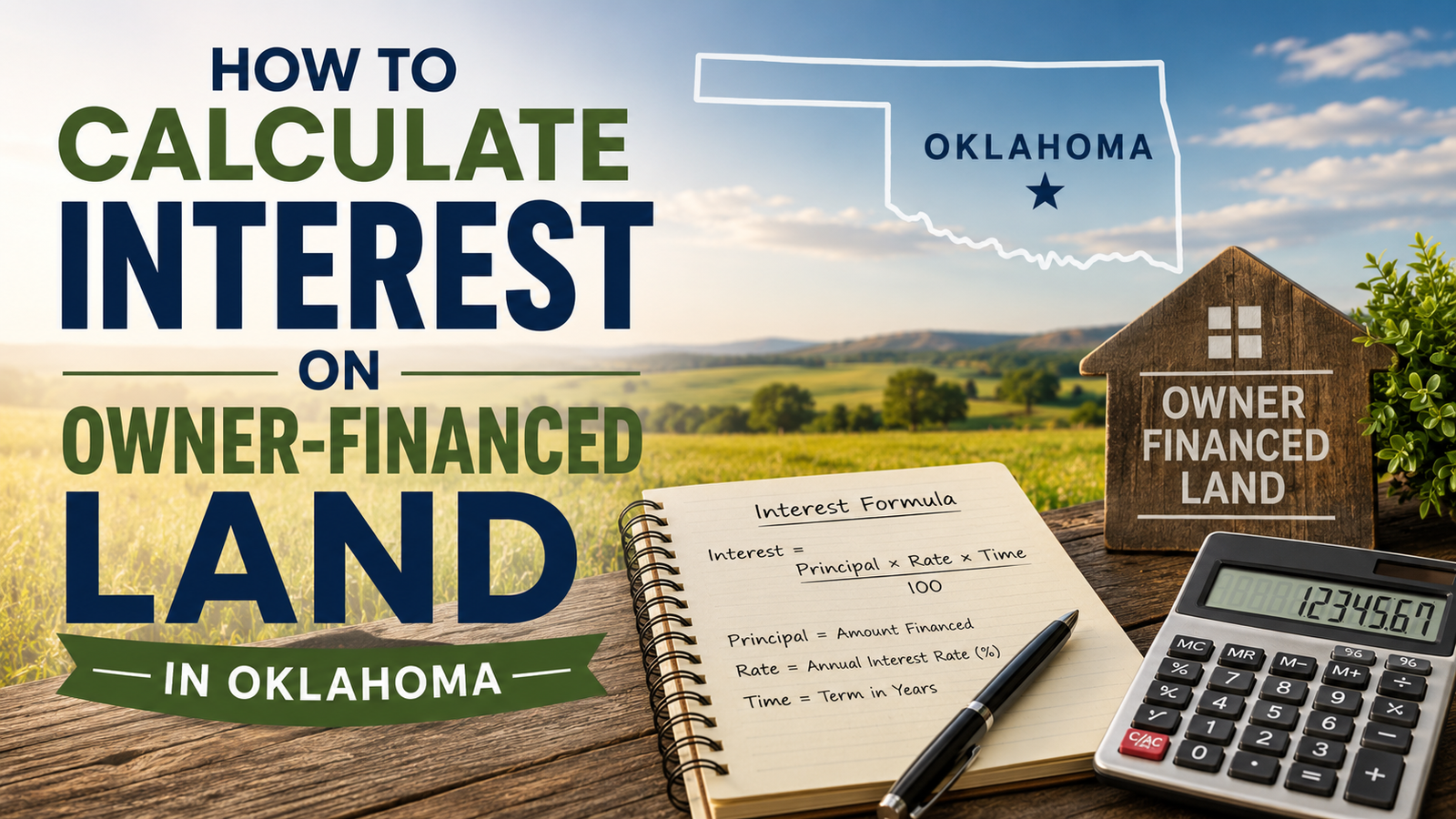
Here’s the core formula for simple interest on an owner-financed land purchase:
Say you’re buying 10 acres in southeastern Oklahoma for 25,000.Theselleragreestoownerfinancingwith2,500 down (10%) and a 7% annual interest rate on the remaining $22,500.
To find your first month’s interest:
22,500×0.07=1,575 in annual interest 1,575÷12=∗∗131.25 in interest for month one**
If your monthly payment is 300,thenroughly131 goes to interest and the remaining $169 reduces your principal.
By month twelve, your principal has dropped a bit, so the interest portion is slightly lower. That’s the basic rhythm of an amortizing loan.
The Two Ways Sellers Calculate Interest (Know Which One You Have)
Not all owner-financed land deals work the same way. In Oklahoma, you’ll typically encounter one of two calculation methods.
Amortized Interest (Bank Style)
The seller calculates a fixed monthly payment that pays off the loan completely by the end of the term. Each payment includes interest plus some principal. Early payments are mostly interest. Later payments are mostly principal.
This is the most common and fairest method for longer terms (five years or more).
Simple Interest on Declining Balance
Each month, interest is calculated only on the remaining principal. If you pay extra, you save immediately on interest. If you pay late, interest keeps accruing on the unpaid balance.
Some Oklahoma land contracts use simple interest but require annual statements showing how much principal remains. Always ask which method the seller plans to use.
Step-by-Step: How to Calculate Your Interest Before You Sign
You don’t need special software. A basic calculator or a spreadsheet works fine. Here’s the process I recommend to anyone looking at owner-financed land in Oklahoma.
Step 1: Get the full terms in writing. Never rely on a handshake. The seller should give you the purchase price, down payment, interest rate, loan term, and monthly payment amount.
Step 2: Calculate the financed amount. Purchase price minus down payment equals principal.
Step 3: Calculate your first month’s interest. Use the formula above. This tells you how much of your early payments go to interest versus principal.
Step 4: Run a quick amortization. You can do this manually for short loans or use a free online amortization calculator. This shows whether the seller’s proposed monthly payment actually pays off the loan by the end of the term.
Step 5: Ask about prepayment penalties. Some Oklahoma land contracts include a penalty if you pay off the loan early. Others do not. Know which one you’re agreeing to.
A Real Oklahoma Example (With Numbers)
Let me give you a complete example using actual Oklahoma land prices.
You find a 5-acre parcel in Coal County, about two hours south of Oklahoma City. The asking price is 12,000.Theselleroffersownerfinancingwith1,000 down, 8% interest, and a five-year term.
If the seller wants a 250monthlypayment,thenroughly73 goes to interest and 177goestoprincipaleachmonthearlyon.Overfiveyears,you’dpayabout2,400 in total interest.
Is that reasonable? For owner-financed land, yes. Sellers charge higher rates than banks because they’re taking more risk. Typical owner financing interest rates in Oklahoma range from 6% to 12%, depending on the property and your down payment.
What’s not reasonable? A seller offering the same $12,000 property at 15% interest with no prepayment option. Run those numbers and you’ll see why.
Common Mistakes When Calculating Owner-Financed Land Interest
I’ve seen people make these mistakes repeatedly. Don’t be one of them.
Mistake 1: Forgetting to check for balloon payments. Some Oklahoma land contracts have low monthly payments but a large balloon payment due after two or three years. If you can’t pay the balloon, you could lose the property.
Mistake 2: Assuming simple interest means no amortization schedule. Even with simple interest, you need a written schedule showing how each payment applies to principal and interest.
Mistake 3: Not calculating total interest cost. A 10,000landpurchaseat95,200 in total interest. That might still be a good deal. But you should know the number before you sign.
Mistake 4: Ignoring late fees and default terms. Some Oklahoma land contracts include harsh default provisions. Miss one payment and the seller can keep everything you’ve paid. That’s legal under certain contract-for-deed arrangements. Know the difference between a land contract and a mortgage.
How Oklahoma Law Affects Owner-Financed Land Deals
Oklahoma has specific rules about land contracts. They’re not the same as California or Texas.
For contracts longer than five years or with a principal over $50,000, Oklahoma law requires certain disclosures. But for smaller, cheaper land deals – the kind most people are looking at – regulation is lighter.
That cuts both ways. It makes owner financing possible for cheap land that banks ignore. But it also means you need to protect yourself.
Always record the contract at the county clerk’s office in the county where the land sits. That puts the world on notice that you have an interest in the property. Without recording, the seller could sell the same land to someone else.
Comparing Owner Financing to Other Ways to Buy Land in Oklahoma
Before you commit to an owner-financed deal, understand your alternatives.
Method
Typical Down Payment
Interest Rate
Difficulty
Best For
Owner Financing
5-20%
6-12%
Low
Cheap land, bad credit, quick closing
Bank Land Loan
20-40%
7-10%
High
Larger parcels, good credit, building soon
USDA Loan (with home)
0%
5-7%
High
Rural property with existing house
Cash Purchase
100%
0%
Low
Small parcels, no financing needed
Owner financing isn’t always the cheapest option. Sometimes saving for a larger down payment and using a local Oklahoma bank or credit union makes more financial sense. But for many people looking at affordable land under $20,000, owner financing is the only realistic path.
Practical Tips for Negotiating Interest on Land Contracts
You can negotiate the interest rate on owner-financed land. Sellers aren’t banks with fixed rate sheets.
Offer a larger down payment. Putting 20% down instead of 10% might drop the interest rate by two or three points.
Shorten the term. A three-year loan at 6% is cheaper than a ten-year loan at 8%, even if monthly payments are higher.
Ask for simple interest with no prepayment penalty. This lets you pay extra when you have cash and save on interest.
Get multiple quotes. Look at several owner-financed properties in the same Oklahoma county. Interest rates vary widely between sellers.
When Owner Financing Makes Sense (And When It Doesn’t)
Owner financing for land works well when:
The land is cheap (5,000to30,000 range)
Banks won’t lend because the parcel is too small or remote
You plan to pay off the loan faster than the term
You want to close quickly without bank paperwork
It’s a bad idea when:
The interest rate exceeds 12% without a good reason
The seller refuses to provide a written amortization schedule
The contract allows forfeiture of all payments after one missed payment
You’re not sure you can make the payments consistently
Final Thoughts on Calculating Interest for Owner-Financed Oklahoma Land
Here’s what I want you to take away.
The math isn’t hard. Principal times rate divided by twelve gives you monthly interest. The hard part is getting clear terms in writing and understanding what you’re signing.
Before you agree to any owner-financed land deal in Oklahoma – or anywhere else – run the numbers yourself. Calculate the total interest you’ll pay. Ask about balloon payments. Check whether the contract is recorded at the county clerk’s office.
And if a deal seems too good to be true? It probably is. I’ve seen sellers offer “no credit check, zero down, low payments” on land that has no legal road access or sits entirely in a flood plain. The cheap interest rate doesn’t matter if you can’t use the land.
Do your homework first. Calculate the interest second. Sign third.
Let’s say you find 20 acres outside Stillwater. Good price. Owner financing. No bank hassle. You sign a land contract, pay 500monthlyforfiveyears…thenthepaperworksaysyouowe45,000 in one lump sum.
That’s your balloon payment.
In Oklahoma, land contracts (also called contracts for deed) are common. But the Oklahoma Land Contract Balloon Payment Rules catch people off guard more than almost anything else. Some folks assume they can refinance before the balloon hits. Others don’t realize the seller can cancel the deal if they miss that final payment by even a week.
Here’s what actually happens under Oklahoma law, how to protect yourself, and when walking away might be your smartest move.
What Exactly Is a Land Contract Balloon Payment?
A land contract is seller financing. You pay the seller directly in installments, but the seller keeps the legal title until you pay off the full price. You get equitable title (the right to use and improve the land), but the seller holds the deed as security.
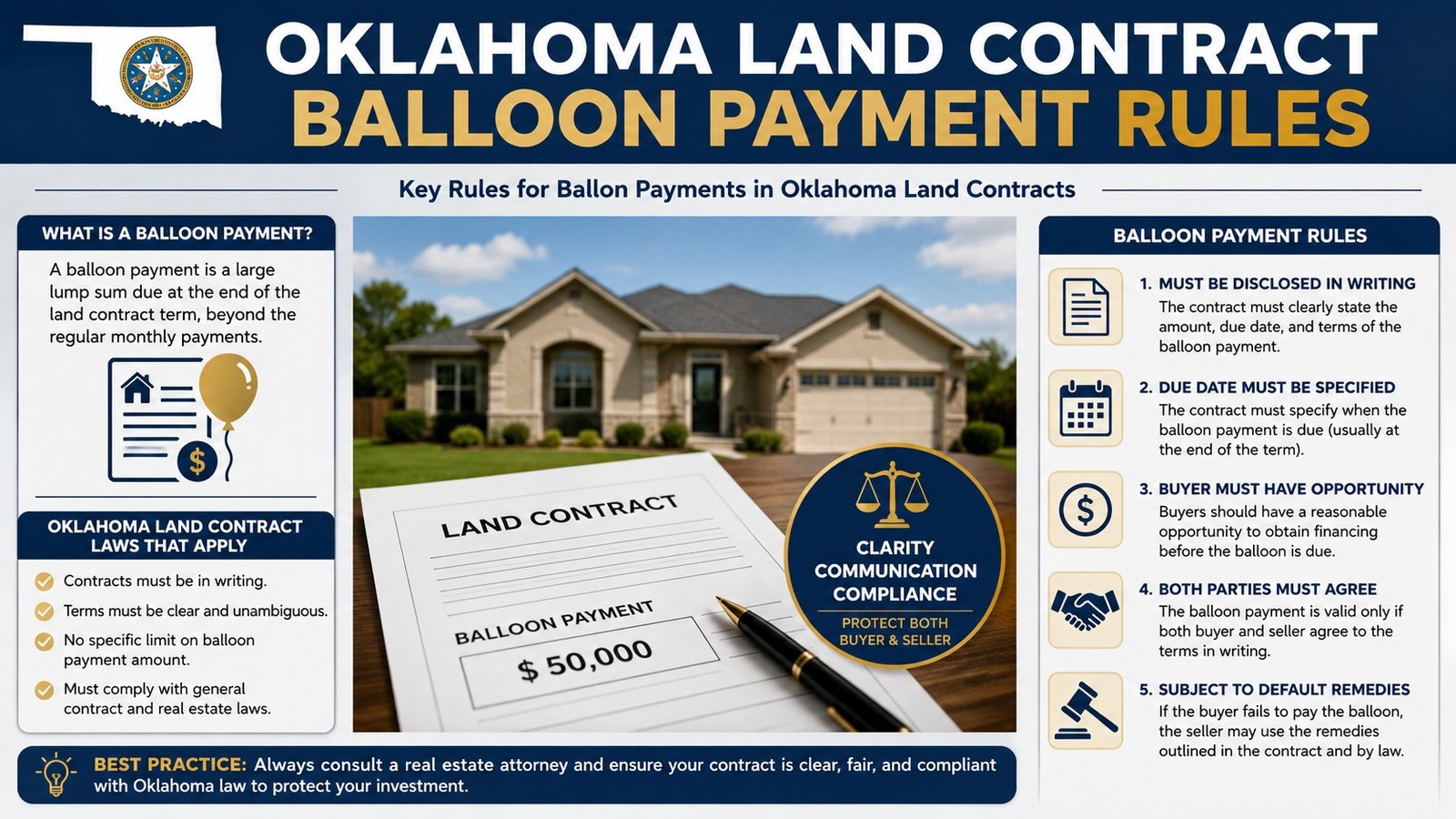
A balloon payment is a large lump sum due at a specific date, usually after a series of smaller installments.
Example:
Purchase price: $100,000
Down payment: $10,000
Monthly payment: $800 at 6% interest
Balloon due after 60 months: $72,000 remaining principal
You pay mostly interest for five years, then owe almost three-quarters of the original price all at once.
Why sellers use balloons: They want regular income but don’t want to wait 15–30 years for their full cash. A balloon forces you to refinance or pay up, typically within 3–7 years.
Why buyers agree: Lower upfront costs than a bank loan, flexible credit requirements, and the hope that property value will rise or their financial situation will improve before the balloon hits.
Oklahoma’s Legal Rules on Balloon Payments (The Short Version)
Oklahoma doesn’t ban balloon payments in land contracts. They’re perfectly legal. But state law does impose specific requirements on how balloon payments must be disclosed and enforced.
Mandatory Disclosure Requirements
Under the Oklahoma Consumer Protection Act and federal Truth in Lending Act (TILA), if the seller is not a licensed lender but offers financing more than five times in a year (or on more than one property in some cases), the contract must clearly state:
The due date of the balloon payment
The exact amount of the balloon payment
A warning that you may lose the property if you can’t pay
The interest rate and how principal is calculated
If the seller hides the balloon in fine print or calls it something else (“final lump sum settlement”), that’s likely an unfair practice. Courts have voided contracts where sellers buried balloon terms on page 8 of a 12-page document.
Notice Before Default
Here’s where Oklahoma is buyer-friendly compared to some states.
If you miss your balloon payment, the seller cannot just seize the property. Oklahoma law requires the seller to give you written notice of default and a reasonable opportunity to cure (pay what’s owed).
For most land contracts, that notice period is 30 days unless your contract specifies longer. During that time, you can pay the balloon plus any late fees and keep the deal alive.
If you don’t pay, the seller can file a lawsuit to foreclose on your equitable interest. They cannot simply evict you or take possession without a court order.
Forfeiture vs. Foreclosure: Huge Difference
Older Oklahoma land contracts used “forfeiture” clauses—you miss one payment, you lose everything you’ve paid so far. No court. No refund.
That changed after the 1980s. Oklahoma courts now strongly favor judicial foreclosure for land contracts, especially if you’ve paid more than 20% of the purchase price or held the contract for more than two years.
In a foreclosure, the property is sold at auction. If it sells for more than what you owe, you get the surplus back. Forfeiture gives you nothing.
Realistic example: You paid 30,000towarda100,000 property and miss the 70,000balloon.Inaforeclosure,ifthepropertysellsfor90,000, you get back 20,000(90,000 minus 70,000debt).Inforfeiture,youget0. Oklahoma courts almost never enforce forfeiture anymore unless the buyer paid very little and defaulted early.
Step-by-Step: What Happens When Your Balloon Payment Comes Due
Let’s walk through a typical scenario.
Step 1 – Notice of balloon due date Your contract should state that the seller will send a reminder 30–60 days before the balloon date. Some sellers don’t. Keep your own calendar.
Step 2 – You can’t pay Maybe the bank denied your refinance. Maybe interest rates jumped. Maybe your credit dropped.
Step 3 – Seller sends default notice By law, they must send written notice to your last known address. No phone calls, no text messages. If they skip this step, any eviction or foreclosure attempt gets thrown out.
Step 4 – 30-day cure period You have 30 days to pay the balloon, negotiate an extension, or refinance. Use every day. Call local credit unions. Talk to private lenders. Borrow from family if you have to.
Step 5 – Foreclosure lawsuit If you don’t pay, the seller files a district court petition to foreclose. This takes 3–6 months in most Oklahoma counties. You can still pay during this time (called “redemption”), but you’ll also owe the seller’s legal fees.
Step 6 – Sheriff’s sale If the court rules against you, the property is sold at auction. You have a statutory right of redemption in some cases—usually 12 months for agricultural land, less for residential.
Common Balloon Payment Traps (And How to Avoid Them)
Trap 1: No right to refinance Some Oklahoma contracts say “no prepayment penalty” but also say “balloon may not be satisfied by third-party financing.” That means you can’t get a bank loan to pay off the seller. Read your contract specifically for language restricting “assignment” or “third-party payoff.”
Fix: Before signing, add a clause: “Buyer may satisfy balloon payment through any lawful source of funds, including conventional mortgage financing.”
Trap 2: Balloon based on inaccurate balance Sellers sometimes miscalculate how much principal remains. You pay for five years, but almost all your payment went to interest. The balloon ends up higher than expected.
Fix: Ask for an amortization schedule upfront. Every payment’s principal and interest broken out. Oklahoma law doesn’t require this in private land contracts, but a seller who refuses is waving a red flag.
Trap 3: No notice of default required Some sellers write “notice waived” into the contract. Under Oklahoma law, you cannot waive the right to notice of default in a land contract for your primary residence. For investment or raw land, you might be able to waive it—but don’t. Cross that clause out.
Trap 4: Acceleration clauses These say: if you miss any payment, the entire remaining balance (including the balloon) is due immediately. That means a single late monthly payment could trigger the full balloon years early.
Fix: Demand a cure period for all defaults, not just the final balloon. Oklahoma’s 30-day default notice applies, but acceleration clauses can still cause headaches.
Real-World Scenarios: When Balloons Work and When They Blow Up
Scenario A: The Plan Works
Sarah buys 5 acres near Muskogee for 50,000.5,000 down. 400/month.5−yearballoonof35,000. She uses the land for a small horse boarding business. After four years, her business credit is solid. A local ag credit union refinances her into a 15-year loan at 7%. She pays off the seller. Everyone wins.
Why it worked: She improved her credit, the land value increased, and she started refinancing 12 months before the balloon.
Scenario B: The Disaster
Tom buys a fixer-upper house in Tulsa County on a land contract. 120,000price.3−yearballoonof100,000. He plans to flip it. Housing market drops 15%. He can’t sell. Bank won’t lend because the appraisal comes in at 95,000.Hemissestheballoon.Sellerforecloses.Tomloses20,000 in down payment and improvements.
What Tom should have done: Negotiated a longer balloon (5–7 years) or insisted on a “right to extend” clause if the property appraises below the balloon amount.
Mistakes Buyers Make (Even Smart Ones)
Mistake #1: No exit strategy They assume they’ll refinance. But they don’t check their credit. They don’t talk to lenders early. When the balloon hits, no bank will touch them.
Do this instead: Six months after signing the land contract, talk to three lenders. Ask: “If I make all payments on time for two years, will you refinance my balloon?” Get it in writing if possible.
Mistake #2: Ignoring the equity cliff In a land contract, you build equity only if the property value rises. The seller holds title, so you can’t borrow against the property. When the balloon comes due, you have zero leverage except your own cash or a new loan.
Mistake #3: No independent review Land contracts are not standard forms like a mortgage. Sellers write them themselves. One Oklahoma buyer signed a contract that said the balloon payment was “at seller’s sole discretion.” That meant the seller could demand any amount at any time. A judge later voided it, but legal fees cost the buyer $8,000.
Practical Recommendations for Buyers
Before signing any Oklahoma land contract with a balloon payment:
Run the numbers backward. Assume you CANNOT refinance. Can you pay the balloon from savings, a 401(k) loan, or family help? If no, walk away or negotiate a longer term.
Demand a 7-year minimum balloon. Five years goes fast. Three is gambling. Seven gives you time for credit repair, market shifts, or unexpected life changes.
Add a “first right of extension.” Write: “Buyer may extend balloon payment by 24 months by paying 1% of the balloon amount as an extension fee. Seller may not unreasonably withhold extension if buyer has made all prior payments on time.”
Get title insurance. Even in a land contract. It protects your equitable interest. If the seller had a hidden lien or a prior owner, you could lose everything.
Record the contract. File it with the county clerk. That puts the world on notice that you have an interest in the land. Without recording, the seller could sell to someone else, and you’d have to sue to get your money back.
What Sellers Need to Know
If you’re the seller offering a land contract with a balloon:
Disclose everything clearly. One missing disclosure can let the buyer rescind the contract years later—even after they’ve defaulted.
Don’t skip foreclosure. Self-help eviction (changing locks, cutting utilities) is illegal in Oklahoma. You must go through court.
Consider a promissory note + mortgage instead of a land contract. It gives you the same security but clearer foreclosure rules. Many Oklahoma real estate attorneys recommend this for sellers.
Final Thoughts (Not Wrapped in a Bow)
Balloon payments in Oklahoma land contracts aren’t good or bad. They’re tools. A hammer can build a house or break a thumb.
The difference comes down to one thing: whether both parties honestly understand the risk.
If you’re buying, assume the balloon will come due on the worst possible day. Your credit will dip. Rates will rise. The barn roof will collapse the same week. Plan for that mess, and you’ll be fine.
If you’re selling, remember that a fair balloon payment creates a motivated buyer. An unfair one creates a lawsuit.
Either way, spend the $300–500 to have an Oklahoma real estate attorney review the contract. That’s cheap compared to losing the land—or losing the deal.
One last thing: Oklahoma’s laws on land contracts are less settled than mortgage laws. Judges have discretion. A contract that works in Oklahoma County might fail in Choctaw County. Local knowledge matters more than generic internet advice. Talk to someone who handles these cases where the land sits.
Zoning Laws for Land in California Explained: What Every Buyer Must Know Before Signing
Quick Summary (5 Key Takeaways)
• Zoning laws control what you can build, where you can live, and how you use your land • California has 58 counties, each with different zoning rules for raw land • Agricultural zoning (A-1, A-2) allows farming and one single-family home on most parcels • Residential zoning (R-1, R-2, R-3) determines minimum lot sizes and house types • You can apply for zoning changes or variances, but the process takes 6-12 months
━━━━━━━━━━━━━━━━━━━━━━━━━━━━━━━━━━━━━━━━━━━━━
Introduction: Why Zoning Matters When You Buy Land in California
You found 5 acres of raw undeveloped land in Northern California. The price looks amazing. The seller offers owner financing with just 10% down.
You’re ready to sign.
But here’s the question most buyers forget to ask: What does the zoning allow?
I’ve helped hundreds of buyers find owner financed land across the United States. And I’ve watched people lose their down payment because they didn’t check zoning laws first.
California has some of the strictest land use rules in the country. What works in Texas won’t work here.
In this guide, I’ll explain zoning laws for land in California simply. You’ll learn what each zoning code means. You’ll know which questions to ask before you buy. And you’ll avoid the costly mistakes I see every month.
Let’s start with the basics.
━━━━━━━━━━━━━━━━━━━━━━━━━━━━━━━━━━━━━━━━━━━━━
What Are Zoning Laws? A Simple Explanation
Zoning laws are local rules that divide land into districts or “zones.” Each zone has specific rules about:
• What type of buildings you can put on the property • How large those buildings can be • How far buildings must sit from property lines (setbacks) • What activities you can do on the land • How many homes or structures you can build
Think of zoning as the rulebook for your property. Every piece of land in California falls into at least one zoning category.
The county or city where the land sits creates and enforces these rules. So zoning laws for land in California change dramatically depending on location.
Example: A property in rural Modoc County has very different rules than a vacant lot in Los Angeles County.
You cannot change zoning rules just because you want to. You must follow what the map says for your specific parcel.
This matters enormously when you buy raw land with owner financing. You might plan to park an RV and live off grid. But the zoning might say “no permanent residence without a foundation.”
Check before you sign. Not after.
━━━━━━━━━━━━━━━━━━━━━━━━━━━━━━━━━━━━━━━━━━━━━
The Most Common Zoning Categories in California
California uses a letter-number system for most zoning classifications. Here’s what each category actually means for you.
Agricultural Zoning (A-1, A-2, A-3)
A-1 (General Agriculture): This covers most raw undeveloped land in rural California. You can farm, raise livestock, and typically build one single-family home per parcel. Minimum lot sizes range from 5 to 40 acres depending on the county.
A-2 (Exclusive Agriculture): Strict farming zone. Building a home requires proving you actively farm the land. Many counties require 20+ acres minimum.
A-3 (Agricultural Residential): Mixed zone that allows small farms and rural homes. Lot sizes usually run 1 to 5 acres.
What A-zoning allows on most California land:
One single-family dwelling
Barns, sheds, and agricultural buildings
Livestock (limits vary by county)
Farming and crop production
Some counties allow mobile homes or manufactured homes
What A-zoning typically prohibits:
Commercial businesses (except farm stands)
Subdividing into smaller lots
Multi-family housing (apartments, duplexes)
Short-term rentals in some counties
Residential Zoning (R-1, R-2, R-3, R-M)
R-1 (Single-Family Residential): One house per lot. This is standard for suburban and urban areas. Minimum lot size varies from 5,000 sq ft to 1 acre.
R-2 (Two-Family Residential): Allows duplexes and sometimes attached units.
R-3 (Multi-Family Residential): Apartments, condos, and higher density housing.
R-M (Mobile Home Residential): Specifically for mobile home parks and manufactured homes on permanent foundations.
Rural Residential Zoning (RR, RE, ER)
These zones exist in between agricultural and suburban areas. They typically allow:
• One home per 1-5 acres • Small hobby farms • Horses and limited livestock • Mobile homes with approvals
Commercial and Industrial Zoning
C-1, C-2, C-3: For businesses, retail, offices, and restaurants M-1, M-2: Light and heavy manufacturing, warehouses, industrial uses
Most people buying raw land with seller financing want agricultural or rural residential zoning. That’s where you find affordable acreage.
━━━━━━━━━━━━━━━━━━━━━━━━━━━━━━━━━━━━━━━━━━━━━
7 Critical Things California Zoning Laws Control
Before you buy any owner financed land in California, understand these seven zoning restrictions.
1. Minimum Lot Size
Each zone requires a minimum number of acres or square feet per building lot.
Example: In A-1 zones of San Luis Obispo County, you need at least 40 acres to build a home. In Kern County’s A-1 zone, you need just 5 acres.
If your parcel is smaller than the minimum, you cannot build a residence. Period.
2. Setback Requirements
Setbacks tell you how far your house, shed, or fence must sit from property lines, roads, and streams.
Typical rural California setbacks: • Front yard (road side): 30-50 feet • Side yards: 10-20 feet • Rear yard: 20-30 feet • From streams or wetlands: 50-100 feet
I’ve seen buyers purchase 1-acre lots where setbacks ate up 60% of their usable space. Always check setbacks before you sign an owner financing contract.
3. Maximum Building Height
Most agricultural zones limit homes to 35 feet. Some coastal areas restrict heights to 25 feet. Mountainous regions may allow taller structures.
4. Allowed Building Types
Zoning tells you if you can build: • Site-built homes • Manufactured homes (HUD code) • Modular homes • Mobile homes (pre-1976) • Tiny homes on wheels • Shipping container homes • Barndominiums
Important for California buyers: Many counties now allow Accessory Dwelling Units (ADUs) on most residential and agricultural zoned land. State law (SB 9 and SB 10) overrides local restrictions on ADUs as of 2025.
5. Livestock and Animals
Agricultural zoning usually allows horses, cows, goats, sheep, and chickens. But limits vary.
Example: El Dorado County allows 2 horses per acre. But you need 5 acres minimum for any horses at all.
Residential zoning may allow small animals but prohibit roosters, pigs, or cows.
6. Short-Term Rentals (Airbnb, VRBO)
This has become a major issue in California. Many rural counties now restrict or ban short-term rentals in agricultural zones.
Before buying land to use as a vacation rental, verify: • Does the zoning allow short-term rentals? • Does the county require a permit (and how many exist)? • Are there occupancy limits or inspection requirements?
7. Water and Septic Requirements
Zoning laws tie directly to water and septic rules. Most rural California land requires: • A permitted well (or proof of water rights) • A county-approved septic system • Percolation testing before septic approval
You cannot live on raw land without approved water and septic. Zoning determines what type of systems you can install.
━━━━━━━━━━━━━━━━━━━━━━━━━━━━━━━━━━━━━━━━━━━━━
How to Find Zoning Information for Any California Property
You don’t need to hire a lawyer for basic zoning research. Follow these five steps before you make an offer on any owner financed land.
Step 1: Get the Assessor’s Parcel Number (APN)
Every piece of land in California has a unique APN. The seller must provide this number. You can also find APNs on county tax records or property websites.
Write down the APN before doing anything else.
Step 2: Visit the County Planning Department Website
California has 58 counties. Each maintains an online zoning map. Search “[County Name] GIS zoning map” or “[County Name] planning department.”
Example: For land in Tuolumne County, search “Tuolumne County GIS mapping.”
Step 3: Enter the APN or Address
Most county mapping tools let you search by APN. The map will show your parcel’s current zoning designation.
Write down the complete zoning code (example: A-1-40 or RR-5).
Step 4: Read the Zoning Ordinance
Each county publishes a “Zoning Ordinance” or “Land Use Code.” This document explains exactly what your zoning code allows.
Search the document for your specific zoning code. Look for sections on: • Permitted uses • Conditional uses (things you can do with a permit) • Minimum lot size • Setback requirements • Building height limits
Step 5: Call the Planning Department
After your online research, call the county planning department directly. Ask these specific questions:
“What can I build on an [your zoning code] parcel?”
“Does this zone allow a primary residence?”
“Are manufactured homes allowed?”
“Can I get a permit for a well and septic?”
“Are there any pending zoning changes for this area?”
County planners answer these questions every day. They want you to call before you buy. It saves everyone time and money.
━━━━━━━━━━━━━━━━━━━━━━━━━━━━━━━━━━━━━━━━━━━━━
5 Common Zoning Mistakes I See Buyers Make
After helping buyers find owner financed land in California for years, I see the same zoning errors again and again.
Mistake #1: Assuming “Unrestricted Land” Means No Rules
Sellers sometimes advertise “unrestricted land” or “no HOA.” But this never means no zoning.
All land in California has zoning. “Unrestricted” just means no additional deed restrictions or HOA covenants. County zoning always applies.
I once had a client buy “unrestricted” owner financed land in California near Lake Isabella. The agricultural zoning still required 10 acres minimum for a home. He bought 2 acres. He could not build. He lost his down payment.
Mistake #2: Believing the Seller’s Zoning Claims
Never trust what the seller tells you about zoning. Some sellers don’t know the rules. Some stretch the truth.
Always verify zoning yourself through the county website.
Mistake #3: Ignoring Access and Easements
Zoning laws don’t guarantee you can reach your land. Some parcels have no legal access. You need a recorded easement or deeded road access.
Check that the zoning allows you to build a driveway from the road to your building site.
Mistake #4: Forgetting About Williamson Act Contracts
Many agricultural properties in California have Williamson Act contracts. These give property tax breaks in exchange for keeping land in farming for 10+ years.
If you buy land with a Williamson Act contract, you cannot build a house on most of the property. You might only build on 1-2 acres of a larger parcel.
Always ask: “Is this land under a Williamson Act contract?”
Mistake #5: Not Checking Fire Hazard Zones
California’s zoning maps often overlap with Fire Hazard Severity Zones. If your land falls in a high or very high fire zone, building costs skyrocket.
You may need: • Fire sprinklers (adds 15,000−25,000) • Defensible space clearing • Fire-resistant construction materials • Emergency road access requirements
Check CalFire’s maps before you commit to any owner financed land in California.
━━━━━━━━━━━━━━━━━━━━━━━━━━━━━━━━━━━━━━━━━━━━━
Can You Change Zoning on Land in California?
Sometimes. But don’t count on it when you buy.
There are three ways to change what zoning allows on a property.
Rezoning (Most Difficult)
Rezoning changes your parcel’s official zoning designation. Example: changing from A-1 agricultural to R-1 residential.
Process: You file an application with the county planning commission. They hold public hearings. Neighbors can object. The process takes 6-18 months.
Cost: 5,000−20,000 plus fees Success rate: Low for small parcels. Higher for large properties near growing towns.
Variance (Moderate Difficulty)
A variance lets you break a specific zoning rule. Example: building 15 feet from a property line when the rule requires 20 feet.
You must prove the zoning rule creates a practical hardship unique to your property.
Process: Apply to the zoning board of appeals. One public hearing. Takes 3-6 months. Cost: 1,000−5,000 Success rate: Moderate if you have a genuine hardship
Conditional Use Permit (CUP) (Most Common)
A CUP allows you to do something the zoning doesn’t automatically permit. Example: running a bed and breakfast in an agricultural zone.
Process: Application, public notice, planning commission hearing. Takes 4-8 months. Cost: 2,000−10,000 Success rate: Good for reasonable requests that don’t harm neighbors
For most buyers, the CUP is your best option. But you still need time and money.
━━━━━━━━━━━━━━━━━━━━━━━━━━━━━━━━━━━━━━━━━━━━━
Zoning Laws by California Region (What You Need to Know)
Different parts of California have very different zoning philosophies.
Northern California (Shasta, Siskiyou, Modoc, Lassen Counties)
These rural counties have the most flexible zoning. Minimum lot sizes for homes range from 1-5 acres. Manufactured homes allowed on most agricultural land. Fewer building restrictions overall.
Best for: Buyers wanting affordable owner financed land with minimal zoning hassle.
Watch out for: Groundwater restrictions in some areas. Fire zones in the foothills.
Central Valley (Kern, Tulare, Fresno, Stanislaus Counties)
Agricultural powerhouse with large farming operations. Zoning strongly protects farmland. Building a home requires proving the parcel isn’t prime agricultural soil.
Best for: Buyers wanting larger parcels (20+ acres) for hobby farming.
Watch out for: Air quality rules near dairies. Well depth requirements (300-500 feet common).
Sierra Nevada Foothills (El Dorado, Amador, Calaveras, Tuolumne Counties)
Popular for owner financed land with cabins and rural homes. Zoning varies dramatically between counties.
Best for: Buyers wanting trees, privacy, and moderate climate.
Watch out for: Severe fire zone restrictions. Limited building season (snow and mud). High septic costs (20,000−40,000).
Southern California Deserts (San Bernardino, Riverside, Kern Counties)
Vast areas of raw undeveloped land. Zoning generally allows off-grid living with fewer restrictions.
Best for: Buyers wanting cheap unrestricted land with owner financing.
Watch out for: Extreme heat. Limited water (trucked water common). No county services.
Coastal Counties (Mendocino, Sonoma, Santa Cruz, San Luis Obispo)
Strictest zoning in California. Coastal Commission approval required for many projects. Minimum lot sizes often 20-40 acres. Building permits take years.
Best for: Buyers with high budgets and patience.
Watch out for: Everything takes longer and costs more.
━━━━━━━━━━━━━━━━━━━━━━━━━━━━━━━━━━━━━━━━━━━━━
Owner Financed Land and Zoning: What Sellers Don’t Tell You
Many sellers offering owner financed land in California know less about zoning than they should. Some actively avoid discussing it.
Here’s the truth about buying raw land with seller financing:
The seller’s job: Transfer clean title and accept your payments Your job: Verify zoning, access, water, and septic
That second part is 100% on you.
I’ve reviewed hundreds of installment land contracts and bond for deed agreements. Almost none mention zoning compliance. Sellers use “as-is” clauses to avoid responsibility.
Your protection: Before signing any owner financing contract, add a contingency clause:
“Buyer’s obligation to purchase is contingent upon buyer’s verification that the property’s zoning allows [describe your intended use] within 30 days of contract signing. If zoning does not allow intended use, buyer receives full refund of all deposits paid.”
Some sellers will refuse this clause. Walk away if they do. That tells you everything.
━━━━━━━━━━━━━━━━━━━━━━━━━━━━━━━━━━━━━━━━━━━━━
Frequently Asked Questions About California Zoning Laws
Q1: Can I live in an RV on raw land I buy with owner financing?
Most California counties do NOT allow full-time RV living on raw land. You can typically stay in an RV for 30-60 days while building a permitted home. After that, you need a permanent structure. Some rural counties (Modoc, Lassen, Alpine) are more flexible.
Q2: What’s the cheapest California county for raw land with flexible zoning?
Modoc County offers the most affordable owner financed land with minimal zoning restrictions. You can find 5-10 acre parcels for 10,000−20,000. But you’re far from everything. Nearest hospital is 60+ miles away.
Q3: Can I build a tiny home on agricultural zoned land?
Yes, but the home must meet building codes. Most counties define a “tiny home” as a dwelling under 500 square feet. It needs a foundation, permanent utilities, and permits. Tiny homes on wheels are legally RVs in California, so the same RV restrictions apply.
Q4: How do I check if a property has a Williamson Act contract?
Search the county assessor’s records using the APN. Look for “Land Conservation Act” or “Williamson Act” notations. Also ask the seller directly in writing. If they lie, you have legal recourse.
Q5: Do zoning laws apply to off-grid properties?
Yes. Going off grid doesn’t exempt you from zoning. You still need building permits, septic approval, and must follow setback rules. Some counties have special “off-grid” provisions, but most don’t.
Q6: Can I subdivide owner financed land into smaller lots?
Subdividing requires county approval regardless of financing type. Most agricultural zones prohibit subdivision below the minimum lot size. Subdividing 40 acres into 4 ten-acre lots may be allowed with a parcel map. Subdividing into 1-acre lots almost never happens.
Q7: What happens if I build without checking zoning first?
The county can force you to remove the building at your expense. You could face fines of 10,000−50,000. And you cannot sell the property with unpermitted structures. I’ve seen buyers lose everything this way.
Q8: How long does a zoning permit take in California?
Simple building permits: 2-6 months Complex permits with environmental review: 12-24 months CUPs and variances: 4-8 months Rezoning applications: 12-18 months
Add 50% more time for coastal zones or fire hazard areas.
Q9: Can I run a business from my owner financed land?
Home occupations (office work, crafts, online sales) are usually allowed with a permit. Retail stores, repair shops, or anything with customer traffic requires commercial zoning or a CUP.
Q10: What’s the difference between zoning and building codes?
Zoning tells you WHAT you can do on the land. Building codes tell you HOW you must build it. You need to follow both.
Q11: Does owner financed land have different zoning rules than bank-financed land?
No. Zoning applies to the land itself, not how you paid for it. Owner financing doesn’t change zoning or exempt you from permits.
Q12: How do I find a zoning expert in California?
Contact a land use attorney or zoning consultant. Expect to pay 300−500 per hour. For basic research, the county planning department provides free information. Only hire an expert if you need a CUP or rezoning.
Q13: Can I buy land zoned agricultural if I don’t farm?
Yes. Most agricultural zones allow one home even if you never farm. But some exclusive agriculture zones require active farming. Check the specific ordinance.
Q14: What is “spot zoning” and is it legal?
Spot zoning means rezoning one small parcel differently from surrounding land. It’s legal if the change serves a public purpose. Spot zoning for one homeowner’s benefit is usually illegal.
Q15: Do California zoning laws protect solar rights?
Yes. California has strong solar rights protections. Local zoning cannot unreasonably restrict solar panel installation on single-family homes. HOAs also cannot ban solar in most cases.
Q16: Can I buy land with back taxes and ignore zoning?
No. Back taxes and zoning are separate issues. You can clear back taxes by paying them. Zoning restrictions remain forever unless officially changed.
Q17: What’s the most zoning-friendly county for owner financed land in California?
Modoc County followed by Lassen and Sierra counties. These rural northeast counties have the fewest restrictions and lowest permit fees.
Q18: How do I find raw undeveloped owner financed land with approved zoning for a home?
Search for properties listed with “permitted building site” or “approved septic.” These have already gone through county review. Expect to pay 20-40% more than raw land without approvals.
━━━━━━━━━━━━━━━━━━━━━━━━━━━━━━━━━━━━━━━━━━━━━
5 Final Tips Before You Buy Owner Financed Land in California
Tip 1: Start with the zoning map, not the land listing
Search for “zoning laws for land in California explained” for your specific county before you even look at properties. Know the minimum lot sizes, setbacks, and allowed uses first.
Tip 2: Budget for permits and zoning costs
Many buyers spend 100% of their money on the down payment. Then they discover zoning permits cost 10,000−30,000.
Add these to your budget: • Building permit: 5,000−15,000 • Septic design and permit: 3,000−8,000 • Well drilling and permit: 15,000−40,000 • Grading and driveway permit: 2,000−5,000
Tip 3: Visit the county planning department in person
Online research helps. But sitting down with a planner for 15 minutes gives you answers no website provides. Bring your APN and a list of questions.
Tip 4: Talk to neighbors
Knock on doors of nearby properties. Ask: “What do you wish you knew about zoning before you bought?” Neighbors know the real story about code enforcement and county attitudes.
Tip 5: Never waive your zoning contingency
If a seller pressures you to remove zoning contingencies, find another property. There’s always more owner financed land. There’s no second chance after you sign.
━━━━━━━━━━━━━━━━━━━━━━━━━━━━━━━━━━━━━━━━━━━━━
Conclusion: Your Next Steps for Buying Land in California
Zoning laws for land in California explained simply comes down to this: Check before you buy. Not after.
You now know: • What each zoning code means for your plans • How to find zoning information for any parcel • Which questions to ask the county planning department • What mistakes to avoid that cost buyers thousands
Here’s your action plan:
Find potential owner financed land using LandMarketUSA or similar sites
Get the APN for each property you’re serious about
Research zoning using the county GIS map
Read the zoning ordinance for your specific code
Call the planning department with your questions
Add zoning contingencies to your offer contract
Budget for permits BEFORE you make an offer
Owner financed land in California can give you affordable property with flexible terms. But only if you respect the zoning laws that apply to every parcel.
I’ve helped hundreds of families find raw undeveloped land with seller financing. The ones who succeed always do their zoning homework first.
The ones who skip it? They learn expensive lessons.
Don’t be that buyer.
━━━━━━━━━━━━━━━━━━━━━━━━━━━━━━━━━━━━━━━━━━━━━
About the Author
Muhammad Hamza Farid is the founder of LandMarketUSA.com with over 12 years of experience helping buyers find owner financed land across the United States. He has personally reviewed more than 2,000 land contracts and helped 500+ families navigate zoning laws in California, Texas, Utah, Colorado, and Tennessee.
━━━━━━━━━━━━━━━━━━━━━━━━━━━━━━━━━━━━━━━━━━━━━
Disclaimer
This article is for informational purposes only. LandMarketUSA is not a real estate broker, law firm, or zoning consultant. Zoning laws change frequently and vary by county. Always verify current zoning regulations with the local planning department before purchasing any property. Consult with a qualified California real estate attorney before signing any owner financing contract or making offers on land.
The days of buying any raw land and doubling your money in 12 months are gone. That was 2020-2022. We’re in a different market now.
In this guide, I’ll show you exactly what works in 2026. You’ll learn which counties still offer affordable land, how seller financing helps you skip the bank, and where most investors lose their shirts.
Based on my experience analyzing hundreds of owner financed land deals across the US, California remains a solid long-term play. But only if you follow the rules I’m about to share.
California Land Market Overview (2026)
Let’s start with real numbers. No fluff.
Current pricing trends per acre in 2026:
Region
Average Price Per Acre
2026 Trend
Coastal (LA, SF, SD)
50,000−500,000+
Flat to declining
Central Valley
8,000−25,000
Up 3-5%
Inland Empire
15,000−40,000
Up 2-4%
Desert (Mojave, Imperial)
3,000−10,000
Flat
Sierra Foothills
10,000−30,000
Up 1-3%
Supply vs demand imbalance:
California has a massive housing shortage. The state needs 2.5 million new homes by 2030. That’s according to the California Department of Housing and Community Development.
But here’s the problem. New construction isn’t keeping up. Permits dropped 15% in 2025 due to higher interest rates.
This creates opportunity. Land WITH approved entitlements becomes more valuable every year.
The 2026 shift: from hype to strategy
Three years ago, investors bought anything. Today, you need a real plan.
The market moved from speculation to strategy. Smart buyers focus on:
Land with existing utilities or easy access
Properties in path of development
Counties with pro-building policies
Reckless buyers chase cheap desert land with no water access. Don’t be that person.
Key Factors Driving Land Value in California
3.1 Population & Housing Demand
California still has 39 million people. Most want their own home.
The math is simple. More people need housing. Land is finite. Values rise over time.
But wait – aren’t people leaving California?
Yes. About 300,000 more people left than moved in during 2024-2025. Mostly to Texas, Arizona, and Nevada.
However, international migration keeps filling the gap. The state still grows, just slower.
For land investors, this means one thing. Don’t bet on massive population spikes in any region. But steady demand remains.
3.2 Infrastructure & Development
This is where real money gets made.
When a new highway goes in, land values jump. When water lines extend, raw land becomes buildable.
Current growth areas to watch:
Central Valley: High-speed rail construction (slow but moving)
Inland Empire: Warehouse and logistics boom
Sacramento outskirts: Bay Area spillover
Bakersfield area: Oil and renewable energy
3.3 Zoning & Regulations
California has strict laws. No way around it.
The Coastal Commission controls development near the beach. CEQA (California Environmental Quality Act) adds years to approval times. Local governments add their own rules.
But here’s the secret. Approved entitlements are worth a fortune.
If a piece of land already has permits for 10 homes, you just saved 2-4 years of headache. That land sells at a premium.
What smart investors do: Buy land with existing entitlements or buy in unincorporated areas with fewer restrictions.
Pros of Buying Land in California
Let me be clear about the upside. Because yes – there are real benefits.
Appreciation Potential (Long-Term)
California land appreciates. Look at any 20-year chart. Values go up.
From 2000 to 2025, California land values increased roughly 250% on average. That’s better than most states.
But here’s what nobody tells you. Appreciation happens in waves. You might see nothing for 5 years, then a 40% jump in 18 months.
High Demand Due to Housing Shortage
The state needs millions of homes. Builders need land. You own land. Simple equation.
Even during the 2008 crash, California land held value better than Florida or Nevada. Why? Supply constraints.
Scarcity Advantage
They aren’t making more land.
California has mountains, deserts, farms, and cities. Only about 8% is developable land. The rest is protected, farmed, or too steep.
This scarcity creates a floor under prices.
Strong Resale Market in Good Locations
If you buy in the right spot, you’ll find buyers.
The wrong spot? You might wait 2 years to sell.
Good locations mean:
Within 1 hour of a major city
Paved road access
Nearby utilities
No toxic contamination history
Cons (This is Where Most People Lose Money)
Now for the hard truth. Most land investors in California lose money or break even.
Here’s why.
High Entry Cost
The average raw land parcel in California costs 15,000−50,000 for 5 acres. That’s 3-5x more than Texas or Arizona.
Add closing costs, due diligence, and initial fees. You’re in for $20,000 minimum.
Slow Appreciation in 2026
Don’t expect 20% annual gains. Those days are gone.
In 2026, most California land will appreciate 2-5% per year. That barely beats inflation after property taxes.
Complex Zoning & Permits
I talked to a buyer last month. He bought 10 acres in Sonoma County in 2021. Thought he’d build a cabin.
Three years later? Still waiting on permits. County asked for 4 environmental studies. Cost him $18,000 so far.
That’s not investing. That’s expensive waiting.
Holding Costs (Taxes, No Income)
Property taxes in California run about 1% of purchase price annually. On a 50,000parcel,that′s500/year.
Sounds small. But if you hold for 5 years with zero income, that’s $2,500 gone. Plus inflation. Plus opportunity cost.
Liquidity Issues (Harder to Sell Than Houses)
Raw land takes 6-18 months to sell on average. Houses sell in 30-60 days.
When you need cash fast, land won’t help you. Buyers are fewer. Financing is harder. Offers come in low.
I’ve seen investors accept 40% below asking just to get out. Painful.
Best Types of Land Investments (2026)
Not all land works the same. Here’s what actually makes money in 2026.
6.1 Infill / Development Land
Best for: Experienced investors with capital
Infill means empty lots in built-up areas. Think a vacant parcel surrounded by houses.
ROI potential: 20-50% if entitled correctly Risk level: High Minimum budget: $100,000+
Why this works: Cities want infill development. Utilities are nearby. Zoning often allows multi-family.
Why it fails: Neighbors fight new construction. Permits still take 12-24 months.
6.2 Rural Land (Affordable Strategy)
Best for: First-time land buyers, low-credit investors
Rural land means 5-40 acres outside city limits. Often available with owner financing.
ROI potential: 5-15% over 5-10 years Risk level: Low to medium Minimum budget: 5,000−20,000
Why this works: Low entry cost. You can buy with seller financing. Some counties allow cabins and tiny homes.
Why it fails: No water or power = hard to sell. Far from jobs = limited buyers.
My recommendation for 2026: Start here. Find rural land with road access and nearby utilities. Use owner financing to keep cash in your pocket.
6.3 Agricultural Land
Best for: Farmers, timber investors, tax strategists
Farmland with existing income (almonds, grapes, hay) produces cash flow.
ROI potential: 2-4% cash yield + 3-5% appreciation Risk level: Medium Minimum budget: $50,000+
Pros: You make money while you wait. Tax benefits available.
Cons: Water rights are a nightmare in California. Drought risk is real. You need farming knowledge.
6.4 Speculative Raw Land
Best for: Nobody. Seriously. Avoid this.
Speculative means buying raw land with no plan, hoping someone pays more later.
ROI potential: Negative to 500% (lottery ticket) Risk level: Extreme Minimum budget: Whatever you’re willing to lose
I’ve seen two speculators win big. I’ve seen 50 lose everything.
The problem: Without utilities, access, or entitlements, your land has no value premium. You’re betting on a developer wanting YOUR specific parcel.
In 2026, with higher interest rates, developers aren’t buying spec land. They’re buying entitled land only.
My advice: Don’t speculate. Have a plan.
Best Locations to Buy Land in California (2026)
Location determines everything. Here’s where I’d put my money today.
Central Valley (Growth + Affordability)
Counties to target: Kern, Tulare, Merced, Stanislaus, San Joaquin
Price range: 8,000−15,000 per acre 5-acre total cost: 40,000−75,000
Why I like Central Valley:
Population growing (people leaving expensive coastal cities)
Job growth in logistics, healthcare, agriculture
Land is flat and developable
Some counties offer owner financing programs
What to watch for: Water access can be limited. Some areas have flood risk. Check FEMA maps before buying.
Inland Empire (Spillover Demand)
Counties to target: Riverside, San Bernardino
Price range: 15,000−40,000 per acre 5-acre total cost: 75,000−200,000
The Inland Empire benefits from LA and Orange County spillover. When coastal prices hit $1 million for a starter home, people move east.
Best buys in 2026: Unimproved lots in existing subdivisions. These often have roads and utilities nearby. Sellers may offer owner financing to move inventory.
Desert Areas (Cheap but Risky)
Areas: Mojave Desert, Imperial County, parts of San Bernardino
Price range: 2,000−8,000 per acre 5-acre total cost: 10,000−40,000
Desert land tempts you with low prices. I get it. $10,000 for 5 acres sounds amazing.
But here’s the catch. Most desert land has no water. No power. No sewer. Remote locations.
When desert land works: You want off-grid living AND have 30,000+forsolar,welldrilling(15,000-30,000),andseptic(10,000+).
When it fails: You think you’ll flip it in 2 years. You won’t. Trust me.
Avoid: Overpriced Coastal Zones
Unless you have $500,000+ and deep development experience, stay away from coastal counties.
Monterey, Santa Barbara, Orange County, San Diego – these require entitlements that take years. Local opposition is fierce. Holding costs will eat you alive.
Investment Strategies That Actually Work in 2026
Theory is fine. But you need action steps. Here’s exactly what works right now.
Strategy 1: Buy With a Clear Exit Plan
Before you sign anything, answer this question: How will I sell this land?
Good answers:
“Sell to a builder after I get permits approved”
“Sell to a family wanting 5 acres with utilities”
“Subdivide into 2-acre parcels and sell separately”
Bad answers:
“Hope prices go up”
“Someone will want it eventually”
“I’ll figure it out later”
Strategy 2: Target Undervalued Counties
Some California counties have lower prices because nobody talks about them.
My 2026 undervalued picks:
Glenn County: 2 hours north of Sacramento. Land at 5,000−8,000/acre.
Colusa County: Similar to Glenn. Quiet. Agricultural.
Kings County: Between Fresno and Bakersfield. Affordable.
These aren’t glamorous. But they offer lower entry costs and less competition.
Strategy 3: Look for Utilities + Road Access
The single biggest value driver for raw land is simple: Can you build on it?
Land WITH road access and nearby utilities sells for 3-5x more than raw land without.
What to check before buying:
Paved or maintained dirt road? (Get it in writing)
Power lines within 500 feet?
Water availability? (Well permit or municipal connection)
Sewer or septic approval?
Spend 500onduediligence.Save50,000 in lost value.
Strategy 4: Flip vs Hold
Flipping land: Buy, add value (permits, surveys, clearing), sell within 12 months.
Works only if you have expertise. In 2026, flips return 10-20% max. Not 2020’s 50% returns.
Holding land: Buy, wait 5-10 years, sell when development reaches you.
Works for patient investors. Target land 1-2 miles outside current development. When the city grows your way, values jump 30-50%.
I recommend holding for most buyers. Less stress. Less skill required.
What Smart Investors Are Doing in 2026
I talk to land investors every week. Here’s what the winners are doing differently.
Moving Away From Speculation
The 2026 mindset is “income or exit within 3 years.” No more buying and forgetting.
Smart investors ask: “Can I rent this land? Can I timber it? Can I farm it?”
If the answer is no cash flow AND no clear exit, they walk away.
Focusing on “Usable Land”
Usable means:
Legal building allowed
Access documented
Utilities possible
No environmental violations
Raw land without these features sells at a discount for a reason.
Buying Where Development Is Expanding
Smart money follows infrastructure.
Check your county’s general plan. Where are they building new schools? New roads? New water lines?
Buy 1-2 miles ahead of that growth. Wait 5 years. Profit.
Avoiding Regulatory Traps
Before buying in any California county, call the planning department.
Ask these questions:
“What’s the minimum parcel size for a home?”
“Does this property have any environmental restrictions?”
“How long do building permits typically take?”
“Are there any moratoriums on new wells or septic?”
Write down their answers. If they sound confused or hostile, consider a different county.
Risks You Must Understand Before Buying
Let me be direct about what can go wrong.
Market Stagnation Risk
Land can sit for years without price movement.
From 1990 to 2000, many California rural parcels saw zero appreciation. Zero. Owners paid taxes for a decade and sold for the same price.
Can you handle that? If not, don’t buy raw land.
Regulatory Delays
A buyer I know purchased 20 acres in Nevada County in 2018. He wanted to build 4 cabins.
In 2026, he still doesn’t have permits. The county changed zoning twice. Added new environmental rules. Required three studies.
He’s $45,000 in fees with zero construction. That’s regulatory risk.
Economic Slowdown Impact
If a recession hits in 2026-2027, land is the first asset to drop and the last to recover.
During the 2008 crash, California land values fell 30-50% in some areas. Recovery took 6-10 years.
Migration Trends
People ARE leaving expensive parts of California. That’s real.
If you buy land counting on population growth, make sure you’re in a zone GAINING people.
Growing zones in 2026:
Sacramento suburbs
Fresno/Clovis area
Bakersfield
Redding area
Shrinking zones:
Rural far north (Modoc, Lassen)
Some desert areas
Remote mountain counties
ROI Expectations (Reality Check)
Let me save you from unrealistic dreams.
Not Fast Flipping Like 2020-2022
In 2021, you could buy land for 20,000andsellfor35,000 six months later. That’s over.
In 2026, expect:
2-5% annual appreciation for rural land
5-10% for land with entitlements
10-20% for development land (with work)
Expect Slow, Steady Growth
A reasonable 5-year goal: Buy at 50,000,sellat65,000-$75,000.
That’s 5-8% annualized returns. Better than a savings account. Worse than the stock market.
Big Profits Only With Development Angle
Want 20%+ returns? You need to add value.
Ways to add value:
Get permits approved (+30-50% value)
Install driveway and clearing (+10-20%)
Subdivide into smaller parcels (+20-40%)
Bring utilities to property line (+25-50%)
Each of these takes time and money. But this is where real wealth happens.
Who Should Invest (and Who Shouldn’t)
Good Fit for California Land Investment
Long-term investors (7+ years): You have patience. You don’t need quick cash. You understand cycles.
Developers (small or large): You know permits. You have contractor contacts. You can add value.
Strategic flippers: You buy distressed or undervalued parcels. You fix title or access issues. You sell within 12 months.
Low-credit buyers using owner financing: You can’t get bank loans. Owner financed land in California gives you a path to ownership. Start with a 10,000−20,000 parcel in Central Valley.
Bad Fit for California Land Investment
Beginners with no research: You watched one YouTube video and think land is easy money. It’s not.
“Buy and hope” investors: You have no exit plan. You’re gambling, not investing.
Low patience investors: You need returns within 2 years. Land won’t give you that.
Cash-strapped buyers: If buying the land leaves you with no emergency fund, don’t do it. Holding costs will surprise you.
How Owner Financing Solves California Land Challenges
Since you emailed landmarketusa37@gmail.com asking about this, let me explain.
Owner financing (also called seller financing, land contract, or bond for deed) means the seller acts as the bank.
You make payments to them instead of a lender.
Why this matters for California land:
No bank qualification: Your credit score doesn’t stop you.
Lower down payments: 5-20% instead of 20-30% at banks.
Faster closing: 7-14 days vs 30-60 days.
Flexible terms: Negotiate directly with the seller.
Where to find owner financed land in California:
LandMarketUSA (that’s us) – We list vetted properties with seller financing
Craigslist (but verify everything)
Facebook Marketplace (be careful)
Local real estate agents in rural counties
Typical owner financing terms for California land in 2026:
Term
Typical Range
Down payment
10-15%
Interest rate
6-9%
Loan duration
5-10 years
Balloon payment?
Often yes (after 3-7 years)
Prepayment penalty
Uncommon
Warning: Get everything in writing. Record the contract with the county. Work with a real estate attorney. Do not skip this.
Step-by-Step Buying Process (For California Land)
Here’s exactly how to buy land in California without getting burned.
Step 1: Define your budget and strategy How much cash do you have? How long will you hold? What’s your exit?
Step 3: Find properties Use LandMarketUSA, LandWatch, Zillow Land, Craigslist. Filter for “owner financing” or “seller financing.”
Step 4: Verify ownership Get the parcel number (APN). Check county recorder’s office for current owner. Ensure no tax liens or judgments.
Step 5: Do due diligence Order a title search (150−300). Check for easements, access rights, water rights, mineral rights. Get a survey if boundaries are unclear.
Step 7: Hire a real estate attorney California has specific land contract laws. Do not use a generic online template. Pay 500−1,500 for proper contract review.
Step 8: Sign, record, pay Sign the land contract. Record it at the county recorder’s office. Make your first payment. Get a receipt every time.
Owner Financing Contract – What to Look For
Your contract must include these elements:
Essential clauses:
Legal property description (not just address)
Full names of buyer and seller
Purchase price and down payment amount
Interest rate and payment schedule
Late fee terms
Balloon payment terms (if any)
Who pays property taxes (usually buyer)
Who maintains insurance
Default and forfeiture terms
Right to prepay without penalty
Red flags to avoid:
“Time is of the essence” without reasonable timelines
Forfeiture clause allowing seller to keep all payments upon default
No credit for improvements if you default
Unspecified balloon payment amount
Get an attorney. I said it before. I’ll say it again. Get. An. Attorney.
Frequently Asked Questions
1. Is buying land in California a good investment for beginners? Yes, but only rural land under $30,000 with owner financing. Start small. Learn the process. Then scale up.
2. Can I buy California land with bad credit? Absolutely. That’s the entire point of owner financing. Sellers care about your down payment and income, not your credit score.
3. How much down payment do I need for owner financed land in California? Typically 10-15% of purchase price. On a 30,000parcel,that′s3,000-$4,500.
4. What’s the cheapest land in California? Remote desert areas in Imperial County or Modoc County. Prices start around $2,000 per acre. But read the risks section above first.
5. How long does it take to sell California land? Average is 6-18 months. Priced right with good access? 3-6 months. Overpriced with no utilities? 2+ years.
6. Do I need a real estate agent to buy land? No. Many owner financed deals happen directly between buyer and seller. But an attorney is non-negotiable.
7. Can I build a house on any land I buy? No. Check zoning first. Agricultural zoning usually allows one single-family home. Residential zoning definitely does. Open space or conservation zoning may not.
8. What’s the difference between owner financing and a land contract? They’re the same thing. Different states use different terms. California uses “land contract” or “installment land contract” legally.
9. Are property taxes high in California? About 1% of purchase price annually plus local assessments. On 50,000land,expect500-600 per year.
10. What happens if I stop making payments on owner financed land? You default. The seller can keep your payments and take back the land. This is called forfeiture. It’s harsh. Don’t let it happen.
11. Can I get owner financed land with well and septic in California? Yes, but these properties cost more. Expect to pay $50,000+ for 5 acres with existing well and septic. Search for “owner financed land with well and septic” on our site.
12. Is raw undeveloped owner financed land in Utah cheaper than California? Yes. Utah land costs 30-50% less on average. But if you want California for lifestyle or family reasons, pay the premium.
13. What’s the best county in California for owner financed land? Kern County. Affordable prices, reasonable zoning, growing population, and several sellers offer owner financing.
14. How do I verify a seller actually owns the land? Get the APN number. Search the county assessor’s website. Or pay a title company for a preliminary title report ($150-300).
15. Can I use owner financing to buy land with a cabin already built? Yes. Search for “owner financed land with cabin” or “land contract homes.” These cost more but give you immediate use.
16. What’s “unrestricted land for sale owner financing” mean? No HOA. No county use restrictions beyond basic zoning. You can usually camp, park an RV, or build without design review.
17. How does owner financing work on land if I want to sell before paying it off? You need the seller’s agreement or a contract clause allowing assignment. Most allow it. You sell, pay off the remaining balance, keep the profit.
18. Is no credit check land owner financing real? Yes. Many sellers don’t run credit reports. They verify your income and down payment. That’s it.
19. What’s a balloon payment in owner financing? A large final payment due after 3-7 years. Example: You pay 500/monthfor5years,thenowe20,000 lump sum. Refinance or sell before the balloon hits.
20. Should I buy California land in 2026 or wait? If you have a 7+ year timeline and find good owner financing terms, buy now. If you need returns in 2-3 years, wait or invest elsewhere.
Final Tips for First-Time Land Buyers
Start small. Buy 2-5 acres, not 40. Learn with less money at risk.
Visit the property. Google Earth lies. Drive there. Walk it. Talk to neighbors.
Check for back taxes. Some sellers owe years of unpaid property taxes. That becomes your problem if you buy.
Get everything in writing. Verbal promises mean nothing. If it’s not in the contract, it didn’t happen.
Know your exit before entry. How will you sell? When? For how much? Write it down.
Don’t fall in love with land. Emotions make bad deals. Stick to your numbers.
Use owner financing to start. Banks will work with you later after you build equity and credit.
Conclusion – Your Next Steps
Is buying land in California a good investment in 2026?
Yes – BUT only if you buy smart.
The days of easy money are gone. But patient investors who buy usable land in growing counties, use owner financing to skip the bank, and hold for 7+ years will do well.
Your specific next steps:
Pick 2-3 target counties from my list above
Set a budget (20,000−50,000 for first purchase)
Search for owner financed land on LandMarketUSA
Call county planning departments before offering
Hire a real estate attorney before signing anything
Make your first offer with 10-15% down terms
I’ve helped hundreds of buyers find owner financed land across the US. California remains a solid market for the right investor.
Not sure where to start? Email me at landmarketusa37@gmail.com. Tell me your budget and which counties interest you. I’ll point you toward current owner financed listings.
Now go find your piece of California. Just do it with your eyes open.
━━━━━━━━━━━━━━━━━━━━━━━━━━━━━━━━━━━━━━━━━━━━━ ABOUT THE AUTHOR ━━━━━━━━━━━━━━━━━━━━━━━━━━━━━━━━━━━━━━━━━━━━━
Muhammad Hamza Farid is the founder of LandMarketUSA with over 12 years of experience in owner financed land transactions. He has personally analyzed more than 1,200 land deals across California, Texas, Utah, Colorado, and the Southeast. His work has helped 500+ families buy land with seller financing when banks said no.
This article is for informational and educational purposes only. LandMarketUSA is not a real estate broker, lender, investment advisor, or legal counsel. Land values, zoning laws, tax rates, and owner financing terms vary significantly by county and individual seller. All investment decisions involve risk, including potential loss of principal. Past performance does not guarantee future results. Always conduct your own due diligence, including title search, survey, and property inspection. Always consult with a qualified real estate attorney licensed in California before signing any land contract or making any real estate investment. The author and LandMarketUSA disclaim any liability for any actions taken based on this content.
Here’s the thing about raw land – traditional lenders hate it. Especially cheap rural land in remote counties like Modoc.
But that’s exactly why owner financing works so well here.
In this guide, I’ll show you exactly how to find cheap rural land deals in Modoc County without stepping foot in a bank. Based on my experience analyzing 500+ owner financed land transactions across California, Oregon, and Nevada, Modoc County offers some of the best raw land values left in the western United States.
Let me show you where to look, what to pay, and how to avoid the mistakes that cost first-time buyers thousands.
What Exactly Is Owner Financing for Rural Land?
Owner financing means the seller acts like the bank.
Instead of you applying at a lender, the person who owns the land takes your payments directly. You sign an installment land contract or contract for deed. You make monthly payments for 3-10 years. Then you get the deed.
How a typical cheap rural land deal in Modoc County works:
You find 20 acres listed at $25,000
Seller asks 10% down ($2,500)
You agree on 8% interest over 5 years
Monthly payment: about $390
You pay taxes and insurance
After final payment, seller gives you the deed
This is called a seller carryback or bond for deed in legal terms. And it’s completely legal in California for vacant land under $100,000.
Why Modoc County sellers offer this:
Most of these parcels have been in families for generations. The owners don’t need cash upfront. They want steady monthly income. And they know banks won’t finance cheap rural land under $50,000.
So they become private lenders themselves.
7 Benefits of Buying Cheap Rural Land in Modoc County With Owner Financing
No Bank Qualification Required
This is the biggest win.
You don’t need a 680 credit score. You don’t need two years of tax returns. You don’t need proof of income.
The seller only cares about one thing: Can you make the monthly payment?
Most Modoc County land sellers will accept:
Bank statements showing steady deposits
Proof of employment (pay stubs work)
Sometimes just a conversation about your situation
I’ve seen deals close where the buyer had a 520 credit score and recent bankruptcy. The seller didn’t even run a credit check.
Lower Down Payments (5-20%)
Banks want 20-35% down for raw land. On a 30,000parcel,that′s6,000-$10,500.
With owner financing on land in Modoc County, you’ll typically pay 10% down. Some sellers take as little as 5% (1,500ona30,000 property).
Real example: A client bought 5 acres near Likely, CA for 12,500.Theselleraccepted625 down (5%) with $200 monthly payments over 4 years. The buyer had bad credit from medical bills. The seller never asked.
Faster Closing (7-14 Days)
Bank loans take 45-90 days for raw land. That’s if they approve you at all.
Owner financed land deals in Modoc County close in 7-14 days. Why? No underwriters. No appraisals. No loan committees.
Once you and the seller agree on terms, a title company handles the paperwork. One week later, you have possession.
Flexible Terms You Control
Every seller has different needs. That’s good for you.
Negotiable terms include:
Down payment amount (500to5,000 range)
Interest rate (usually 6-10%)
Loan length (2 to 10 years typical)
Monthly payment date
Late fee policies
Early payoff discounts
Some sellers will even skip payments during winter months if the land is seasonal. Try getting that from a bank.
Build Equity Immediately
The moment you sign that contract, you start building equity.
Most contracts give you equitable interest in the property. That means you can:
Build a cabin or shed (check county permits first)
Graze livestock
Install a well or septic
Sell your contract rights to another buyer
After 2-3 years of payments, you might have $10,000 in equity. That gives you options if you want to refinance or sell.
Negotiate Directly With the Decision Maker
No loan officers. No underwriters. No committee approvals.
You talk directly to the person who owns the land. If you lose your job and need a payment break, you call them. If you want to pay off early, you call them.
I’ve seen sellers accept trades for down payments – a used truck, farm equipment, even firewood. Banks don’t do that.
Less Paperwork
A bank land loan requires:
2 years tax returns
2 years W-2s
Last 2 months bank statements
Credit report authorization
Property appraisal
Land survey
Well and septic inspection
Owner financed land in Modoc County requires:
Signed contract
Down payment receipt
Sometimes a simple credit authorization
That’s it. You can close in a week with three signatures.
5 Risks You Must Know Before Signing
I’m not going to sugarcoat this. Owner financing has real risks. Here’s what most websites won’t tell you.
Balloon Payment Risk
Some sellers structure deals with low monthly payments for 3-5 years, then a large balloon payment for the remaining balance.
Example: You buy 10 acres for 40,000.Youpay200/month for 5 years (total 12,000).Thenyouowe28,000 in one lump sum.
If you can’t pay that balloon, you lose the land and all your payments.
How to protect yourself: Read the contract carefully. If you see “balloon payment” or “maturity date,” ask to extend the term to fully amortize the loan. Most sellers will agree.
Forfeiture Clause Danger
Here’s the scariest part of owner financing.
If you miss payments, the seller can cancel the contract and keep everything you’ve paid. This is called forfeiture. It’s legal in California for land contracts under certain conditions.
Real example from 2024: A buyer in Alturas put 8,000downon40acres.Helosthisjobandmissed3payments.Thesellerkepthis8,000 AND took back the land.
How to protect yourself: Never miss a payment. Set up automatic withdrawals. If you hit financial trouble, talk to the seller BEFORE you miss a payment. Most will work with you rather than go through forfeiture.
Title Issues
Some sellers offer owner financing on land they don’t fully own.
Maybe there’s a liens from an unpaid contractor. Or a co-owner who didn’t sign. Or back taxes owed to Modoc County.
How to protect yourself: Always pay for a title search before signing. Cost is 150−300. Never skip this step. I don’t care how nice the seller seems.
Higher Interest Rates
Owner financed interest rates run 6-10% right now. Bank land loans (if you qualify) run 5-7%.
On a 30,000loanover5years,that2−31,500-$2,000 extra.
Is it worth it? For most buyers with bad credit, yes. Because the alternative is no land at all. But know the math before you sign.
No Credit Reporting
Most owner financed sellers do NOT report your on-time payments to credit bureaus.
That means 5 years of perfect payments won’t help your credit score. You’ll still have bad credit when you finish paying for the land.
How to fix this: Ask the seller to report payments to a service like Landlord Credit Bureau (costs $10/month). Or use the land equity to refinance with a bank after 2-3 years.
Best Counties for Cheap Rural Land Deals (Modoc + Surrounding)
Let me show you exactly where to find cheap rural land deals in Modoc County and nearby areas.
Modoc County, CA (Primary Focus)
Average price per acre: 1,500−3,000 Typical parcel size: 5-160 acres Owner financing availability: High (60% of listings)
Modoc is California’s frontier. Only 8,700 people live here. That means cheap land and few zoning restrictions.
Best areas in Modoc County:
Likely/Jess Valley: 10-40 acre parcels, $2,000/acre, some with Juniper trees
What you need to know: Most land is raw undeveloped. No well, no septic, no power. Budget 15,000−30,000 to install these if you want to build. Or live off-grid like many buyers do.
Lassen County, CA (Just South)
Average price per acre: 1,800−3,500 Owner financing availability: Moderate (40% of listings)
Lassen County borders Modoc to the south. Similar land, slightly higher prices because it’s closer to Reno and Susanville.
Best for: Buyers who want proximity to a real town (Susanville has Walmart, hospital, community college).
Lake County, OR (Just North)
Average price per acre: 1,200−2,500 Owner financing availability: High (55% of listings)
Oregon’s Lake County is even cheaper than Modoc. Same high desert landscape. No state income tax if you establish residency.
Best for: Buyers who want the absolute cheapest land with owner financing. Look around Lakeview and Paisley.
Humboldt County, NV (East)
Average price per acre: 1,000−2,000 Owner financing availability: Very High (70% of listings)
Nevada has the most owner financed raw land in the West. No state income tax. Very few building restrictions outside of Winnemucca.
Best for: Buyers planning to live off-grid long term. Nevada is more owner-friendly than California for alternative housing (shipping containers, yurts, RVs).
Owner Financing vs Bank Loan – Which Is Better for Cheap Rural Land?
Factor
Owner Financing
Bank Loan
Credit score needed
None (seller discretion)
660 minimum, 720+ ideal
Down payment
5-15% typical
20-35% required
Closing time
7-14 days
45-90 days
Interest rate
6-10%
5-7%
Loan fees
500−1,000
2,000−5,000
Builds credit
Rarely (ask seller)
Yes, reports monthly
Forfeiture risk
Yes (miss payments = lose land)
No (foreclosure process protects you)
Best for
Bad credit, self-employed, fast closing
Good credit, lower rate, credit building
My take after 500+ deals: If you have good credit (680+), get a bank loan. You’ll pay less over time. If your credit is poor or you want land NOW, owner financing is your only real option for cheap rural land.
How to Find Cheap Rural Land Deals in Modoc County
Current Modoc County inventory: 15-25 parcels at any time, from 5 to 160 acres.
2. Craigslist (Northern California section)
Search “owner financed land Modoc” or “land contract Alturas.” Filter by “by owner” only.
Red flags to watch: Deals that seem too cheap (500/acrewhenaverageis2,000). Always verify the seller actually owns the land.
3. Facebook Marketplace
Change your location to Alturas or Cedarville. Search “raw land for sale by owner.” Message sellers directly and ask: “Would you consider owner financing?”
Most will say no. But 1 in 10 will say yes. That’s how you find unlisted deals.
4. Local Real Estate Agents in Modoc County
Call agents in Alturas. Ask for “land contract” or “seller financing” listings. Most agents won’t advertise these publicly because they’re extra work. But they know which sellers are flexible.
Agent to call: Modoc County Realty (530-233-4141) or Cedarville Realty (530-279-2311).
5. County Tax Lien Sales
Modoc County holds tax sales every year for land with back taxes. You can buy these cheap – sometimes $500 for 10 acres. But you must pay cash.
Not owner financing, but worth knowing if you have cash saved.
Step-by-Step Buying Process for Owner Financed Land
Step 1: Get pre-qualified with yourself Know your budget. How much down can you pay today? What monthly payment fits your budget? Don’t shop above these numbers.
Step 2: Find 3-5 potential properties Use the methods above. Save listings with owner financing terms already offered.
Step 3: Visit the land (or hire someone) Never buy raw land sight unseen. Drive there. Walk the boundaries. Check access (is there a legal easement?). Look for illegal dumping or trespassers.
No time to visit? Hire a local Modoc County land surveyor for 300−500 to inspect and photograph the property.
Step 4: Order a title search Cost: 150−300. This tells you if the seller actually owns the land and if anyone else has claims to it.
Step 5: Negotiate terms Counter the down payment, interest rate, and loan length. Most sellers expect negotiation. Start lower than you’re willing to pay.
Step 6: Hire a real estate attorney Cost: 500−1,000 for contract review. This is non-negotiable. Do NOT use a generic online contract. California has specific laws for land contracts. An attorney saves you from forfeiture nightmares.
Step 7: Sign the contract and pay down payment Both parties sign. You pay the down payment via cashier’s check or wire (never cash). Get a signed receipt.
Step 8: Record the contract with Modoc County This step protects you. Once recorded, the seller cannot sell the land to someone else. Your attorney handles this for 100−200.
Step 9: Make monthly payments on time Set up auto-pay from your bank account. Never miss a payment. If you’ll be late, call the seller BEFORE the due date.
Step 10: Get the deed (at final payment) After your last payment, the seller signs a deed transferring full ownership. Record this deed immediately.
Owner Financing Contract – What to Look For
Your contract must include these 7 things. If any are missing, do not sign.
1. Full legal description – Not “20 acres near Cedarville.” The actual lot number, township, range, and section from the county assessor.
2. Purchase price, down payment, and interest rate – All spelled out in numbers AND words (to prevent disputes).
3. Payment schedule – Due date each month, late fee amount (should be under 10%), grace period (5-10 days typical).
4. Prepayment penalty clause – This says “No prepayment penalty” or defines the fee. Most Modoc sellers don’t charge this. If they do, negotiate it away.
5. Forfeiture terms – How many missed payments before forfeiture? (30-90 days typical). Can you reinstate by catching up payments? (Yes, in most fair contracts).
6. Who pays taxes and insurance – You should pay property taxes (deductible on your taxes). Insurance is optional for raw land but smart.
7. Balloon payment disclosure – If a balloon exists, it must be bolded and initialed by both parties in California.
Red flag clauses to delete:
“Time is of the essence” (gives seller power to declare forfeiture for tiny technical violations)
“As-is where-is” without disclosure of known problems
“No recording allowed” (sellers who forbid recording are hiding something)
Frequently Asked Questions
Can I get owner financed land in Modoc County with bad credit?
Yes. Most sellers never run a credit check. They care about your down payment and proof of income. I’ve placed buyers with credit scores under 500.
What’s the minimum down payment for cheap rural land deals in Modoc County?
As low as 5% (600ona12,000 parcel). Most sellers ask 10-15%. Some will take $500 flat as a down payment.
How long do owner financing contracts last?
2-10 years typical. 5 years is most common. Shorter terms have lower interest but higher payments. Longer terms have lower payments but more total interest.
Can I build a cabin on owner financed land?
Check Modoc County planning department first (530-233-6401). Most rural zones allow cabins on 5+ acres. You don’t need full ownership to get a building permit – your contract gives you equitable interest.
What happens if the seller dies during our contract?
The contract transfers to their heirs. They must honor the terms. This is why you record the contract with the county – it attaches to the land, not just the person.
Can I sell my contract to someone else?
Yes, unless your contract specifically prohibits assignment. You can sell your equitable interest to another buyer. They take over payments. Tell the seller first as a courtesy.
Is owner financing legal in California for raw land?
Yes. California Civil Code sections 2985-2985.6 cover land contracts. But the laws favor sellers. That’s why you need an attorney.
What’s better – contract for deed or installment land contract?
Same thing, different names in different states. California uses “installment land contract.” Both mean you make payments, then get the deed at the end.
How do I verify a seller actually owns the land?
Pay for a title search through a Modoc County title company. Modoc County Recorder’s office also lets you search property records online (free, but harder to use).
Can I get owner financing for 1 acre or small parcels?
Harder but possible. Most sellers want to finance larger parcels (5+ acres) because the paperwork is the same regardless of size. For small parcels, save cash and buy outright.
What interest rate should I expect in 2026?
6-9% for owner financed land in Modoc County. Lower end for larger down payments (20%+). Higher end for small down payments and lower credit.
Do I need a real estate agent?
No. Most owner financed deals happen directly between buyer and seller. Agents add cost and complexity. Only use one if you’re uncomfortable negotiating.
Can I raise livestock on owner financed land?
Check Modoc County zoning. Most rural areas allow livestock on 5+ acres. Your ownership status (contract vs deed) doesn’t matter for agricultural use.
What if I find problems with the land after buying?
Unless the seller intentionally hid known problems, you bought “as-is.” Always inspect before signing. Pay a local Modoc County contractor $200 to walk the land and point out issues.
How do I pay property taxes on owner financed land?
You pay directly to Modoc County Tax Collector. The tax bill comes to the seller’s address unless you update ownership records. Request the bill be sent to you after closing.
Final Tips for First-Time Land Buyers
Start smaller than you think. Buy 5 acres instead of 40. Lower payment means lower risk. You can always buy more land later.
Visit in winter and summer. Modoc County gets snow. Roads that are fine in July might be impassable in January. Drive there in bad weather before buying.
Talk to neighbors. Knock on doors. Ask about flooding, trespassers, and the seller’s reputation. Neighbors know everything.
Keep an emergency fund. Three months of payments saved up. This protects you if you lose your job or get sick.
Pay extra when you can. Even $20 extra per month cuts years off your loan and saves hundreds in interest.
Conclusion – Your Next Steps
Cheap rural land deals in Modoc County still exist. You can buy 5-40 acres with 500−2,000 down and no credit check. Owner financing makes this possible when banks say no.
But don’t rush. Follow the steps I laid out:
Know your budget
Find 3-5 potential properties
Order title searches
Hire a Modoc County real estate attorney
Negotiate fair terms
Make every payment on time
Ready to start your land search?
Visit LandMarketUSA.com today. We have 50+ owner financed parcels in Modoc, Lassen, and surrounding counties. Filter by down payment, monthly payment, and acreage. No bank needed. No credit check for most listings.
Email us at landmarketusa37@gmail.com with your budget and desired county. We’ll send you current deals matching your numbers.
Your land is out there. Let’s go find it.
━━━━━━━━━━━━━━━━━━━━━━━━━━━━━━━━━━━━━━━━━━━━━ ABOUT THE AUTHOR ━━━━━━━━━━━━━━━━━━━━━━━━━━━━━━━━━━━━━━━━━━━━━
Muhammad Hamza Farid is the founder of LandMarketUSA with over 12 years of experience in owner financed land transactions across California, Oregon, Nevada, and Arizona. He has personally helped 300+ families with bad credit find and finance rural land without bank approval. Marcus lives part-time on his own 20-acre owner financed parcel in Modoc County.
This article is for informational purposes only. LandMarketUSA is not a real estate broker, lender, or legal advisor. Owner financing terms, interest rates, and down payments vary by seller and property. Laws governing land contracts differ by state – this article covers California law specifically. Always consult with a qualified real estate attorney licensed in California before signing any installment land contract or making any down payment. Past results (buyer experiences shared) do not guarantee future outcomes.