How to Calculate Interest on Owner-Financed Land in Oklahoma

How to Calculate Interest on Owner-Financed Land in Oklahoma

Let me paint a picture you might recognize.

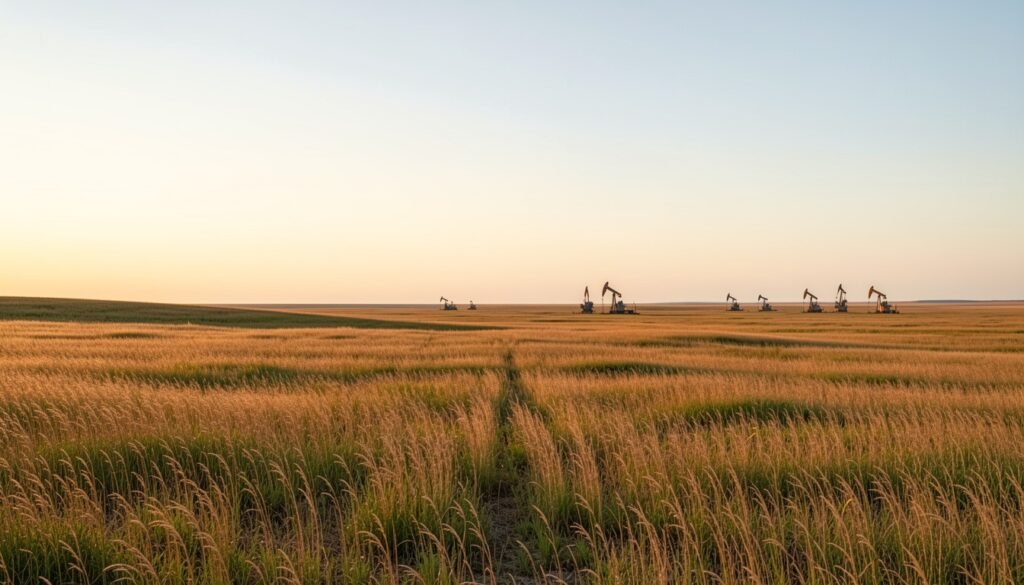
You’ve been looking at cheap land in rural Oklahoma. Maybe it’s a few acres near Broken Bow. Or a remote plot in the Panhandle. The price is right – say $15,000 for a five-acre parcel. But banks won’t touch it. Too small. Too remote. No house yet.

Then the seller says something interesting: “I’ll finance it for you.”

That’s owner financing. Also called a land contract or contract for deed. It’s how a lot of affordable land changes hands in Oklahoma, especially in counties like Pushmataha, Texas, or Cimarron.

But here’s the thing most people miss. They focus on the monthly payment and forget to ask: What interest rate am I actually paying? And How to Calculate Interest on Owner-Financed Land in Oklahoma?

That mistake can cost you thousands.

Let me show you exactly how to calculate interest on an owner-financed land deal in Oklahoma. No finance degree required.

Why Owner Financing Is Different (And Why It Matters)

When you get a bank loan, the bank uses a standardized amortization formula. They give you a truth-in-lending statement. Everything is regulated to death.

Owner financing is different. It’s a private contract between you and the seller. That means more flexibility, but also more room for confusion.

Some sellers use the same bank-style amortization. Others use a simple interest calculation. A few try to structure payments in ways that heavily favor them.

If you don’t know how to calculate the interest yourself, you could agree to a bad deal without realizing it.

The good news? The math is straightforward once you understand three basic pieces: the principal, the interest rate, and the loan term.

How to Calculate Interest on Owner-Financed Land in Oklahoma

The Simple Formula for Calculating Interest on Land Contracts

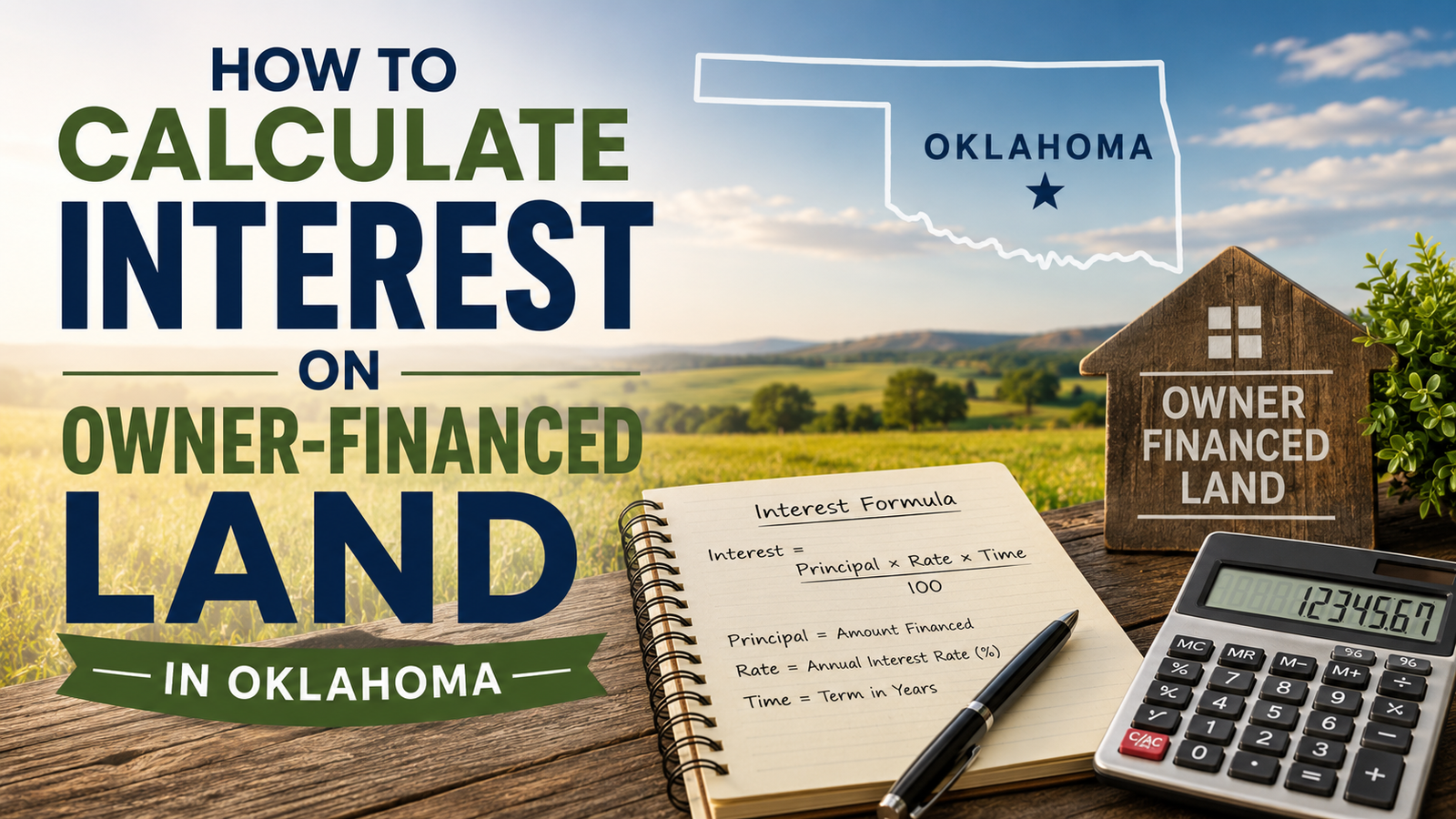
Here’s the core formula for simple interest on an owner-financed land purchase:

Interest = Principal × Rate × Time

Or more practically for monthly payments:

Monthly Interest = (Remaining Principal × Annual Interest Rate) ÷ 12

Let me walk you through a real example.

Say you’re buying 10 acres in southeastern Oklahoma for 25,000.Theselleragreestoownerfinancingwith25,000.Theselleragreestoownerfinancingwith2,500 down (10%) and a 7% annual interest rate on the remaining $22,500.

To find your first month’s interest:

22,500×0.07=22,500×0.07=1,575 in annual interest
1,575÷12=1,575÷12=∗∗131.25 in interest for month one**

If your monthly payment is 300,thenroughly300,thenroughly131 goes to interest and the remaining $169 reduces your principal.

By month twelve, your principal has dropped a bit, so the interest portion is slightly lower. That’s the basic rhythm of an amortizing loan.

The Two Ways Sellers Calculate Interest (Know Which One You Have)

Not all owner-financed land deals work the same way. In Oklahoma, you’ll typically encounter one of two calculation methods.

Amortized Interest (Bank Style)

The seller calculates a fixed monthly payment that pays off the loan completely by the end of the term. Each payment includes interest plus some principal. Early payments are mostly interest. Later payments are mostly principal.

This is the most common and fairest method for longer terms (five years or more).

Simple Interest on Declining Balance

Each month, interest is calculated only on the remaining principal. If you pay extra, you save immediately on interest. If you pay late, interest keeps accruing on the unpaid balance.

Some Oklahoma land contracts use simple interest but require annual statements showing how much principal remains. Always ask which method the seller plans to use.

Step-by-Step: How to Calculate Your Interest Before You Sign

You don’t need special software. A basic calculator or a spreadsheet works fine. Here’s the process I recommend to anyone looking at owner-financed land in Oklahoma.

Step 1: Get the full terms in writing. Never rely on a handshake. The seller should give you the purchase price, down payment, interest rate, loan term, and monthly payment amount.

Step 2: Calculate the financed amount. Purchase price minus down payment equals principal.

Step 3: Calculate your first month’s interest. Use the formula above. This tells you how much of your early payments go to interest versus principal.

Step 4: Run a quick amortization. You can do this manually for short loans or use a free online amortization calculator. This shows whether the seller’s proposed monthly payment actually pays off the loan by the end of the term.

Step 5: Ask about prepayment penalties. Some Oklahoma land contracts include a penalty if you pay off the loan early. Others do not. Know which one you’re agreeing to.

How to Calculate Interest on Owner-Financed Land in Oklahoma

A Real Oklahoma Example (With Numbers)

Let me give you a complete example using actual Oklahoma land prices.

You find a 5-acre parcel in Coal County, about two hours south of Oklahoma City. The asking price is 12,000.Theselleroffersownerfinancingwith12,000.Theselleroffersownerfinancingwith1,000 down, 8% interest, and a five-year term.

Financed amount: 11,000Monthlyinterestcalculation:11,000Monthlyinterestcalculation:11,000 × 0.08 ÷ 12 = $73.33

If the seller wants a 250monthlypayment,thenroughly250monthlypayment,thenroughly73 goes to interest and 177goestoprincipaleachmonthearlyon.Overfiveyears,youdpayabout177goestoprincipaleachmonthearlyon.Overfiveyears,youdpayabout2,400 in total interest.

Is that reasonable? For owner-financed land, yes. Sellers charge higher rates than banks because they’re taking more risk. Typical owner financing interest rates in Oklahoma range from 6% to 12%, depending on the property and your down payment.

What’s not reasonable? A seller offering the same $12,000 property at 15% interest with no prepayment option. Run those numbers and you’ll see why.

Common Mistakes When Calculating Owner-Financed Land Interest

I’ve seen people make these mistakes repeatedly. Don’t be one of them.

Mistake 1: Forgetting to check for balloon payments. Some Oklahoma land contracts have low monthly payments but a large balloon payment due after two or three years. If you can’t pay the balloon, you could lose the property.

Mistake 2: Assuming simple interest means no amortization schedule. Even with simple interest, you need a written schedule showing how each payment applies to principal and interest.

Mistake 3: Not calculating total interest cost. A 10,000landpurchaseat910,000landpurchaseat95,200 in total interest. That might still be a good deal. But you should know the number before you sign.

Mistake 4: Ignoring late fees and default terms. Some Oklahoma land contracts include harsh default provisions. Miss one payment and the seller can keep everything you’ve paid. That’s legal under certain contract-for-deed arrangements. Know the difference between a land contract and a mortgage.

How Oklahoma Law Affects Owner-Financed Land Deals

Oklahoma has specific rules about land contracts. They’re not the same as California or Texas.

For contracts longer than five years or with a principal over $50,000, Oklahoma law requires certain disclosures. But for smaller, cheaper land deals – the kind most people are looking at – regulation is lighter.

That cuts both ways. It makes owner financing possible for cheap land that banks ignore. But it also means you need to protect yourself.

Always record the contract at the county clerk’s office in the county where the land sits. That puts the world on notice that you have an interest in the property. Without recording, the seller could sell the same land to someone else.

Comparing Owner Financing to Other Ways to Buy Land in Oklahoma

Before you commit to an owner-financed deal, understand your alternatives.

MethodTypical Down PaymentInterest RateDifficultyBest For
Owner Financing5-20%6-12%LowCheap land, bad credit, quick closing
Bank Land Loan20-40%7-10%HighLarger parcels, good credit, building soon
USDA Loan (with home)0%5-7%HighRural property with existing house
Cash Purchase100%0%LowSmall parcels, no financing needed

Owner financing isn’t always the cheapest option. Sometimes saving for a larger down payment and using a local Oklahoma bank or credit union makes more financial sense. But for many people looking at affordable land under $20,000, owner financing is the only realistic path.

Practical Tips for Negotiating Interest on Land Contracts

You can negotiate the interest rate on owner-financed land. Sellers aren’t banks with fixed rate sheets.

Offer a larger down payment. Putting 20% down instead of 10% might drop the interest rate by two or three points.

Shorten the term. A three-year loan at 6% is cheaper than a ten-year loan at 8%, even if monthly payments are higher.

Ask for simple interest with no prepayment penalty. This lets you pay extra when you have cash and save on interest.

Get multiple quotes. Look at several owner-financed properties in the same Oklahoma county. Interest rates vary widely between sellers.

When Owner Financing Makes Sense (And When It Doesn’t)

Owner financing for land works well when:

  • The land is cheap (5,000to5,000to30,000 range)
  • Banks won’t lend because the parcel is too small or remote
  • You plan to pay off the loan faster than the term
  • You want to close quickly without bank paperwork

It’s a bad idea when:

  • The interest rate exceeds 12% without a good reason
  • The seller refuses to provide a written amortization schedule
  • The contract allows forfeiture of all payments after one missed payment
  • You’re not sure you can make the payments consistently

Final Thoughts on Calculating Interest for Owner-Financed Oklahoma Land

Here’s what I want you to take away.

The math isn’t hard. Principal times rate divided by twelve gives you monthly interest. The hard part is getting clear terms in writing and understanding what you’re signing.

Before you agree to any owner-financed land deal in Oklahoma – or anywhere else – run the numbers yourself. Calculate the total interest you’ll pay. Ask about balloon payments. Check whether the contract is recorded at the county clerk’s office.

And if a deal seems too good to be true? It probably is. I’ve seen sellers offer “no credit check, zero down, low payments” on land that has no legal road access or sits entirely in a flood plain. The cheap interest rate doesn’t matter if you can’t use the land.

Do your homework first. Calculate the interest second. Sign third.

That order will save you money every single time.
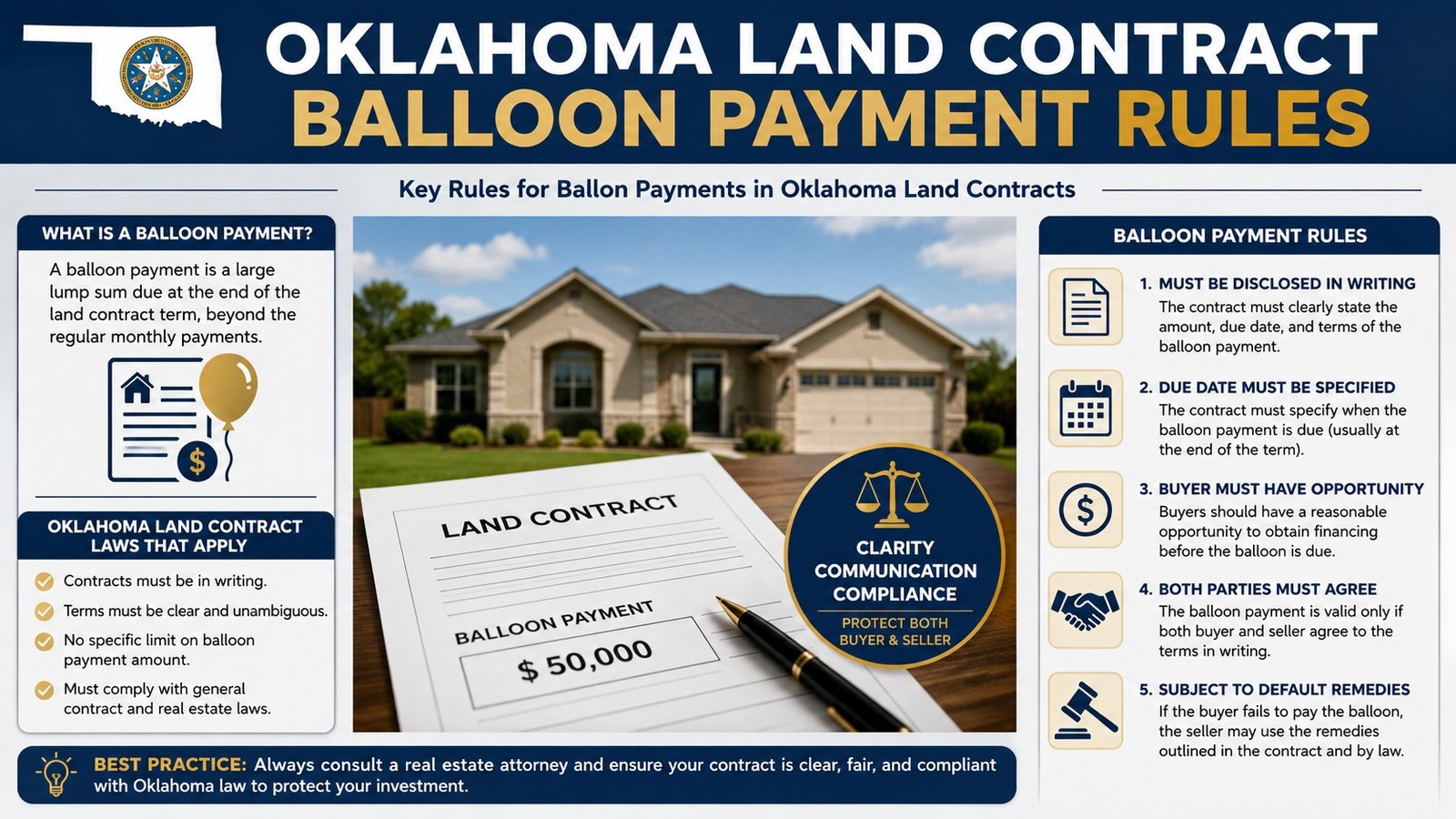
Oklahoma Land Contract Balloon Payment Rules

Oklahoma Land Contract Balloon Payment Rules

Let’s say you find 20 acres outside Stillwater. Good price. Owner financing. No bank hassle. You sign a land contract, pay 500monthlyforfiveyearsthenthepaperworksaysyouowe500monthlyforfiveyearsthenthepaperworksaysyouowe45,000 in one lump sum.

That’s your balloon payment.

In Oklahoma, land contracts (also called contracts for deed) are common. But the Oklahoma Land Contract Balloon Payment Rules catch people off guard more than almost anything else. Some folks assume they can refinance before the balloon hits. Others don’t realize the seller can cancel the deal if they miss that final payment by even a week.

Here’s what actually happens under Oklahoma law, how to protect yourself, and when walking away might be your smartest move.

What Exactly Is a Land Contract Balloon Payment?

A land contract is seller financing. You pay the seller directly in installments, but the seller keeps the legal title until you pay off the full price. You get equitable title (the right to use and improve the land), but the seller holds the deed as security.

A balloon payment is a large lump sum due at a specific date, usually after a series of smaller installments.

Example:

  • Purchase price: $100,000
  • Down payment: $10,000
  • Monthly payment: $800 at 6% interest
  • Balloon due after 60 months: $72,000 remaining principal

You pay mostly interest for five years, then owe almost three-quarters of the original price all at once.

Why sellers use balloons: They want regular income but don’t want to wait 15–30 years for their full cash. A balloon forces you to refinance or pay up, typically within 3–7 years.

Why buyers agree: Lower upfront costs than a bank loan, flexible credit requirements, and the hope that property value will rise or their financial situation will improve before the balloon hits.

Oklahoma’s Legal Rules on Balloon Payments (The Short Version)

Oklahoma doesn’t ban balloon payments in land contracts. They’re perfectly legal. But state law does impose specific requirements on how balloon payments must be disclosed and enforced.

Mandatory Disclosure Requirements

Under the Oklahoma Consumer Protection Act and federal Truth in Lending Act (TILA), if the seller is not a licensed lender but offers financing more than five times in a year (or on more than one property in some cases), the contract must clearly state:

  • The due date of the balloon payment
  • The exact amount of the balloon payment
  • A warning that you may lose the property if you can’t pay
  • The interest rate and how principal is calculated

If the seller hides the balloon in fine print or calls it something else (“final lump sum settlement”), that’s likely an unfair practice. Courts have voided contracts where sellers buried balloon terms on page 8 of a 12-page document.

Oklahoma Land Contract Balloon Payment Rules

Notice Before Default

Here’s where Oklahoma is buyer-friendly compared to some states.

If you miss your balloon payment, the seller cannot just seize the property. Oklahoma law requires the seller to give you written notice of default and a reasonable opportunity to cure (pay what’s owed).

For most land contracts, that notice period is 30 days unless your contract specifies longer. During that time, you can pay the balloon plus any late fees and keep the deal alive.

If you don’t pay, the seller can file a lawsuit to foreclose on your equitable interest. They cannot simply evict you or take possession without a court order.

Forfeiture vs. Foreclosure: Huge Difference

Older Oklahoma land contracts used “forfeiture” clauses—you miss one payment, you lose everything you’ve paid so far. No court. No refund.

That changed after the 1980s. Oklahoma courts now strongly favor judicial foreclosure for land contracts, especially if you’ve paid more than 20% of the purchase price or held the contract for more than two years.

In a foreclosure, the property is sold at auction. If it sells for more than what you owe, you get the surplus back. Forfeiture gives you nothing.

Realistic example: You paid 30,000towarda30,000towarda100,000 property and miss the 70,000balloon.Inaforeclosure,ifthepropertysellsfor70,000balloon.Inaforeclosure,ifthepropertysellsfor90,000, you get back 20,000(20,000(90,000 minus 70,000debt).Inforfeiture,youget70,000debt).Inforfeiture,youget0. Oklahoma courts almost never enforce forfeiture anymore unless the buyer paid very little and defaulted early.

Step-by-Step: What Happens When Your Balloon Payment Comes Due

Let’s walk through a typical scenario.

Step 1 – Notice of balloon due date
Your contract should state that the seller will send a reminder 30–60 days before the balloon date. Some sellers don’t. Keep your own calendar.

Step 2 – You can’t pay
Maybe the bank denied your refinance. Maybe interest rates jumped. Maybe your credit dropped.

Step 3 – Seller sends default notice
By law, they must send written notice to your last known address. No phone calls, no text messages. If they skip this step, any eviction or foreclosure attempt gets thrown out.

Step 4 – 30-day cure period
You have 30 days to pay the balloon, negotiate an extension, or refinance. Use every day. Call local credit unions. Talk to private lenders. Borrow from family if you have to.

Step 5 – Foreclosure lawsuit
If you don’t pay, the seller files a district court petition to foreclose. This takes 3–6 months in most Oklahoma counties. You can still pay during this time (called “redemption”), but you’ll also owe the seller’s legal fees.

Step 6 – Sheriff’s sale
If the court rules against you, the property is sold at auction. You have a statutory right of redemption in some cases—usually 12 months for agricultural land, less for residential.

Common Balloon Payment Traps (And How to Avoid Them)

Trap 1: No right to refinance
Some Oklahoma contracts say “no prepayment penalty” but also say “balloon may not be satisfied by third-party financing.” That means you can’t get a bank loan to pay off the seller. Read your contract specifically for language restricting “assignment” or “third-party payoff.”

Fix: Before signing, add a clause: “Buyer may satisfy balloon payment through any lawful source of funds, including conventional mortgage financing.”

Trap 2: Balloon based on inaccurate balance
Sellers sometimes miscalculate how much principal remains. You pay for five years, but almost all your payment went to interest. The balloon ends up higher than expected.

Fix: Ask for an amortization schedule upfront. Every payment’s principal and interest broken out. Oklahoma law doesn’t require this in private land contracts, but a seller who refuses is waving a red flag.

Trap 3: No notice of default required
Some sellers write “notice waived” into the contract. Under Oklahoma law, you cannot waive the right to notice of default in a land contract for your primary residence. For investment or raw land, you might be able to waive it—but don’t. Cross that clause out.

Trap 4: Acceleration clauses
These say: if you miss any payment, the entire remaining balance (including the balloon) is due immediately. That means a single late monthly payment could trigger the full balloon years early.

Fix: Demand a cure period for all defaults, not just the final balloon. Oklahoma’s 30-day default notice applies, but acceleration clauses can still cause headaches.

Oklahoma Land Contract Balloon Payment Rules

Real-World Scenarios: When Balloons Work and When They Blow Up

Scenario A: The Plan Works

Sarah buys 5 acres near Muskogee for 50,000.50,000.5,000 down. 400/month.5yearballoonof400/month.5−yearballoonof35,000. She uses the land for a small horse boarding business. After four years, her business credit is solid. A local ag credit union refinances her into a 15-year loan at 7%. She pays off the seller. Everyone wins.

Why it worked: She improved her credit, the land value increased, and she started refinancing 12 months before the balloon.

Scenario B: The Disaster

Tom buys a fixer-upper house in Tulsa County on a land contract. 120,000price.3yearballoonof120,000price.3−yearballoonof100,000. He plans to flip it. Housing market drops 15%. He can’t sell. Bank won’t lend because the appraisal comes in at 95,000.Hemissestheballoon.Sellerforecloses.Tomloses95,000.Hemissestheballoon.Sellerforecloses.Tomloses20,000 in down payment and improvements.

What Tom should have done: Negotiated a longer balloon (5–7 years) or insisted on a “right to extend” clause if the property appraises below the balloon amount.

Mistakes Buyers Make (Even Smart Ones)

Mistake #1: No exit strategy
They assume they’ll refinance. But they don’t check their credit. They don’t talk to lenders early. When the balloon hits, no bank will touch them.

Do this instead: Six months after signing the land contract, talk to three lenders. Ask: “If I make all payments on time for two years, will you refinance my balloon?” Get it in writing if possible.

Mistake #2: Ignoring the equity cliff
In a land contract, you build equity only if the property value rises. The seller holds title, so you can’t borrow against the property. When the balloon comes due, you have zero leverage except your own cash or a new loan.

Mistake #3: No independent review
Land contracts are not standard forms like a mortgage. Sellers write them themselves. One Oklahoma buyer signed a contract that said the balloon payment was “at seller’s sole discretion.” That meant the seller could demand any amount at any time. A judge later voided it, but legal fees cost the buyer $8,000.

Practical Recommendations for Buyers

Before signing any Oklahoma land contract with a balloon payment:

  1. Run the numbers backward. Assume you CANNOT refinance. Can you pay the balloon from savings, a 401(k) loan, or family help? If no, walk away or negotiate a longer term.
  2. Demand a 7-year minimum balloon. Five years goes fast. Three is gambling. Seven gives you time for credit repair, market shifts, or unexpected life changes.
  3. Add a “first right of extension.” Write: “Buyer may extend balloon payment by 24 months by paying 1% of the balloon amount as an extension fee. Seller may not unreasonably withhold extension if buyer has made all prior payments on time.”
  4. Get title insurance. Even in a land contract. It protects your equitable interest. If the seller had a hidden lien or a prior owner, you could lose everything.
  5. Record the contract. File it with the county clerk. That puts the world on notice that you have an interest in the land. Without recording, the seller could sell to someone else, and you’d have to sue to get your money back.

What Sellers Need to Know

If you’re the seller offering a land contract with a balloon:

  • Disclose everything clearly. One missing disclosure can let the buyer rescind the contract years later—even after they’ve defaulted.
  • Don’t skip foreclosure. Self-help eviction (changing locks, cutting utilities) is illegal in Oklahoma. You must go through court.
  • Consider a promissory note + mortgage instead of a land contract. It gives you the same security but clearer foreclosure rules. Many Oklahoma real estate attorneys recommend this for sellers.

Final Thoughts (Not Wrapped in a Bow)

Balloon payments in Oklahoma land contracts aren’t good or bad. They’re tools. A hammer can build a house or break a thumb.

The difference comes down to one thing: whether both parties honestly understand the risk.

If you’re buying, assume the balloon will come due on the worst possible day. Your credit will dip. Rates will rise. The barn roof will collapse the same week. Plan for that mess, and you’ll be fine.

If you’re selling, remember that a fair balloon payment creates a motivated buyer. An unfair one creates a lawsuit.

Either way, spend the $300–500 to have an Oklahoma real estate attorney review the contract. That’s cheap compared to losing the land—or losing the deal.

One last thing: Oklahoma’s laws on land contracts are less settled than mortgage laws. Judges have discretion. A contract that works in Oklahoma County might fail in Choctaw County. Local knowledge matters more than generic internet advice. Talk to someone who handles these cases where the land sits.

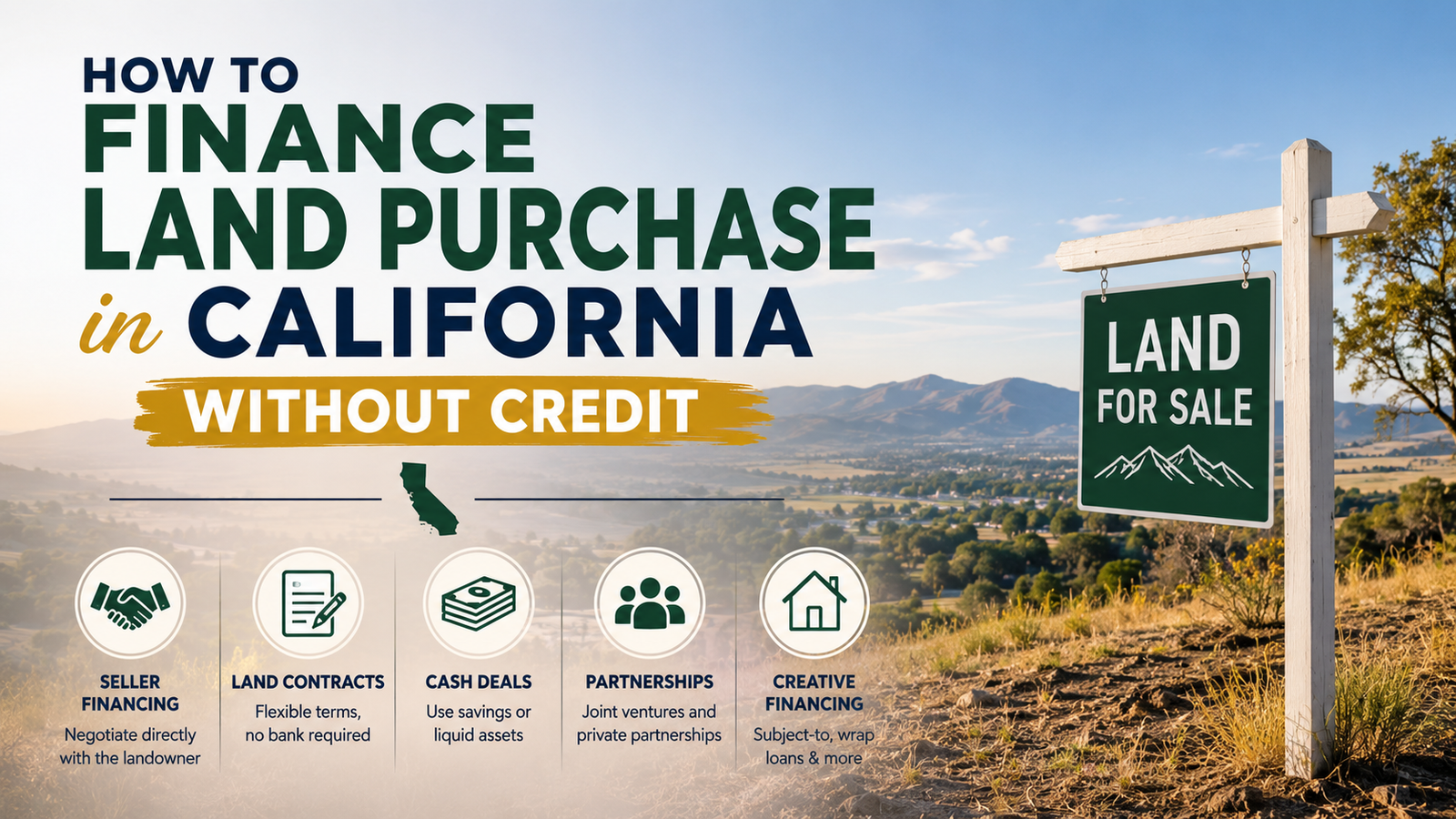
How to Finance Land Purchase in California Without Credit 

Finance Land Purchase in California Without Credit

You’ve found a two-acre plot in the Sierra foothills. Maybe it’s for a tiny home, a workshop, or just a place to park an RV on weekends. The price is right—$35,000—which is a steal for California.

Then comes the gut punch. You realize banks don’t really do traditional loans for raw land. And when they do? They want a 720 credit score and 30% down.

If you have bad credit—or no credit at all—you probably think this dream just died.

It doesn’t have to. You just need to stop thinking like a home buyer and start thinking like a land investor.

I’ve watched people walk away from incredible Finance Land Purchase in California land deals simply because they assumed a bank was the only option. It’s not. In fact, for land under $100k, traditional financing is usually the worst path forward. Let me show you four ways to buy Finance Land Purchase in California Without Credit without a single credit inquiry.

Why California Land is Different (And Why Banks Say No)

First, understand why your credit score doesn’t matter as much as you think for this specific task.

Banks hate raw land. It’s risky for them. If you stop paying on a house, they can sell it quickly. If you stop paying on a bare patch of desert in San Bernardino County? They might wait five years to find a buyer. So, they jack up the requirements.

But because banks have abandoned the “small raw land” market, private sellers have stepped in. And private sellers care about trust and down payment, not your FICO score.

Here is how you leverage that.

Finance Land Purchase in California Without Credit

Strategy 1: Seller Financing (The Credit-Score Loophole)

This is your best bet. Period.

Seller financing means the owner of the land acts as the bank. You pay them monthly installments. When the last payment is made, they hand you the deed.

How to structure this in California:
Most sellers want cash. You have to convince them that taking payments is safer than waiting for a mythical cash buyer. You do this with a large down payment and a short term.

  • Down payment: 20% to 40% of the purchase price. For a 40,000lot,youneed40,000lot,youneed8,000 to $16,000 cash.
  • Term: 5 years or less. Sellers don’t want a 30-year mortgage. Offer 3 to 5 years at 6-8% interest.
  • The hook: Tell them, “I will pay for the title search and the promissory note. You don’t pay a dime in closing costs.”

The catch: If the seller still has a mortgage on the land, they usually cannot do seller financing. You need a seller who owns the land “free and clear.” Ask this upfront to save time.

Strategy 2: Unconventional Down Payment (Sweat Equity)

Let’s say you have the monthly income to pay 500/month,butyoudonthave500/month,butyoudonthave10,000 for the down payment.

You can offer “sweat equity” instead of cash down. This works shockingly well on rural California properties that have been listed for over 6 months.

What sellers actually want:

  • Fence repair: That boundary fence is falling down. It will cost the owner $5,000 to fix. You offer to fix it (materials paid by you or split) as your down payment.
  • Brush clearing: Fire risk is massive in CA. If a lot is overgrown with manzanita, the owner faces fines from the county. Offer to clear the brush as your “down payment.”
  • Surveying: Many old plots have “lost” boundaries. Offer to pay for a $2,000 boundary survey instead of giving them cash.

Realistic example: A buyer in Lake County wanted a 30,000lotbutonlyhad30,000lotbutonlyhad3,000. The seller was an elderly woman who couldn’t clear the dead trees. The buyer spent three weekends with a chainsaw (and a permit) clearing the vegetation. The seller dropped the price by $6,000. The buyer used that “saved” equity as his down payment on a seller financing deal.

Strategy 3: The “Lease to Own” Land Contract

This is riskier for the buyer, but it works when the seller is paranoid.

You sign a Land Contract (or Contract for Deed). You move onto the land immediately. You make payments every month. But the deed stays in the seller’s name until you make the final payment.

Why use this with no credit?
Because legally, if you miss one payment in California on a land contract, the seller can evict you quickly and keep your payments. This terrifies most buyers, which means sellers love it. You can negotiate a lower price and zero credit checks because the seller holds all the power.

The warning: Never do this on a property with an existing mortgage. And always get a title search done first. If the seller has hidden debt, you lose everything.

Strategy 4: Partnership & Syndication (No Bank, No Cash)

You have no credit, but maybe you have skills. Find a partner who has cash but no time.

Look for real estate investors in your local California Facebook group. Post this exact message: *”Looking for a silent partner to buy raw land in [County]. I will do all the due diligence, permitting, and resell. You bring the cash. 50/50 split.”*

Investors care about ROI, not your credit score. If you find a 20,000lotthatwillbeworth20,000lotthatwillbeworth40,000 after you get a perc test and a well permit, an investor will write the check.

Finance Land Purchase in California Without Credit

The Big Trap: “No Credit Check” Lenders

Be careful. When you search online, you’ll find companies offering “hard money loans” for land with no credit check.

In California, these are often sharks. They will lend you the money at 18% interest with a 5-point origination fee. On a 50,000loan,youowe50,000loan,youowe9,000 in fees on day one. If you miss a payment, they foreclose immediately.

Avoid these unless you are flipping the land within 90 days.

Realistic Down Payment Savings for No-Credit Buyers

If none of the above work today, here is the fastest way to get the cash you do need (usually 20-30%) without a loan.

  • Sell a vehicle: Do you have a paid-off truck or motorcycle? Selling a 6,000vehiclegetsyouintoa6,000vehiclegetsyouintoa30,000 land deal.
  • Borrow from a life insurance policy: This never hits your credit report because it’s your own money.
  • Side hustle mapping: Rural land buyers need GIS maps and flood zone reports. Learn to pull these from county websites in 10 minutes. Charge $50/report. Do 100 reports.

Three Mistakes That Kill Land Deals (With No Credit)

  1. Falling in love with the first plot. Sellers smell desperation. Look at 20 lots. Make low-ball offers on 5 of them. Land is sitting longer than houses. Use that.
  2. Ignoring access rights. You buy a gorgeous plot in Mendocino County, only to find out the only road to it is owned by a neighbor who hates you. No credit score can fix that. Always check for a legal easement.
  3. Forgetting taxes. California counties can sell your land at a tax auction if you miss one payment. Factor property taxes (usually 1% of the value) into your monthly offer.

So, Can You Actually Do This?

Yes. But you have to shift your mindset.

You are not applying for a mortgage. You are negotiating a private deal. Sellers in the California land market—especially in places like Kern County, Humboldt, or the Mojave—are often tired, cash-poor, and just want the property off their tax bill.

Walk up to them with a solution. “I will give you 25% down, pay all closing costs, and have you cashed out in 4 years. I don’t care about my credit score, and neither should you.”

It won’t work on every seller. It will fail on 9 out of 10. But that tenth deal is how you get your piece of California without ever talking to a loan officer.

Cheap Land Hudspeth County TX Owner Financing 

Cheap Land Hudspeth County TX Owner Financing

Cheap Land in Hudspeth County Texas (Owner Financing Deals Under $5000) – 2026 Guide QUICK TAKEAWAYS – 5 MINUTES TO READ, A LIFETIME OF VALUE ✓ You can buy Cheap Land Hudspeth County TX with owner financing for as little as $500 down ✓ Most properties range from 1,000to1,000to5,000 for 1-5 acre parcels ✓ No bank … Read more

Buy Land in USA With Dirt Road Access Cheap (2026 Guide)

Buy Land in USA With Dirt Road Access Cheap (2026 Guide)

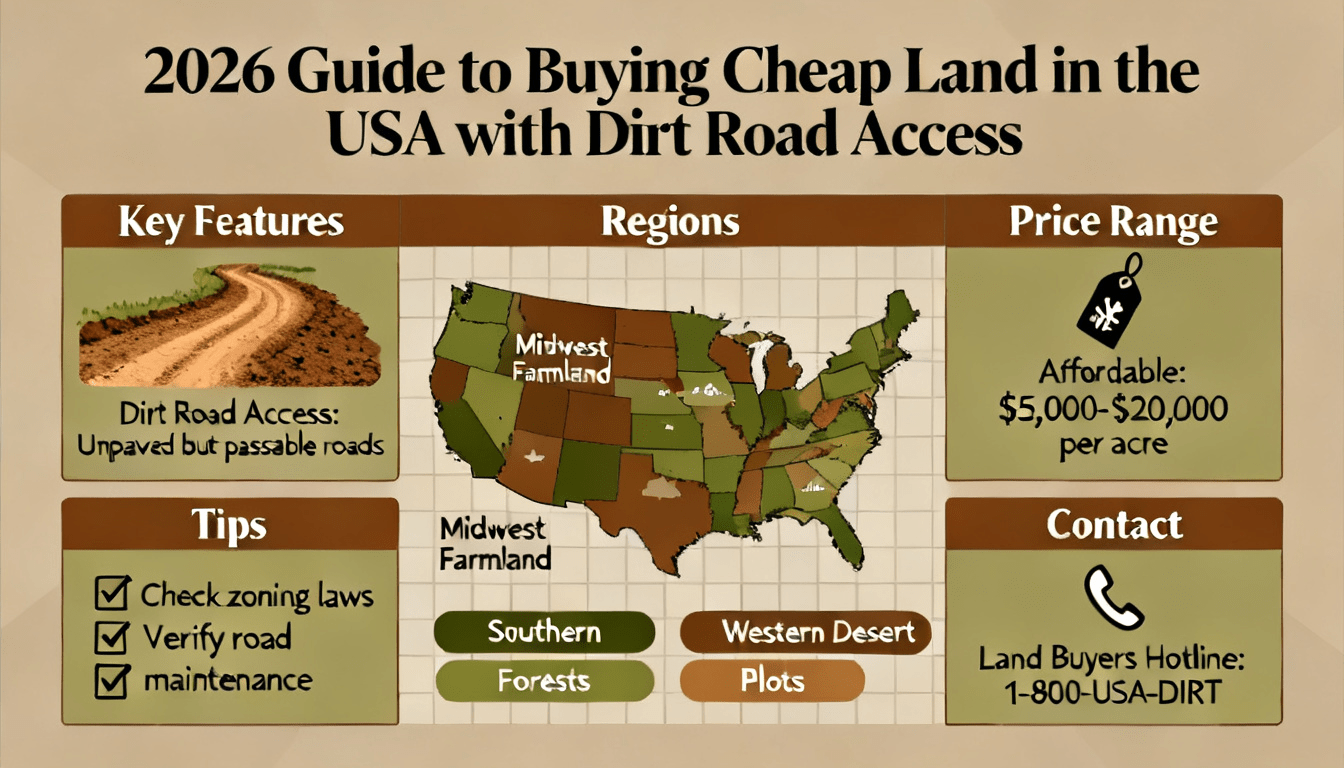
Introduction You want raw land. You don’t have perfect credit. And you definitely don’t want to spend $50,000 on an acre. Here’s the truth most real estate sites won’t tell you: Buy Land in USA With Dirt Road Access Cheap still exists in 2026. You can buy 5, 10, even 40 acres for under $10,000. But there’s … Read more

Follow by Email
Instagram